NIST CSF 2.0 vs ISO 27001: Complete Guide to Frameworks vs Regulations
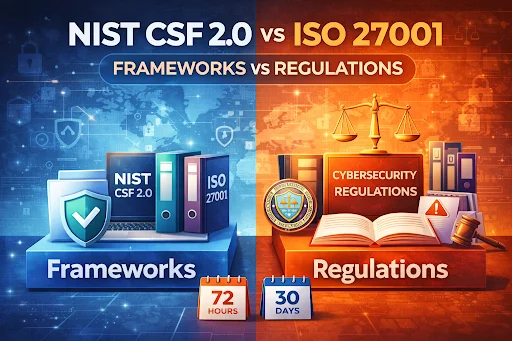
NIST CSF 2.0 and ISO 27001 are cybersecurity frameworks, not laws, and neither one automatically satisfies a legal or regulatory obligation. NIST CSF 2.0 is a free, voluntary framework built around six functions (Govern, Identify, Protect, Detect, Respond, Recover). ISO 27001 is a certifiable international standard for an information security management system. Both strengthen security posture, but organizations still need regulatory mapping to connect framework controls to specific laws like GDPR, DORA, and SEC disclosure rules.
There is a statement that shows up in security meetings more often than it should. Sometimes it sounds like this: ‘We follow NIST, so we are covered.’ Other times it comes out as: ‘We have ISO 27001 certification, so we are compliant.’ Both versions of that statement feel reasonable when you say them out loud. Both create real problems in practice.
The issue is not that NIST CSF 2.0 or ISO 27001 are weak frameworks. They are not. They are among the most thoughtfully designed and globally respected cybersecurity frameworks available. Organizations that implement them seriously are, in most cases, in better security shape than organizations that do not.
The problem is a category error that even experienced security and compliance professionals make. Frameworks are not laws. They do not replace legal obligations. They do not automatically satisfy regulatory requirements. And treating them as if they do leaves organizations exposed in ways that only become visible when enforcement arrives, an incident is investigated, or a regulator asks a question that a framework profile cannot answer.
This guide explains the distinction clearly, without legal jargon, and shows how NIST CSF 2.0 and ISO 27001 can be used correctly as tools within a broader cybersecurity compliance program. Organizations comparing NIST CSF 2.0 vs ISO 27001 should understand that neither framework replaces legal obligations. Instead, both provide structured approaches to improving cybersecurity while supporting broader compliance efforts.It covers why regulatory mapping is the step that most organizations skip, how frameworks relate to real laws including GDPR, DORA, and U.S. sector regulations, and how governance risk management connects frameworks to actual legal accountability.
Organizations comparing NIST CSF 2.0 vs ISO 27001 should understand that these frameworks support cybersecurity and compliance, but neither replaces legal or regulatory obligations.
Why the Confusion Between Frameworks and Laws Persists
The confusion is not irrational. Frameworks and regulations overlap significantly in the territory they cover. Both talk about risk management. Both address access controls, incident response, monitoring, detection, and governance accountability. So when a security team implements controls that align to a respected framework, it genuinely feels like compliance has been achieved. Auditors comment favorably on it. Customers ask for evidence of it. Sales teams promote it in RFP responses.
But there is a structural difference that matters enormously when things go wrong.
A law or regulation tells you what you must do, by when, and what happens if you do not. A framework tells you how to organize your security thinking and controls in a principled way. Frameworks are voluntary. Regulations are mandatory. Frameworks are descriptive, they tell you what good looks like. Regulations are prescriptive, they tell you what is required and hold you legally accountable for meeting it.
Frameworks exist to help organizations manage risk. Regulations exist to protect consumers, financial markets, critical infrastructure, and public welfare. Because their purposes are different, regulations contain things that frameworks are specifically designed to avoid: hard deadlines, mandatory reporting timelines, specific legal definitions, penalty structures, and regulator discretion over enforcement.
No framework tells you to notify a supervisory authority within 72 hours of discovering a personal data breach. No framework specifies which regulatory body receives that notification or how the disclosure must be structured. No framework defines what happens to your organization if the notification is late or incomplete. Those are legal obligations, and they live in laws, not frameworks.
Key Takeaways
• NIST CSF 2.0 and ISO 27001 are cybersecurity frameworks not laws.
• Frameworks improve security but do not replace legal obligations.
• Regulatory mapping connects legal requirements to security controls.
• Governance provides evidence that compliance requirements have been met.
What NIST CSF 2.0 Actually Is and What It Is Not
NIST CSF 2.0, published by the National Institute of Standards and Technology in February 2024, is the latest evolution of the Cybersecurity Framework that NIST first released in 2014. Version 2.0 represents a significant expansion of the original, incorporating a decade of practitioner experience and extending the framework’s scope from its original focus on critical infrastructure to organizations of any size, sector, and technical maturity.
The framework is organized around six core functions that describe what effective cybersecurity looks like across an organization: Govern, Identify, Protect, Detect, Respond, and Recover. The addition of Govern as an explicit core function in version 2.0 is meaningful. It reflects a deliberate shift in how NIST treats cybersecurity, moving it from a primarily technical discipline to one that is explicitly embedded in enterprise risk management, leadership decision making, and organizational accountability.
This makes NIST CSF 2.0 genuinely useful as a strategic foundation for building a cybersecurity compliance program. It helps organizations create a shared language for cybersecurity across teams and leadership levels, align security investment priorities with business objectives, assess current capability gaps without immediately jumping to tool selection, communicate risk in terms that boards and executives can act on, and structure multi-year improvement roadmaps with measurable milestones.
What it does not do is substitute for legal analysis. NIST CSF 2.0 is not tied to any specific industry, any specific country, or any specific regulatory body. It does not contain reporting timelines, it does not define legal obligations, and following it does not confer any form of regulatory safe harbor. When a regulator asks whether your organization met its legal obligations, pointing to a NIST CSF profile is not a complete answer. When evaluating NIST CSF 2.0 vs ISO 27001, organizations often discover that each serves a different purpose. NIST CSF focuses on improving cybersecurity capabilities, while ISO 27001 establishes a certifiable information security management system. Understanding the differences between NIST CSF 2.0 vs ISO 27001 helps organizations choose the right framework based on their cybersecurity goals, regulatory requirements, and business needs.
Comparison Table
| Feature | NIST CSF 2.0 | ISO 27001 |
|---|---|---|
| Type | Cybersecurity Framework | International Standard |
| Certification | No | Yes |
| Primary Focus | Risk Management | Information Security Management |
| Best For | Flexible Security Programs | Formal ISMS |
What ISO 27001 Really Represents
ISO/IEC 27001:2022 is an international standard for information security management systems, published by the International Organization for Standardization. Unlike NIST CSF, which is a framework published by a government standards body and implemented voluntarily, ISO 27001 is a formal standard against which organizations can seek independent third-party certification.
Achieving ISO 27001 certification requires considerably more than implementing a set of controls. It requires establishing and documenting a formally scoped information security management system, conducting a structured risk assessment and developing a risk treatment plan, implementing controls from the standard’s Annex A control catalog, demonstrating management commitment and leadership involvement, operating the system for a period of time with evidence of effectiveness, and passing an external audit by an accredited certification body.
Certification has genuine value. It signals organizational maturity, demonstrates that security practices have been validated by an independent party, and provides a credible basis for customer and partner assurance. Many large enterprises require ISO 27001 certification as a condition of doing business with vendors who handle sensitive data.
But certification is evidence of how you manage information security. It is not evidence that you have met every legal obligation that applies to your organization. Regulators conducting enforcement investigations do not typically ask for your certification status. They ask what controls you had in place, how they were operating at the time of the incident, what decisions were made and by whom, what reporting obligations applied to your organization, and whether you met those obligations on time. Certification can demonstrate good faith and documented management discipline. It cannot substitute for legal compliance. When evaluating NIST CSF 2.0 vs ISO 27001, it’s important to remember that ISO 27001 provides a certifiable management system, while NIST CSF 2.0 offers a flexible cybersecurity framework.
The Three-Layer Model That Makes Compliance Work
One of the most useful ways to think about the relationship between frameworks and regulations is through a three-layer model. Each layer has a distinct role, and the most common compliance failures occur when organizations conflate the layers or skip one entirely.
The first layer is legal requirements. This is where regulations, laws, and binding regulatory guidance live. It defines what your organization must do, by when, to whom it must report, and what the consequences are for non-compliance. This layer requires legal analysis, not just security expertise.
The second layer is operational controls. This is where frameworks like NIST CSF 2.0 and ISO 27001 live. Frameworks give you structure for building and operating the security controls that support your legal obligations. They provide language, categories, maturity models, and implementation guidance.
The third layer is evidence and governance. This is where documentation, audit trails, management reviews, risk treatment records, and decision logs live. Governance connects the legal requirements layer to the operational controls layer. It produces evidence that demonstrates controls were designed, implemented, and operating effectively in relation to applicable obligations.
Frameworks are powerful in the second layer and support the third layer well. They are not designed to operate in the first layer. Organizations that start with a framework and work backward to identify legal requirements almost always discover gaps. Organizations that start with legal requirements and use frameworks to implement them operationally tend to build more complete and defensible programs.
Why Regulatory Mapping Is the Step Most Organizations Skip
Regulatory mapping is the process of formally connecting specific legal and regulatory requirements to specific operational controls. It answers a question that sounds simple but is surprisingly difficult to answer under audit pressure: which controls support which obligations, and how?
Most organizations perform some version of this mapping informally. A security engineer says a particular control addresses a particular requirement. A compliance manager nods. The assumption is recorded somewhere, or sometimes not at all. No one documents the reasoning, tests whether the control actually satisfies the regulatory expectation, or identifies the gaps where the framework does not address a legal requirement.
This informal approach works until it does not. Formal regulatory mapping is what allows an organization to demonstrate, rather than merely assert, that its controls meet its legal obligations. It is also what reveals the gaps that frameworks systematically leave, particularly around reporting timelines, notification content requirements, and regulator-specific procedural obligations.
How Regulatory Mapping Works in Practice
Regulatory mapping does not require sophisticated tooling. It requires discipline and a willingness to start from the regulation rather than from the framework.
The process typically works as follows. Begin with a specific regulatory obligation, for example a requirement to detect unauthorized access to personal data, implement a defined incident response process, notify a supervisory authority within a specified timeframe, and maintain senior leadership accountability for cybersecurity decisions. Then look at the framework controls that are in place and ask explicitly which controls support detection, which support response, which support governance accountability, and which do not address notification timelines or regulatory reporting at all.
That last question is where the truth shows up. NIST CSF 2.0 and ISO 27001 are excellent at supporting detection, response, protection, recovery, and governance. They are not designed to address regulatory reporting deadlines, notification content requirements, or regulator-specific procedural obligations. Mapping exposes those gaps cleanly, so they can be addressed with explicit regulatory workflow design rather than left as assumptions.
A completed regulatory mapping also becomes an invaluable artifact during audits and regulatory examinations. It demonstrates that the organization understood its obligations, deliberately designed controls to address them, and can trace the connection between a legal requirement and an operational control with documented evidence.
A Concrete Example: Incident Response Under Frameworks Versus Under Law
The difference between what a framework asks for and what a regulation requires is clearest in the context of incident response. Walking through a specific example makes the distinction tangible.
Under NIST CSF 2.0, incident response is addressed as a capability across the Respond and Recover core functions. The framework describes desired outcomes: the organization can execute a response plan, coordinate with stakeholders, manage communications, perform analysis, contain the incident, and recover affected systems. It provides a structure for building that capability and assessing its maturity over time.
Under ISO 27001, incident management is part of the information security management system. Organizations must maintain documented procedures for identifying, reporting, and responding to information security events and incidents. The standard requires continual improvement and performance evaluation of the incident management process.
Now consider what actual regulations require in the same domain. GDPR Article 33 requires controllers to notify the relevant supervisory authority within 72 hours of becoming aware of a personal data breach, unless it is unlikely to result in a risk to individuals’ rights and freedoms. If notification is delayed beyond 72 hours, the organization must provide a reasoned explanation for the delay. Article 34 requires notification to affected individuals without undue delay when a breach is likely to result in a high risk to those individuals.
DORA, the EU Digital Operational Resilience Act, requires financial entities to report major ICT-related incidents to competent authorities within specific timeframes and in specific formats. The U.S. SEC cybersecurity disclosure rule requires public companies to file a Form 8-K disclosure within four business days of determining that a cyber incident is material to investors. NYDFS Part 500 requires covered entities to notify the New York Department of Financial Services within 72 hours of determining that a cybersecurity incident has occurred.
Frameworks help you build the capability to run the incident effectively. Laws tell you who to notify, when, what content the notification must include, and what consequences follow if you miss the deadline. These are not overlapping concerns. They are sequential dependencies. You need the framework capability to execute the incident response, and you need explicit regulatory workflow design to meet the legal reporting obligations.
The Governance Emphasis in NIST CSF 2.0 and Why It Matters for Compliance
One of the most significant and practically important changes in NIST CSF 2.0 is the introduction of Govern as an explicit core function. In the original 2014 framework, governance was addressed implicitly within other functions. Version 2.0 makes it explicit, recognizing that cybersecurity is fundamentally a governance challenge, not just a technical one.
The Govern function covers organizational context, risk management strategy, cybersecurity supply chain risk, roles and responsibilities, policies and oversight, and the integration of cybersecurity into enterprise risk management. This is a significant expansion of scope, and it aligns directly with what modern regulations increasingly require of organizations.
GDPR requires organizations to implement appropriate technical and organizational measures and to be able to demonstrate compliance. DORA explicitly requires ICT risk management to be embedded in the overall risk management framework of financial entities. The SEC cybersecurity disclosure rule requires public companies to disclose the board’s oversight of cybersecurity risk and management’s role in assessing and managing it. These are governance requirements, and the Govern function in NIST CSF 2.0 provides a structured framework for addressing them operationally.
The important caveat is the same one that applies throughout this guide. The Govern function in NIST CSF 2.0 helps organizations build governance capability. It does not tell them what specific governance structures are legally required, what documentation must be maintained for regulatory purposes, or what accountability mechanisms are mandated by specific laws. Those requirements come from the regulations themselves and must be explicitly mapped to the governance structures organizations build using the framework.
Operating Across Borders: One Framework, Many Legal Obligations
Most organizations of meaningful size today operate across multiple jurisdictions. A company headquartered in the United States may process the personal data of EU residents, operate financial services infrastructure subject to DORA, hold data governed by sector-specific U.S. regulations like HIPAA or GLBA, and face national cybersecurity laws in additional countries where it does business.
No single framework eliminates this legal complexity. NIST CSF 2.0 and ISO 27001 were not designed to. What they can do, when used correctly, is provide a stable operational backbone that supports compliance across multiple jurisdictions simultaneously in NZ Privacy Act 2020 obligations.
The practical approach is to treat the framework as a control backbone and map each jurisdiction’s specific requirements onto it. For each applicable regulation or legal regime, the organization identifies its specific obligations, maps them to the framework control categories where they are supported, and explicitly designs additional workflows for the obligations that the framework does not address, primarily reporting, notification, and regulator-specific procedural requirements.
Organizations that maintain this kind of structured regulatory mapping find that adding a new jurisdiction’s requirements is a bounded, manageable task. They know what their existing controls cover. They can assess gaps in a structured way. They can implement compliance additions without redesigning the entire security program. Organizations that lack this mapping find each new regulatory requirement disorienting, because they have no clear picture of what their controls actually cover and where the gaps are. Many international organizations adopt both NIST CSF 2.0 and ISO 27001 because the two frameworks complement each other across multiple regulatory environments.
How ISO 27001 Certification Should Actually Be Used
ISO 27001 certification is a signal of management system maturity and independent verification. Used correctly, it provides a strong foundation for compliance work. Used incorrectly, it creates false confidence that can produce serious problems.
The correct use of certification in a compliance context involves explicitly integrating regulatory requirements into the information security management system itself. This means including applicable legal and regulatory obligations in the scope of the ISMS, incorporating regulatory requirements as inputs to the risk assessment process, mapping specific legal obligations to relevant Annex A controls and identifying where additional controls are required, including compliance metrics and regulatory reporting obligations in management reviews, and testing regulatory workflows, not just technical controls, as part of the continual improvement process.
When this integration is done properly, the ISMS becomes a genuine compliance platform, not just a management system that happens to coexist with compliance obligations. When it is not done, certification and compliance drift apart, and the gap between them becomes visible at the worst possible time, which is typically during an incident investigation or a regulatory examination.
Certification also has a time dimension that is relevant to compliance. ISO 27001 certification is maintained through surveillance audits and periodic recertification. The regulatory environment does not stand still between audits. New laws are enacted. Existing regulations are amended. Regulatory guidance is updated. An ISMS that does not have a formal process for monitoring regulatory changes and updating its compliance analysis will fall behind the current legal environment even while maintaining its certification status.
What Regulators Actually Look for During Investigations and Examinations
Understanding what regulators actually examine helps clarify why the framework-is-compliance misconception is dangerous in practice.
During a regulatory examination or post-incident investigation, the questions that regulators ask are rarely about framework adherence. They are about legal obligations. Regulators want to understand whether the organization knew what legal obligations applied to it, whether it implemented controls that were reasonably designed to meet those obligations, whether leadership and the board had visibility into cybersecurity risk and the organization’s compliance posture, whether decisions about risk acceptance were made consciously and documented, whether required reporting timelines were met, and whether the organization acted in good faith throughout.
Frameworks support most of these inquiries indirectly. An organization that has implemented NIST CSF 2.0 seriously and can demonstrate it is more likely to have documented risk decisions, defined governance structures, tested incident response procedures, and a clear audit trail of security activities. ISO 27001 certification demonstrates that security management has been independently verified against a recognized standard. Both of these things help.
What they do not replace is explicit compliance analysis. If an organization cannot demonstrate that it understood its specific legal obligations and designed its program to address them, framework adherence and certification provide limited protection. Regulators have consistently shown, in enforcement actions across GDPR, SEC, FTC, and sector-specific regulatory contexts, that good intentions and general security maturity do not excuse failures to meet specific mandatory requirements.
“In our work with mid-sized organizations pursuing ISO 27001 certification, the gap shows up in a predictable place: the ISMS is well-documented, but the regulatory reporting workflow was never tested under time pressure. One financial services client had a certified ISMS and a complete Annex A control set, but no rehearsed process for the 72-hour DORA reporting window – the certification covered how they managed information security, not whether they could hit a legal deadline.”
A Practical Model for Using Frameworks Within a Compliance Program
The following model reflects how organizations that use frameworks effectively tend to structure their compliance programs. It is not complex, but it requires discipline at the starting point.
Step 1: Identify Applicable Laws and Regulations First
Before selecting a framework or designing any controls, identify the full set of legal and regulatory obligations that apply to your organization. This requires legal analysis, not just security expertise. The output should be a documented inventory of applicable regulations with their key requirements, reporting obligations, and timelines identified explicitly.
Step 2: Select a Framework as Your Operational Backbone
Choose NIST CSF 2.0, ISO 27001, or another respected framework based on your industry context, organizational maturity, and customer or partner requirements. Implement it seriously and with appropriate depth. The framework will structure your control environment, support your risk management process, and provide a language for governance and leadership communication.
Step 3: Build a Formal Regulatory Mapping
For each applicable legal obligation, document which framework controls support it, how those controls address the specific requirement, and where gaps exist. Be explicit about the obligations that frameworks do not address, particularly reporting timelines and notification content requirements.
Step 4: Design Explicit Regulatory Workflows for Gaps
For each gap identified in the mapping, design a specific workflow. Incident notification workflows with defined owners, timelines, and required content. Breach assessment processes that can operate under time pressure. Regulatory reporting templates that are populated and tested before they are needed. These workflows sit alongside the framework controls but address legal obligations that the framework was never designed to cover.
Step 5: Integrate Regulatory Requirements Into Governance Routines
Legal and regulatory obligations should be standing items in risk assessment cycles, management reviews, and board reporting. The organization’s compliance posture should be reviewed against specific legal obligations, not just against framework maturity levels. When regulations change, the mapping and the program should be updated in response.
Step 6: Collect and Maintain Evidence Continuously
Build continuous evidence collection into routine operations. Control effectiveness records, access certifications, penetration test results, vendor oversight documentation, incident response test reports, and governance meeting records should be maintained as a standard operational habit. When an audit or regulatory examination occurs, evidence should already exist. It should not need to be assembled from memory.
Common Mistakes That Lead to Compliance Failures Despite Framework Adoption
The following errors appear repeatedly in regulatory enforcement actions and post-incident investigations involving organizations that had implemented recognized frameworks.
- Treating framework adoption as the endpoint of the compliance program. The framework is the beginning of the operational control work, not a conclusion about legal compliance.
- Ignoring reporting timelines because they do not appear in the framework. Incident notification deadlines are among the most commonly violated regulatory requirements precisely because frameworks do not address them.
- Failing to document the regulatory mapping. Informal alignment between framework controls and legal requirements cannot be demonstrated to a regulator who asks for it.
- Treating certification as a shield against enforcement. Certification demonstrates management system maturity. It does not demonstrate legal compliance with every applicable obligation.
- Separating governance from operational security. Governance that is not connected to actual operational decisions and documented evidence cannot meet the accountability requirements of modern regulations.
- Failing to monitor regulatory changes between audit cycles. Regulations evolve. A mapping that was accurate at the time of certification may be out of date when a regulator asks questions.
Frameworks and Compliance Working Together: What It Looks Like in Practice
When frameworks and regulatory compliance are used together correctly, they reinforce each other in ways that make the overall program stronger than either would be alone.
The framework provides structure, language, and operational discipline. It makes the security program coherent and manageable. It gives leadership a meaningful way to understand and engage with cybersecurity risk. It provides a basis for comparing organizational maturity to recognized benchmarks and for identifying where investment will have the most impact.
The regulatory compliance layer provides accountability, specificity, and legal grounding. It ensures that the security program is designed to meet actual legal obligations, not just general best practice. It forces explicit decisions about reporting workflows, notification procedures, and governance accountability mechanisms that the framework leaves to organizational discretion.
Governance risk management is the connective tissue. It translates legal obligations into operational priorities, ensures that framework controls are evaluated against regulatory requirements rather than in isolation, maintains the evidence that demonstrates compliance to external parties, and keeps leadership informed about both the security posture and the compliance posture in terms they can act on.
Organizations that maintain this three-part structure, framework for operational discipline, legal analysis for regulatory grounding, and governance for accountability and evidence, build programs that hold up under real pressure. They can respond to incidents with confidence. They can answer regulators precisely. They can demonstrate good faith comprehensively. And they can maintain compliance across multiple jurisdictions without rebuilding the program from scratch each time a new regulation applies.
The Bottom Line on Frameworks, Laws, and Compliance
NIST CSF 2.0 and ISO 27001 are excellent tools. Using them seriously and with appropriate depth makes organizations measurably more secure and provides a strong foundation for a mature cybersecurity compliance program. That is not the point of debate.
The point is that frameworks are tools within a compliance program, not substitutes for one. They sit in the operational controls layer. Legal obligations sit in the legal requirements layer. Governance connects both layers and produces the evidence that makes compliance demonstrable rather than assumed.
The organizations that navigate cybersecurity compliance successfully are the ones that resist the temptation to stop at the framework. They start with legal requirements. They use frameworks to implement controls that address those requirements. They explicitly map the connection between obligations and controls. They design specific workflows for the gaps that frameworks do not cover. They maintain evidence continuously. And they treat governance as a living function rather than an annual certification exercise.
That combination is what a cybersecurity compliance program actually looks like. The framework is indispensable to it. It is not the whole of it.
Conclusion
When comparing NIST CSF 2.0 vs ISO 27001, the most important takeaway is that both frameworks strengthen cybersecurity, but neither replaces legal or regulatory obligations. Organizations achieve stronger compliance by combining framework implementation with regulatory mapping and effective governance.
Frequently Asked Questions
Does following NIST CSF 2.0 mean an organization is compliant with cybersecurity regulations?
No. NIST CSF 2.0 is a voluntary framework that helps organizations manage cybersecurity risk. It does not carry the force of law, does not address reporting timelines, and does not automatically satisfy the specific requirements of regulations like GDPR, DORA, HIPAA, or sector-specific cybersecurity mandates. Organizations must separately analyze their legal obligations and map their framework-aligned controls to those obligations.
Can ISO 27001 certification replace a legal compliance analysis?
No. ISO 27001 certification demonstrates that an organization operates a recognized information security management system that has been independently audited. It does not verify compliance with every applicable law and regulation. Regulatory requirements must be explicitly integrated into the ISMS for certification to support legal compliance work meaningfully.
What is regulatory mapping and why does it matter?
Regulatory mapping is the formal process of connecting specific legal obligations to specific security controls. It identifies which controls support which requirements and, critically, where the framework does not address regulatory obligations. Without formal mapping, organizations cannot demonstrate, rather than merely assert, that their controls meet their legal requirements. Mapping also exposes the gaps that frameworks leave around reporting timelines and notification procedures.
Do regulators recognize NIST CSF 2.0 or ISO 27001 as evidence of compliance?
Regulators in many jurisdictions recognize both frameworks as indicators of security maturity and good faith effort. Some regulations explicitly reference them as acceptable implementation approaches. However, recognition of a framework as a useful structure does not mean that adherence to the framework satisfies all legal obligations. Regulators examine whether specific mandatory requirements were met, not just whether a recognized framework was followed.
Which comes first: choosing a framework or identifying regulatory obligations?
Legal and regulatory obligations should be identified first. Understanding what specific requirements apply to your organization, including reporting timelines and notification content obligations, is the foundation of a compliance program. The framework is then selected to provide operational structure for implementing controls that address those obligations. Starting with the framework and working backward to legal requirements reliably produces gaps.
Q: Can an organization implement both NIST CSF 2.0 and ISO 27001 at the same time? A: Yes. The two frameworks are complementary rather than competing – many organizations use ISO 27001 for certifiable management system structure and NIST CSF 2.0 for its governance-focused, jurisdiction-agnostic risk language. Using both strengthens coverage across multiple regulatory environments without duplicating effort.
Q: Does ISO 27001 certification satisfy GDPR requirements? A: No. ISO 27001 certification demonstrates a mature information security management system but doesn’t verify GDPR-specific obligations like 72-hour breach notification or lawful basis for processing. Those requirements must be separately mapped and tested as explicit workflows.
Q: How long does it take to get ISO 27001 certified?
A: Most organizations take 6-18 months from initial gap assessment through certification audit, depending on organizational size and existing control maturity. This includes building the ISMS, running it long enough to generate audit evidence, and passing the external certification audit.
Q: Is NIST CSF 2.0 required by law in the United States?
A: No. NIST CSF 2.0 is voluntary for most private-sector organizations, though some U.S. federal agencies and contractors face requirements to align with it. Sector-specific laws (HIPAA, GLBA) impose their own mandatory requirements that NIST CSF 2.0 can support but doesn’t replace.
Q: What’s the fastest way to identify regulatory gaps a framework doesn’t cover?
A: Start from the regulation, not the framework. List each specific legal obligation (reporting deadlines, notification content, accountability requirements), then check which framework controls address it. Obligations with no matching control – typically reporting timelines – are your gaps.
Closing CTA
“If you’re not sure whether your current framework implementation actually covers your legal obligations, a regulatory mapping exercise is the fastest way to find out. [Contact us / book a compliance gap assessment] to see where your NIST CSF 2.0 or ISO 27001 controls leave you exposed.”
References
NIST Cybersecurity Framework 2.0 Overview and Resources: https://www.nist.gov/cyberframework
NIST CSF 2.0 Full Framework Document (February 2024): https://nvlpubs.nist.gov/nistpubs/CSWP/NIST.CSWP.29.pdf
ISO/IEC 27001:2022 Information Security Management Systems Standard Overview: https://www.iso.org/standard/27001
ISO Information Security Management Systems and Certification Overview: https://www.iso.org/isoiec-27001-information-security.html
GDPR Article 33 and Article 34 Breach Notification Requirements, EUR-Lex: https://eur-lex.europa.eu/legal-content/EN/TXT/?uri=CELEX:32016R0679
EU Digital Operational Resilience Act (DORA), Official Journal of the EU: https://eur-lex.europa.eu/legal-content/EN/TXT/?uri=CELEX:32022R2554
SEC Final Rule: Cybersecurity Risk Management, Strategy, Governance, and Incident Disclosure (July 2023):https://www.sec.gov/files/rules/final/2023/33-11216.pdf
Need help reducing your business security risk?
Contact us

