How Much Does an Enterprise-Grade ITDR Solution Cost?
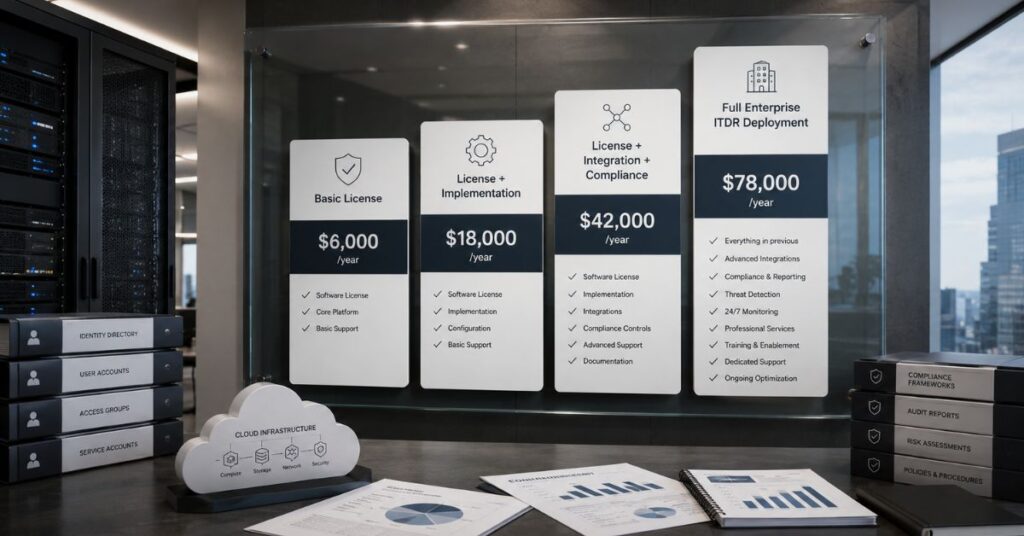
An enterprise-grade identity threat detection and response (ITDR) solution typically costs between $5 and $57 per user per month, depending on the vendor, deployment model, and whether the tool is standalone or bundled into a broader security platform. For a 500-person organisation, that translates to an annual licensing spend of $30,000–$342,000 before implementation, training, or integration costs are factored in.
Those numbers alone tell you why procurement teams struggle to budget for ITDR. The vendor price is just the starting point.
This post breaks down what enterprise ITDR actually costs, which pricing factors move the number most, and where organisations consistently overspend.
What Drives the Price of an Enterprise ITDR Solution?
Before reviewing vendor pricing, it’s worth understanding the variables that move the number.
Identity count vs. user count
Most vendors price per identity, not per employee. Service accounts, API keys, and automation agents often outnumber human users by a significant margin. If a vendor charges a full per-user licence for every non-human identity in your environment, your bill can double or triple. Always ask vendors explicitly how they count and price non-human identities.
Hybrid vs. cloud-only environments
On-premises Active Directory monitoring requires different tooling than cloud-first Entra ID or Okta coverage. Organisations running hybrid AD environments typically pay more because comprehensive coverage requires both layers. Some vendors handle this better than others and the pricing reflects it.
Deployment model
Standalone ITDR tools are licensed independently. Platform-bundled ITDR comes folded into broader XDR or MDR subscriptions. The bundled route is often cheaper per capability, but it locks you into an ecosystem. For organisations considering a managed detection and response service, ITDR capabilities may already be included or available as an add-on at reduced cost.
Microsoft licensing requirements
Many ITDR and SIEM tools require Microsoft 365 E5 licences to function fully. That can add $20–$40 per user per month to your Microsoft bill on top of the ITDR vendor cost, a hidden cost that catches procurement teams off guard. Cloud-native tools that don’t require premium Microsoft licensing avoid this.
Compliance obligations
Organisations subject to SOC 2, HIPAA, GDPR, or other frameworks need their ITDR tool to produce audit-ready evidence, not just alerts. That capability isn’t always included at the base tier. If your security compliance requirements are significant, ask vendors specifically what documentation their platform generates and whether it satisfies your auditors’ requirements out of the box.
Enterprise ITDR Vendor Pricing: What’s Publicly Known
Specific pricing for enterprise ITDR solutions is rarely published as a clean per-user figure. Most vendors use custom quoting based on identity count, deployment complexity, and contract length. The figures below represent the best publicly available information as of mid-2026.
Microsoft Defender for Identity is available as a standalone subscription with commercial pricing starting at approximately $6.60 per user per month, based on reseller-published pricing.
For organisations already on Microsoft 365 E5 or the E5 Security add-on (approximately $12 per user per month for existing E3 customers), Defender for Identity is included in the bundle alongside Defender for Endpoint, Defender for Office 365, and Microsoft Entra ID P2.
CrowdStrike Falcon Identity Protection is available as a separate add-on module for existing Falcon platform customers, or included in higher Falcon bundle tiers.
CrowdStrike does not publish per-identity pricing publicly and requires a customised quote based on deployment scale and existing contract structure. Organisations already running CrowdStrike for endpoint protection will typically find identity protection available at negotiated add-on pricing.
Huntress Managed ITDR publishes its pricing more transparently than most enterprise vendors. At the 50–99 identity tier, the published rate is $4.80 per identity per month for a 12-month subscription.
This includes 24/7 SOC monitoring, detection, and automated remediation for Microsoft 365 and Entra ID environments, with no additional Microsoft licensing requirements.
Sophos ITDR, launched in October 2025, is built as an integrated add-on to Sophos MDR or Sophos XDR subscriptions. Sophos describes its licensing as cloud-based with no upfront infrastructure costs, but does not publish standalone ITDR pricing, it requires contact with sales.
Semperis Directory Services Protector is an enterprise-focused Active Directory security and recovery platform that covers hybrid AD and Entra ID environments. Semperis does not publish pricing publicly.
The platform is purpose-built for large organisations with complex on-premises AD environments and is positioned at the higher end of the ITDR market, with pricing negotiated based on the number of identities protected and deployment scope.
Here is the simple breakdown in table:
| Vendor | Pricing Model | Published Price | Best Fit |
| Microsoft Defender for Identity | Per user/month, standalone or E5 bundle | ~$6.60/user/mo (standalone) | Microsoft-centric enterprises |
| CrowdStrike Falcon Identity | Per-identity add-on or bundle | Quote required | Existing Falcon customers |
| Huntress Managed ITDR | Per identity/month, annual | $4.80/identity/mo (50–99 tier) | Mid-market, SMB, MSP-served |
| Sophos ITDR | Add-on to MDR/XDR subscription | Quote required | Existing Sophos customers |
| Semperis DSP | Enterprise custom pricing | Quote required | Large enterprise, complex AD |
The Hidden Costs That Break ITDR Budgets

Hidden Costs That Break ITDR Budgets
The licence fee is only part of the real cost. Organisations consistently underestimate what Huntress describes as the total cost of ownership calculation, the combination of hard costs and soft costs that determine what ITDR actually costs to run.
Internal staff time
It is the largest hidden cost. Deploying an ITDR platform, tuning alert thresholds, integrating it with existing SIEM and SOC workflows, and maintaining user provisioning documentation all require skilled security personnel. If you’re sizing this correctly, those hours need a dollar value assigned before you finalise the budget.
Professional services and custom integrations
Complex environments with multiple identity providers, legacy on-premises infrastructure, or strict compliance requirements typically need professional services to deploy cleanly. This is often billed separately and is not included in the base licence.
Microsoft licensing uplift
As noted above, many enterprise ITDR tools require E5 or equivalent premium Microsoft licensing to function. If your organisation is currently on E3, that delta alone can represent a cost increase that dwarfs the ITDR licence itself.
Compliance documentation overhead
Implementing an ITDR tool without updating your formal incident response plan and access governance documentation creates compliance exposure. SOC 2, HIPAA, and similar frameworks require auditors to see updated documentation. Skipping this step doesn’t save money, it creates audit risk. Organisations managing compliance reporting obligations should build this administrative time into the project budget from the start.
Scope creep
Add a 10–20% contingency buffer. ITDR projects frequently expand once stakeholders discover gaps in coverage, “can this also monitor Okta? What about our on-prem AD?”, and those expansions have pricing implications.
A Realistic Budget Framework
For a 200-person organisation considering a standalone enterprise ITDR deployment with hybrid AD coverage:
- Licensing: $5–$15 per identity per month, depending on vendor and identity count. At 300 total identities (including service accounts), expect $18,000–$54,000 annually.
- Implementation and professional services: $5,000–$25,000, depending on environment complexity.
- Internal staff time (year one): 40–80 hours of senior security engineer time for deployment, tuning, and documentation.
- Compliance documentation updates: 10–20 hours for policy and incident response plan revisions.
- Contingency buffer: 10–20% of total projected spend.
Year-one total cost of ownership in this scenario typically lands between $30,000 and $90,000 before any Microsoft licensing uplift.
Frequently Asked Questions
What does an enterprise ITDR solution cost per user?
Enterprise ITDR solutions typically cost between $5 and $57 per user per month, depending on the vendor, deployment model, and whether the tool is standalone or part of a larger security platform bundle. Organisations with large numbers of service accounts and API keys should also factor in how vendors price non-human identities, as this can significantly increase the total licence cost.
Is Microsoft Defender for Identity worth the cost?
For organisations already running Microsoft 365 E5, Defender for Identity is included at no additional cost and delivers strong hybrid AD and Entra ID coverage. For organisations not yet on E5, the standalone licence at approximately $6.60 per user per month is competitive, but the value case strengthens considerably when bundled. The platform is most effective in Microsoft-centric environments where it can leverage signal correlation across the broader Defender suite.
What hidden costs should I budget for with ITDR?
The most significant hidden costs are internal staff time for deployment and tuning, professional services for complex integrations, Microsoft E5 licensing uplift if required, compliance documentation updates, and scope expansion contingency. Analysts recommend adding a 10–20% contingency buffer to any ITDR budget to account for these variables.
Do small businesses need an enterprise ITDR solution?
Most small businesses with fewer than 50 staff don’t require a standalone enterprise ITDR deployment. The more practical and cost-effective approach is to ensure identity threat monitoring is included in a managed security service, specifically, that the provider monitors Microsoft 365 and Active Directory environments for authentication anomalies and credential misuse.
How much does an enterprise-grade ITDR solution cost?
An enterprise-grade ITDR solution typically costs between $5 and $57 per user per month, depending on the vendor, deployment model, and whether the tool is standalone or bundled into a broader platform. For a 500-person organisation, licensing alone is often $30,000–$342,000 per year before implementation, training, or integration costs. See the vendor pricing table above for published figures where available.
Is Enterprise ITDR the Right Investment for Your Business?
Enterprise ITDR pricing is designed for organisations with in-house security teams, existing IAM infrastructure, and the operational capacity to manage a complex platform. Most businesses with fewer than 50 staff don’t need, and can’t operationally sustain a standalone enterprise ITDR deployment.
For smaller organisations, identity threat protection is typically delivered more practically as part of a broader managed security service. A managed detection and response provider that monitors Microsoft 365 environments, responds to authentication anomalies, and provides compliance-ready documentation achieves many of the same outcomes at a fraction of the operational burden.
The key is ensuring that whatever protection is in place actually covers the identity layer not just endpoints and email. Stolen credentials remain the leading initial access vector precisely because too many organisations treat identity security as an IAM problem rather than a detection and response problem. If you’re unsure whether your current setup covers the identity layer, contact CyberMark for a no-obligation assessment.
Need help reducing your business security risk?
Contact us

