MDR vs EDR Comparison Australia
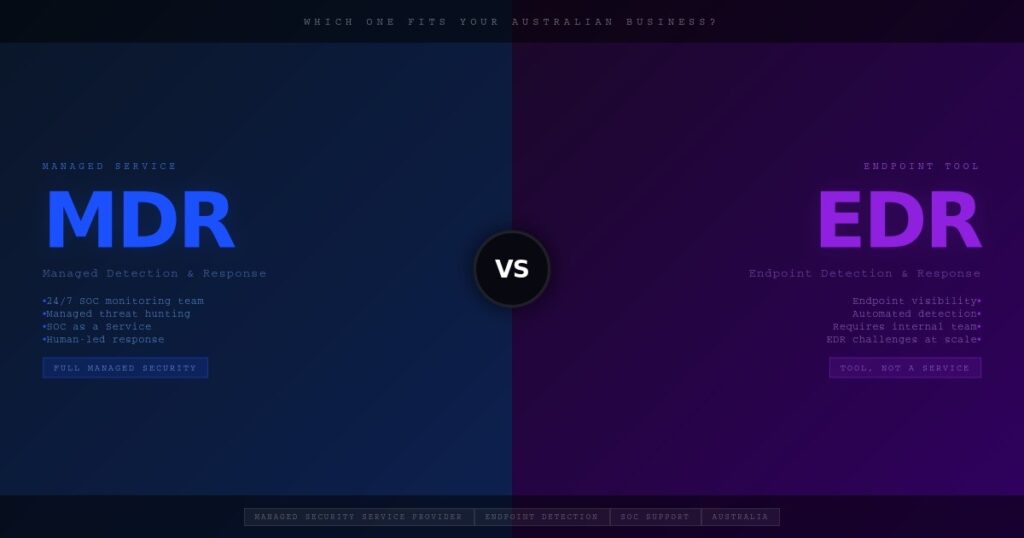
Choosing between MDR and EDR can feel confusing, especially for Australian businesses that know they need stronger cyber security but do not want to waste money on the wrong solution.
Both options are designed to improve threat detection. Both can support better visibility across devices and systems. Both can help reduce the risk of ransomware, account compromise, and suspicious endpoint activity.
But they are not the same.
That is why a clear MDR vs EDR comparison Australia guide is useful. The real question is not “Which one sounds more advanced?” The better question is “Which one fits our business, our internal skills, our risk level, and our ability to respond when an alert happens?”
For some businesses, EDR may be enough if they already have a skilled IT or security team. For others, MDR is the better fit because it adds managed investigation and response support. The difference matters because detecting a threat is only helpful if someone knows what to do next.
This guide explains the difference between MDR and EDR in practical terms, especially for small and mid-sized Australian businesses that need stronger protection without building a full internal security operations centre.
What Is EDR?
EDR stands for endpoint detection and response. It is a security technology that monitors endpoint activity and helps detect suspicious behaviour on devices such as laptops, desktops, servers, and sometimes virtual machines.
EDR goes beyond traditional antivirus. Antivirus is usually focused on known malware, while EDR looks more closely at behaviour. It can detect unusual activity that may suggest compromise, even when the threat does not match a known malware signature.
For example, EDR may detect unusual PowerShell activity, suspicious file changes, credential dumping behaviour, or a process trying to move across systems.
In simple terms, EDR gives your business more visibility into what is happening on endpoints.
The catch is that EDR often creates alerts that someone needs to understand. If your team does not have time or skill to investigate alerts properly, important signals may be missed.
That is where the MDR vs EDR comparison Australia conversation becomes important.
What Is MDR?
MDR stands for managed detection and response. MDR usually includes detection technology, often EDR, but adds a managed service layer.
That means human analysts or a security team help monitor alerts, investigate suspicious activity, and guide response.
MDR is not just a product. It is a service.
Instead of leaving your internal team to review every alert, MDR gives the business access to external security expertise. This can be useful for companies that do not have a full-time cyber security team, do not monitor systems after hours, or do not know how to respond to advanced threats.
MDR can help answer practical questions during an incident.
Is this alert serious?
Which devices are affected?
Has the attacker moved further?
Should we isolate a device?
Should we disable an account?
Do we need to begin recovery planning?
For Australian small businesses, this support can be the difference between seeing an alert and actually stopping an incident.
MDR vs EDR at a Glance
| Area | EDR | MDR |
| Main function | Endpoint detection and response technology | Managed detection, investigation, and response support |
| Human support | Usually handled by your internal team | External security analysts help monitor and respond |
| Best fit | Businesses with internal IT or security skills | Businesses needing expert monitoring and response help |
| After-hours coverage | Depends on internal team availability | Often available as part of managed monitoring |
| Alert handling | Your team reviews and investigates alerts | MDR team helps triage and investigate |
| Cost model | Usually tool licensing and internal effort | Service cost plus managed support |
| Response support | Depends on internal capability | Usually includes guided or assisted response |
| Main risk | Alerts may be ignored or misunderstood | Service must be aligned with your business environment |
This table gives a quick MDR vs EDR comparison Australia businesses can use before speaking with providers.
The Key Difference: Tool vs Managed Service
The biggest difference between EDR and MDR is not the detection itself. It is who is responsible for reviewing alerts and taking action.
EDR gives visibility. MDR adds people and process.
If your business has EDR but no one checks alerts after 5 p.m., then a Friday night attack may still run for hours before anyone notices. If your business has EDR but your IT team is already overloaded, alerts may pile up and lose urgency.
MDR helps solve that gap by providing managed monitoring and response support.
That does not mean EDR is weak. It means EDR needs skilled attention. MDR can be a better option when the business does not have that attention internally.
This is the heart of any practical MDR vs EDR comparison Australia discussion.
When EDR May Be the Better Fit
EDR can be a strong option for businesses that already have the right internal capability.
For example, EDR may suit an Australian business with an experienced IT team that understands endpoint alerts, can investigate suspicious behaviour, and has time to respond quickly.
It may also suit businesses that want more control and already have a security operations process in place.
EDR may be a good fit when:
- Your IT team has security experience
- Someone reviews alerts regularly
- You already have an incident response plan
- You can respond after hours if needed
- You want more direct control over the tools
- Your environment is not too complex
The challenge is making sure EDR does not become “just another dashboard.” A tool that is not monitored properly will not deliver full value.
When MDR May Be the Better Fit
MDR may be better for businesses that need stronger security visibility but do not have internal security resources.
Many small and mid-sized businesses in Australia have general IT support, but not dedicated cyber security analysts. That creates a gap. The business may have tools, but no one has time to investigate suspicious activity deeply.
MDR can help fill that gap by providing monitoring, triage, and response support.
MDR may be a good fit when your business has remote workers, sensitive data, limited internal IT resources, high downtime risk, cyber insurance expectations, or a need for faster ransomware detection.
It is also useful for businesses that cannot afford to miss alerts outside normal working hours.
For many organisations, MDR is not about buying more technology. It is about gaining access to cyber security expertise without hiring a full internal team.
How MDR and EDR Help With Ransomware
Ransomware is one of the main reasons businesses compare MDR and EDR.
Ransomware often creates warning signs before encryption spreads widely. There may be suspicious login behaviour, privilege escalation, abnormal file changes, unusual scripts, or attempts to disable security tools.
EDR can help detect those signs at the endpoint level. MDR can help investigate them and escalate response.
That response may include isolating a device, disabling a compromised account, blocking suspicious processes, or guiding the internal team through containment.
However, neither MDR nor EDR replaces backup and recovery.
A business still needs secure backups, tested restores, and a disaster recovery plan. If ransomware damages files or systems, recovery depends on whether clean data is available.
This is where RedVault Systems Backup & Disaster Recovery fits into the wider strategy. RedVault Systems provides cloud storage and Backup & Disaster Recovery, with data encrypted before it is sent to Backblaze B2 storage.
The strongest approach combines detection, response, and recovery.
Why Backup and Recovery Still Matter
It is easy to focus only on detection tools. But every business should ask a harder question:
What happens if the attack is not stopped in time?
Even strong detection tools cannot guarantee that no incident will ever cause damage. A compromised account, insider mistake, ransomware event, hardware failure, or accidental deletion can still affect business data.
That is why backup and recovery remain essential.
A strong recovery plan should include secure cloud storage, backup encryption, multiple restore points, access controls, retention rules, and regular restore testing.
For businesses comparing MDR and EDR, backup should be part of the same planning conversation. Detection helps you respond faster. Recovery helps you keep operating if the incident causes damage.
This is especially important for Australian businesses that rely on cloud apps, customer records, finance systems, shared folders, or operational data every day.
Cost Considerations for Australian Businesses
Cost is a major factor in the MDR vs EDR comparison Australia decision.
EDR may appear cheaper because it is often licensed as software. But the business still needs people to manage it. If internal staff must spend hours reviewing alerts, tuning policies, and investigating incidents, that cost is real.
MDR may cost more upfront as a service, but it includes managed expertise. For businesses without internal security staff, this can be more practical.
The right comparison should include:
| Cost Area | EDR Consideration | MDR Consideration |
| Licensing | Tool cost per endpoint | Service cost per endpoint or environment |
| Internal time | Higher if your team investigates alerts | Lower internal investigation burden |
| Expertise | Requires skilled internal staff | Expertise included in service |
| After-hours response | May require internal on-call coverage | Often included or available |
| Incident handling | Internal team must lead | Managed team supports response |
| Long-term value | Strong if managed well internally | Strong if internal team needs support |
The cheapest option is not always the safest. The best option is the one your business can actually operate well.
Questions to Ask Before Choosing
Before choosing MDR or EDR, Australian businesses should ask practical questions.
How many endpoints do we need to protect?
Do we have internal staff who can investigate alerts?
Who responds after hours?
What systems are most critical?
How quickly do we need to detect ransomware behaviour?
Do we have tested backups?
Can we restore critical systems within an acceptable timeframe?
Do we need reporting for insurance, clients, or suppliers?
These questions help keep the decision grounded in business needs.
A company with strong internal capability may choose EDR. A company that needs outside help may choose MDR. A company with high risk may use both EDR technology and MDR service support.
Common Mistakes to Avoid
One common mistake is buying EDR and assuming security is solved. EDR still needs monitoring, tuning, and response.
Another mistake is choosing MDR without defining internal responsibilities. Even with managed support, the business must know who receives alerts, who approves urgent actions, and who communicates during incidents.
A third mistake is forgetting recovery. Detection is important, but if critical data is lost, the business still needs backups.
The final mistake is comparing providers only on price. Cyber security decisions should consider business risk, downtime cost, data sensitivity, and response capability.
Practical Decision Table
| Business Situation | Better Fit | Why |
| You have skilled internal security staff | EDR | Your team can manage alerts and response |
| You have limited IT resources | MDR | Managed support reduces internal burden |
| You need after-hours monitoring | MDR | External monitoring can cover gaps |
| You want full control over tools | EDR | Internal team keeps direct control |
| You face high ransomware risk | MDR with strong backup recovery | Detection and recovery both matter |
| You need client or insurer confidence | MDR plus tested backups | Shows stronger readiness |
| You are building security maturity gradually | Start with MDR or managed EDR | Helps avoid unmanaged alert overload |
This is the simplest way to think about MDR vs EDR comparison Australia. The better choice depends on your team, risk, and response capability.
How RedVault Systems Supports the Bigger Security Strategy
RedVault Systems does not replace MDR or EDR. It supports the recovery side of cyber resilience, which is just as important.
If MDR or EDR detects a threat early, that is a strong result. But if systems are damaged, encrypted, or corrupted, the business needs clean backups and a tested recovery process.
With RedVault Systems cloud storage, data is encrypted before it is sent to Backblaze B2 storage. This helps protect backup data and supports stronger recovery planning.
For Australian businesses comparing MDR and EDR, RedVault Systems helps answer the next question: if something still goes wrong, can we recover?
FAQs
What is the main difference between MDR and EDR?
EDR is primarily a detection and response technology for endpoints. MDR is a managed service that includes monitoring, investigation, and response support, often using EDR tools as part of the service.
Which is better for small businesses in Australia?
For many small businesses, MDR is more practical because it includes managed support. EDR can work well if the business has internal staff who can monitor alerts and respond quickly.
Does MDR include EDR?
Many MDR services include or integrate with EDR technology. The difference is that MDR adds human investigation and response support.
Can MDR or EDR stop ransomware completely?
No solution can guarantee complete prevention. MDR and EDR can help detect and contain ransomware activity, but businesses still need secure backups and disaster recovery planning.
How does RedVault Systems help alongside MDR or EDR?
RedVault Systems supports cloud storage and Backup & Disaster Recovery. Data is encrypted before being sent to Backblaze B2 storage, helping businesses protect backup data and recover if an incident causes damage.
Final Thoughts
The MDR vs EDR comparison Australia decision is really about capability. EDR gives businesses stronger endpoint visibility, but it needs skilled attention. MDR adds managed monitoring and response support, which can be valuable for companies without a dedicated security team.
For some Australian businesses, EDR is enough. For many others, MDR is the safer and more practical choice.
The best security strategy also includes recovery. Detection matters, but clean backups, encryption, restore testing, and disaster recovery planning decide how well the business survives a serious incident.
For Australian businesses that want stronger cloud storage and Backup & Disaster Recovery, RedVault Systems provides encrypted data protection before storage and a practical foundation for resilience.
Need help reducing your business security risk?
Contact us

