Vulnerability Scanning vs Penetration Testing: Key Differences Explained
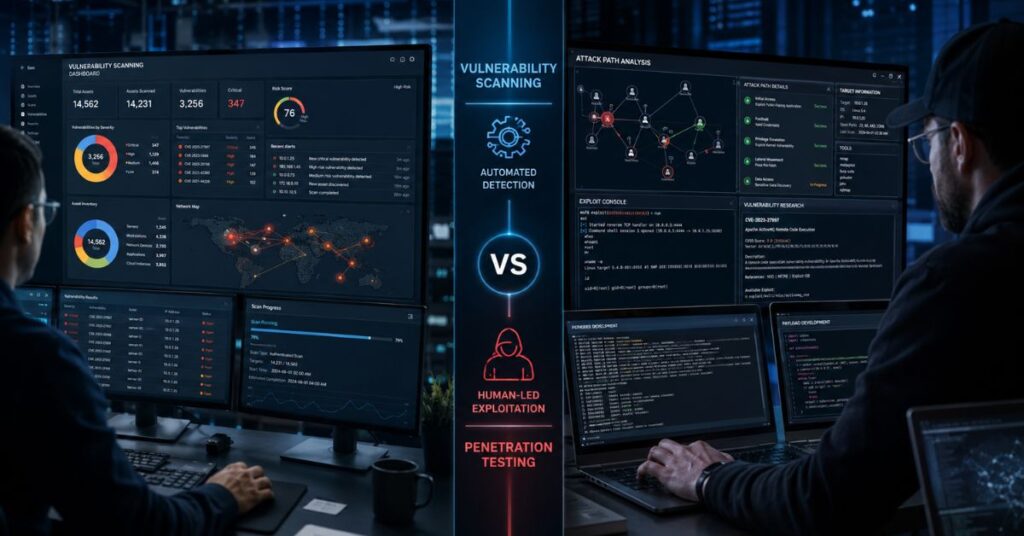
Vulnerability scanning is an automated process that identifies known security weaknesses across your systems. Penetration testing is a manual, human-led simulation where a security professional actively tries to exploit those weaknesses. Scanning is fast, broad, and affordable. Pen testing is slower, deeper, and significantly more expensive. Both have a place in a serious security program, but at different times and for different reasons.
Business owners often buy one when they actually need the other. Or they run a scan, get a clean report, and assume they’re protected. That assumption is exactly where things go wrong.
What Is Vulnerability Scanning?
Vulnerability scanning is an automated security process that checks your systems, networks, and applications against a database of known weaknesses. Point a scanner at your environment, and it compares everything it finds, software versions, open ports, configurations, against the CVE list and similar databases. If anything matches a known flaw, it gets flagged with a severity rating: high, medium, or low.
What you get out is a report. Your team works through the list, confirms which findings are real rather than false positives, and patches them.
No attempt to break in. No simulation of an attack. Just identification of what might be wrong.
How the Vulnerability Scanning Process Works
- The scanner probes your network, devices, and applications
- Findings are compared against the vulnerability database
- A ranked report comes out with every issue sorted by severity
- Your team reviews, triages false positives, and patches real issues
Good tools like Nessus, Qualys, and OpenVAS cover over 50,000 known vulnerabilities in a single pass. Teams using nmap for vulnerability scanning get strong results for network discovery and port enumeration, but nmap works best alongside a dedicated scanner rather than as a standalone solution.
Types of Vulnerability Scanning
Different environments need different scans. Here’s a breakdown:
- External vulnerability scan: checks what’s visible to an attacker from outside your network: public-facing systems, exposed services, open ports
- Network vulnerability scanning: maps internal infrastructure, device configurations, and service versions
- Application vulnerability scan: targets web applications and APIs for coding flaws and authentication gaps
- Container vulnerability scanning: scans Docker and Kubernetes environments for misconfigurations and unpatched CVEs, which has become essential for teams running cloud-native workloads
- Continuous vulnerability scanning: runs on an automated schedule rather than one-off assessments, so new threats get caught before they’re exploited
The Honest Benefits and Limits
Pricing runs around $100 per IP per year, which makes scanning an accessible option for smaller businesses. PCI DSS, FFIEC, and GLBA all require regular scanning as part of their compliance mandates. If you operate in a regulated industry, scanning is likely already non-negotiable.
Zero-day threats with no published CVE yet won’t show up in results. False positives are a consistent frustration, too, flagging things that look like problems but can’t actually be exploited in your environment. Someone on your team still has to manually review and triage before acting on anything.
Fundamentally, a scan identifies the unlocked door. Whether anyone’s inside, or what’s on the other side, isn’t something it can answer.
What Is Penetration Testing?

Penetration testing reveals hidden vulnerabilities through simulated attacks.
Penetration testing is a manual, human-led security assessment where a trained professional simulates a real cyberattack against your systems. Unlike a scan, the tester doesn’t just identify weaknesses; they actively try to exploit them, the same way an actual attacker would, to find out how far they could get and what the real damage would look like.
Security teams often describe their first pen test as genuinely eye-opening. A scan might flag an outdated plugin or unpatched certificate. A pen test might show that the same unpatched plugin gives an attacker a path from your public-facing website straight to your internal customer database in under an hour. Two completely different conversations to have with leadership.
What Are the 7 Stages of Penetration Testing?
Regardless of which methodology a tester uses, most engagements follow these seven stages:
- Pre-engagement: scope, rules of engagement, and off-limits systems are agreed on in writing before anyone touches anything
- Reconnaissance: gathering information about your environment without active probing
- Scanning and enumeration: mapping the real attack surface in detail
- Vulnerability analysis: figuring out which weaknesses are worth pursuing
- Exploitation: actively trying to breach those weaknesses using SQL injection, password cracking, buffer overflow, and other real techniques
- Post-exploitation and lateral movement: testing how far an attacker could move once inside
- Reporting: a full write-up of what worked, what was accessed, proof of exploitation, and what to fix first
Nothing in that process is automated. No software does this for you. Testers bring judgment, creativity, and deep knowledge of current attack methods; that combination is what makes results meaningful, and also what drives the cost.
Types of Penetration Testing
- Black box penetration testing: the tester starts with zero knowledge of your systems, simulating a real outside attacker
- Internal penetration testing: simulates an attacker who already has a foothold inside your network
- Web app penetration testing: focuses on application logic, API endpoints, and authentication flows
- Mobile application penetration testing: looks at how mobile apps handle data storage, session tokens, and backend API calls
- Cloud penetration testing: tests access controls and misconfigurations in AWS, Azure, or GCP environments
- Red team penetration testing: a long-duration, full-scope engagement designed to test your detection and response capabilities, not just the technical defences
The Real Limitations of Penetration Testing
Penetration testing costs typically range from $15,000 to $70,000, depending on scope, type, and the provider. Engagements run anywhere from one day to three weeks. Because of that investment, most businesses do one annually or after major infrastructure changes, which creates windows of exposure between assessments.
Compliance requirements under PCI DSS Level 1, HIPAA, FedRAMP, and SOC 2 Type 2 specifically require pen testing. Running a vulnerability scan doesn’t satisfy those requirements on its own. Worth knowing when you’re scoping your security program. And if mobile is part of your attack surface, the benefits of mobile app penetration testing go well beyond what any automated scan will surface, insecure data storage, broken authentication, and API flaws are consistently missed by standard scanners.
Vulnerability Scanning vs Penetration Testing: Key Differences
| Factor | Vulnerability Scan | Penetration Test |
| Method | Automated | Manual, human-led |
| Goal | Identify known weaknesses | Exploit weaknesses to measure real impact |
| Depth | Surface-level | In-depth |
| Cost | ~$100/IP/year | $15,000–$70,000+ |
| Time to complete | Minutes to a few hours | 1 day to 3 weeks |
| Frequency | Weekly, monthly, or quarterly | Annually or after major changes |
| False positives | Common | Ruled out by proving exploitation |
| Compliance use | PCI DSS, GLBA, FFIEC | PCI DSS, HIPAA, SOC 2, FedRAMP |
| Human expertise required | Minimal | Extensive |
Here’s the analogy that actually holds up: scanning is an X-ray, fast, affordable, and catches obvious problems. Pen testing is an MRI, slower and more expensive, but it shows you what’s really happening underneath the surface.
What Are the 4 Types of Vulnerability Scanning?
Four core categories cover most environments:
- Network-based scanning – finds exposed services, open ports, and misconfigured devices across the network
- Host-based scanning – runs directly on individual machines to check installed software, patch levels, and local configurations
- Application scanning – targets web apps and APIs for injection vulnerabilities, authentication flaws, and logic errors
- Database scanning – checks database servers for default credentials, privilege misconfigurations, and known CVEs
Container vulnerability scanning has effectively become a fifth category on its own, especially for businesses running Docker or Kubernetes in production.
Vulnerability Scan vs Penetration Test: When to Use Each One
Choosing the right assessment comes down to what question you’re trying to answer. Here’s a practical breakdown:
A vulnerability scan makes sense when:
- You need continuous, automated coverage across a broad environment
- Compliance with PCI DSS, FFIEC, or GLBA is the priority
- Budget is tight and you need broad visibility without a large upfront cost
- You want to track your security posture over time and benchmark progress
A penetration test makes sense when:
- You need to know whether a real attacker could actually get in
- Your systems or infrastructure have changed significantly
- A compliance framework specifically requires it to be PCI DSS Level 1, HIPAA, and SOC 2 Type 2
- You want proof that your existing security controls hold up under pressure
Run both when:
- You want a complete picture rather than a partial one
- You’re preparing for a compliance audit or certification
- Sensitive customer data is involved, or you operate in a regulated industry
Before deciding which assessment to prioritise, understanding the cybersecurity risks your specific business faces is worth doing first, the right starting point isn’t the same for every organisation.
How AI Is Changing Vulnerability Scanning and Penetration Testing in 2026

How AI Is Changing Vulnerability Scanning and Penetration Testing in 2026
AI is making both vulnerability scanning and penetration testing faster, smarter, and more relevant in 2026, but it’s also making the threats they defend against more dangerous.
Traditional CVSS scores used to flag around 60% of all CVEs as high or critical. Teams ended up drowning in alerts, most of which didn’t require urgent action. Vendors responded by building AI-driven prioritisation into their platforms, Tenable’s Vulnerability Priority Rating (VPR), CrowdStrike’s ExPRT.AI, and Qualys TruRisk all use machine learning to rank findings based on actual exploitability and real threat intelligence rather than a static severity score. Businesses using vulnerability scanning as a service have found that this makes the output considerably more actionable.
On the pen testing side, AI handles lower-level triage work, freeing skilled testers to spend time on the complex vulnerabilities that require real human judgment. Better platforms now combine automated scanning coverage with human-led exploitation in a single continuous workflow, rather than treating them as two separate annual events.
Attackers are moving faster. AI has compressed the gap between a CVE being published and it being weaponised in the wild from weeks to hours. That’s a practical argument for continuous scanning and more frequent pen testing, not just the annual check-box engagement.
Unsanctioned AI tools being used inside organisations are creating entirely new attack surfaces as well, ones that neither scans nor pen tests were originally scoped to cover. The shadow AI risk guide covers what that exposure actually looks like.
Do You Need Both Vulnerability Scanning and Penetration Testing?
For most businesses, yes, you need both. Regular scans keep you on top of known issues. Running them weekly or monthly means your team isn’t flying blind between major assessments. New CVEs get caught quickly, compliance is maintained, and there’s a working list of issues to action.
Pen tests handle the question scans can’t answer: would an attacker actually succeed? Complex, chained vulnerabilities, the kind involving three small misconfigurations working together rather than one obvious flaw, only surface through active exploitation.
Together, scanning tells you what might be wrong. Pen testing tells you what’s genuinely dangerous. Both halves of that picture are worth having.
Frequently Asked Questions
What is the primary goal of penetration testing?
To find out whether your defences would stop a real attack, and to show what happens if they wouldn’t. Unlike a scan, pen testing confirms which vulnerabilities are exploitable in your specific environment and how far an attacker could get once inside.
What is the difference between vulnerability assessment and penetration testing?
Vulnerability assessments use automated tools to identify potential weaknesses. Pen testing takes that further by actively exploiting those weaknesses with human expertise to validate real risk. Assessments are broader and faster; pen tests are deeper and more conclusive.
How much does penetration testing cost?
Engagements typically run between $15,000 and $70,000. Final cost depends on scope, number of systems in scope, and the type of test: network, web application, mobile, cloud, or full red team.
How often should you run a vulnerability scan?
Quarterly at minimum for most compliance frameworks, though weekly or monthly is more common among security-conscious teams. Continuous vulnerability scanning has become standard for high-risk environments or businesses handling sensitive data.
Can vulnerability scanning replace penetration testing?
No. Scanning catches what’s already in the database. Confirming whether a vulnerability is actually exploitable in your specific environment, and replicating the judgment of a skilled tester working through a real attack scenario, which requires a human.
Vulnerability Scan or Penetration Test: What’s Right for You?
Vulnerability scanning and penetration testing aren’t competing options. Scanning gives you regular, affordable coverage of known threats. Pen testing gives you depth and proof that automated tools simply can’t replicate.
Scanning finds what might be exploitable. Pen testing confirms what actually is.
The starting point depends on budget, compliance requirements, and risk tolerance. But stalling on that decision isn’t neutral; new vulnerabilities are being published and exploited faster than ever, and attackers aren’t waiting for a convenient time.
Talk to our team to figure out which approach fits your situation, or take a look at our cybersecurity services to see how we build layered security programs for New Zealand businesses.
Need help reducing your business security risk?
Contact us

