Compliance Readiness Checklist for Security and Regulatory Audits
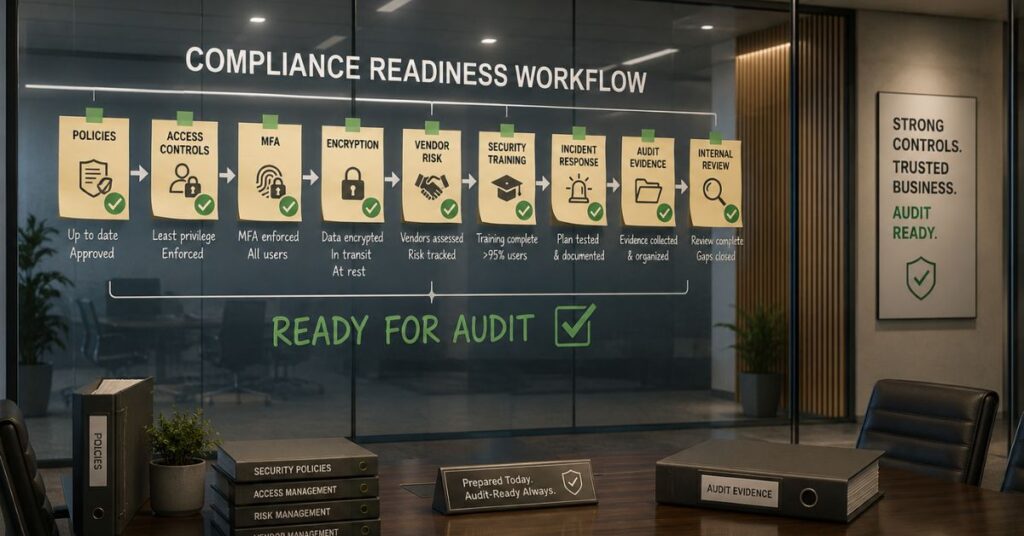
Ask most auditors why an organisation fails a review, and the answer usually isn’t a weak firewall or missing encryption. It’s a missing log, an access review nobody signed off on, or a policy that hasn’t been updated in two years. Controls exist; proof doesn’t.
A compliance readiness checklist is what closes that gap: a structured list of the policies, controls, and evidence you need in place, and kept current, so you can demonstrate alignment with a security or regulatory standard at any point, not just when an audit is scheduled.
Below is the nine-step checklist that gets you from “we think we’re compliant” to “here’s the evidence.”
What Is Compliance Readiness?
Compliance readiness is the ongoing ability to demonstrate that your controls are documented, operating as intended, and mapped to the standard you’re being measured against. It’s different from audit preparation, which is the reactive scramble to pull evidence together once a review date is confirmed.
The distinction matters because readiness is continuous and preparation is a sprint. An organisation that treats compliance as something to fix in the two weeks before an audit will spend far more time and take on far more risk, than one that keeps evidence current year-round. Readiness means the answer to “can you show me that?” is always yes, not “give us a few days.”
Why Small and Mid-Sized Businesses Can’t Treat This as a Once-a-Year Task
Most compliance guidance online is written for enterprise GRC teams with dedicated compliance officers and full-time audit coordinators. That’s not the reality for a 15-person business trying to close a SOC 2 review to win an enterprise client, or a healthcare vendor that needs to prove HIPAA alignment before a contract goes through.
Small businesses face the same regulatory and contractual obligations as large enterprises, just without the headcount to manage them. That’s precisely where managed cyber security services close the gap: instead of hiring a compliance officer, a managed security service provider builds the readiness process into your existing security operations, so evidence collection happens as a byproduct of day-to-day monitoring rather than a separate project. For businesses without the budget for an internal compliance hire, this is usually the more realistic path to staying audit-ready, and it’s worth understanding what a compliance assessment actually costs in NZ before deciding whether to build the function in-house or bring in outside support.
The Compliance Readiness Checklist: 9 Steps to Get Audit-Ready

This is the core of the process. Each step below builds evidence that an auditor will actually ask for, not just a policy that sits unread in a shared drive.
1. Define Your Audit Scope and Applicable Framework
Before anything else, pin down exactly which systems, data types, and business units are in scope, and which framework governs the review. A SOC 2 compliance audit and an ISO 27001 compliance certification test different things, and scoping the wrong boundary either creates unnecessary work or leaves gaps that an auditor will flag. If your customers are in New Zealand, factor in the NZ Privacy Act 2020 from the outset rather than treating it as a separate exercise later.
2. Assign Control Ownership
Every control needs a named person responsible for it. “The IT team” is not an owner; a specific individual who maintains that control, produces its evidence, and answers for it during the audit is. Without clear ownership, controls drift out of date because no one is accountable for keeping them current.
3. Document Policies With Version Control
Auditors expect written, dated, version-controlled policies that reflect what your organisation actually does, not a template downloaded once and never revisited. At a minimum, keep an information security policy, access control policy, incident response plan, and acceptable use policy current and reviewed annually.
4. Lock Down Identity and Access Management
Access control is where most audits get granular. Confirm access follows least-privilege principles, multi-factor authentication is enforced on critical systems, and you have a documented process for what happens to access when someone joins, changes roles, or leaves. Pair this with strong endpoint detection and response so access anomalies are actually caught, not just theoretically prevented.
5. Protect Data With Encryption and Classification
Sensitive data needs to be encrypted both at rest and in transit, with a classification policy that defines what counts as public, internal, or restricted. Reliable, tested backups and secure data storage practices round this out; “we use the cloud provider’s default settings” is not an answer that satisfies most auditors.
6. Build and Test an Incident Response Plan
A written incident response plan that’s never been tested is a paper exercise. Auditors want to see assigned roles, clear escalation paths, and evidence of at least one tabletop exercise in the past year. This is also where the decision between MDR and an internal SOC gets shaped by compliance needs, specifically, since your audit obligations often determine how fast and how documented your incident response has to be.
7. Manage Third-Party and Vendor Risk
If a vendor processes, stores, or transmits your data, they’re part of your audit scope, whether or not you think of them that way. Maintain a vendor inventory with risk tiers, request completed security questionnaires, and keep SLAs that include data protection clauses on file.
8. Deliver Role-Based Security Awareness Training
Auditors don’t just want to know training happened; they want to see who completed it, when, and whether phishing simulation results improved over time. Structured security awareness training with signed acknowledgments is one of the easiest wins on this list, and one of the most commonly missing pieces of evidence.
9. Centralize Audit Evidence and Run Internal Mock Audits
Everything above only matters if it’s retrievable. Build an evidence structure that traces each requirement to its control, its test, and its supporting artifact, and run quarterly internal reviews to catch gaps before an external auditor does. Regular penetration testing adds another layer here: it proves your controls hold up under an actual attempt to break them, not just on paper.
Which Frameworks Does This Checklist Map To?
This checklist isn’t framework-specific by design, because most growing businesses end up subject to more than one standard at once. A single piece of evidence, an access review log, for example, can often satisfy overlapping requirements across SOC 2, ISO 27001, and HIPAA simultaneously, which is why cross-framework mapping saves so much duplicated effort for organisations juggling multiple obligations.
The framework you prioritise depends on who you serve: SOC 2 tends to matter most for US-facing SaaS customers, ISO 27001 carries more weight internationally, and businesses handling EU or UK personal data need GDPR alignment regardless of where they’re headquartered. NZ and Australian businesses have the added layer of the Australian Privacy Act 1988 if they serve customers across the Tasman. Costs vary significantly by framework and by whether you’re pursuing a self-assessment or full third-party certification, so it’s worth reviewing current NZ pricing before committing to a specific audit path.
Frequently Asked Questions
What is a compliance audit checklist?
A compliance audit checklist is a point-in-time list of evidence and controls an organisation prepares for a specific, scheduled audit. It differs from a readiness checklist, which is maintained continuously rather than assembled before a single event.
How do I prepare a compliance checklist?
Start by defining your audit scope and applicable framework, assign an owner to each control, document your policies with version control, and centralise your evidence so it’s retrievable on demand rather than scattered across teams.
What is a readiness checklist?
A readiness checklist is a structured set of items confirming an organisation is prepared for a specific process or review, in this context, mapped to the controls and evidence a security or regulatory audit will test.
What are the 4 domains of ITGC?
The four IT General Controls domains are access to programs and data, program changes, program development, and computer operations. Together they cover the foundational IT controls most compliance and financial audits test.
What is a regulatory compliance checklist?
A regulatory compliance checklist tracks alignment with a legally binding requirement, such as HIPAA or the NZ Privacy Act, as opposed to a voluntary framework like SOC 2 or ISO 27001, which businesses adopt by choice or client demand.
Staying Audit-Ready Doesn’t Have to Fall on You Alone
A compliance readiness checklist only works if someone keeps it current between audits, not just in the weeks before one. That’s the part most small businesses struggle with, not because the checklist is unclear, but because maintaining evidence, testing controls, and tracking framework changes takes time most teams don’t have.
CyberMark Agency builds this into our managed cybersecurity services for New Zealand businesses: continuous monitoring, documented compliance reporting, and audit-ready evidence collection handled as part of your day-to-day protection, not a separate scramble every twelve months. If you want to see exactly where your current setup stands against this checklist, book a free security assessment, and we’ll walk through the gaps with you, no obligation either way.
Need help reducing your business security risk?
Contact us

