MDR vs Internal SOC: Cost, Benefits & Key Differences
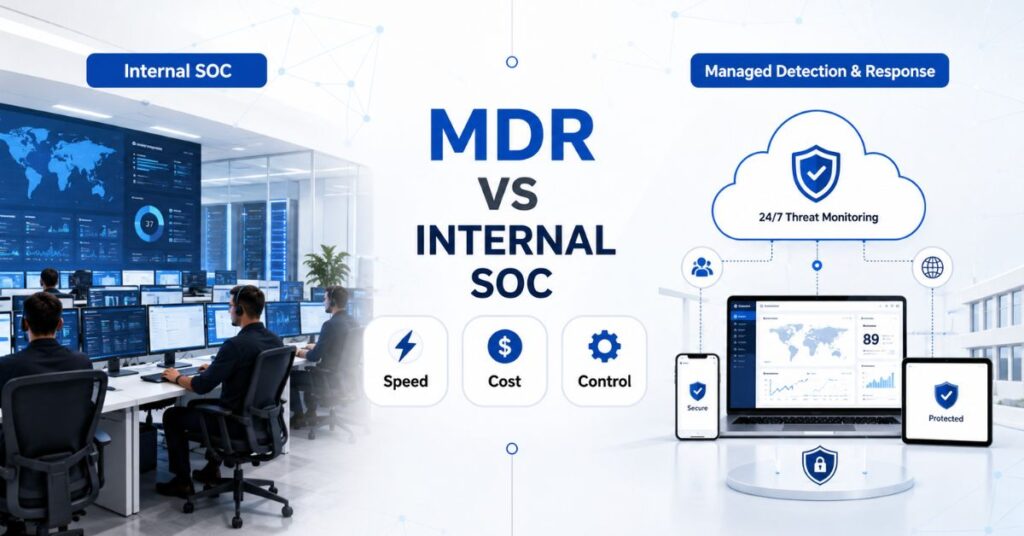
The MDR vs internal SOC decision comes down to one core trade-off: MDR gets you 24/7 threat detection and response in days or weeks, at a fraction of the cost of hiring a team, while an internal SOC gives you full control over tools and process, at a much higher price and a much longer runway. Neither model is universally “better.” The right choice depends on your budget, compliance obligations, and the speed at which you need coverage to be in place.
This guide breaks down what each model actually involves, what they cost in 2026, and how to decide which one fits your organization, or whether a hybrid of both is the smarter path.
What Is an Internal SOC?
An internal SOC (security operations center) is your own in-house team, tools, and processes dedicated to monitoring, detecting, and responding to security threats around the clock. It’s typically staffed with tiered analysts. Tier 1 handles initial alert triage, Tier 2 investigates confirmed incidents, and Tier 3 (often threat hunters) deals with advanced or persistent threats. A SOC manager oversees the function and reports on posture, incidents, and compliance.
Beyond monitoring, a mature internal SOC also owns detection engineering, playbook development, vulnerability management, and compliance reporting. The upside is total control: your team tunes every detection rule and every escalation path to your specific environment. The downside is that building this capability from scratch is slow, expensive, and dependent on hiring in a tight talent market.
What Is MDR?
Managed detection and response (MDR) is an outsourced service where a third-party provider delivers continuous monitoring, threat hunting, alert investigation, and response, using their own analysts, tools, and threat intelligence. Rather than just flagging suspicious activity, MDR providers actively investigate alerts and, in most cases, take direct action to contain a threat, such as isolating a compromised endpoint before your internal team even has to intervene.
Most MDR services pull telemetry from multiple sources, endpoints, cloud platforms, identity systems, and network traffic, to catch multi-stage attacks that a single tool would miss. It’s designed for organizations that need enterprise-grade detection and response without the internal headcount or ramp-up time to build it themselves. If you’re evaluating providers, our MDR buyer’s guide covers the selection criteria and red flags to watch for.
MDR vs Internal SOC: Key Differences
| Factor | Internal SOC | MDR |
| Ownership | Fully in-house | Outsourced to a provider |
| Setup time | 3–18 months to reach operational maturity | Days to a few weeks |
| Cost model | High fixed cost (salaries, tooling, infrastructure) | Predictable subscription, usually per endpoint or user |
| Staffing | 8–12+ analysts needed for genuine 24/7 coverage | No internal analyst headcount required |
| Control | Full customization of tools and workflows | Defined by the provider’s platform and SLA |
| Threat hunting | Requires a dedicated team, often missing in smaller SOCs | Typically included as standard |
| Best fit | Large, mature organizations with strict compliance needs | SMBs and mid-market teams needing fast, reliable coverage |
The practical takeaway: an internal SOC buys you control, but that control has to be earned through months of hiring, tooling, and tuning. MDR trades some of that customization for speed and predictability. You’re covered almost immediately, but within the scope the provider defines. Most organizations aren’t actually choosing between “total control” and “no control.” They’re choosing between owning every operational detail themselves or delegating the 24/7 grind to a team that already does it at scale.
Cost Comparison: MDR vs Building an Internal SOC
The cost gap between these two models is the single biggest factor driving the decision, and it’s larger than most budget proposals initially show.
A fully staffed, genuinely 24/7 internal SOC for a mid-sized organization typically costs $1 million to $2.5 million annually, once you account for analyst salaries, benefits, SIEM and EDR licensing, threat intelligence feeds, and management overhead. Staffing alone drives most of that number; true round-the-clock coverage needs roughly five analysts per shift position once you factor in vacations, sick leave, and training, which usually works out to 8–12 analysts minimum for a functioning team. Add the reality that average SOC analyst tenure is around 18–24 months, and turnover becomes a recurring, budget-draining cost on top of the base staffing bill.
MDR, by contrast, runs on a subscription model, typically priced per endpoint or user. For a mid-market organization, pricing generally lands in the range of $5,000 to $25,000 per month, or roughly $60,000 to $300,000 annually, a fraction of the fully loaded cost of an in-house team. That’s not a like-for-like comparison in every respect (MDR doesn’t include your own tooling ownership or the same depth of environmental customization), but for organizations trying to get real coverage without a seven-figure line item, the gap is significant. For a full breakdown of what drives pricing up or down, see our MDR cost guide.
Benefits of MDR Over an Internal SOC

MDR offers several advantages over building detection and response capability in-house:
- Faster time to coverage: MDR can go live in days to weeks, compared to the 6–18 months it typically takes to stand up an internal SOC from scratch, a critical difference if your environment is currently unmonitored or under-monitored.
- Solves the staffing problem: The global cybersecurity workforce shortage sits at roughly 4.8 million unfilled positions worldwide, making it difficult for most organizations to hire and retain a full internal team on their own.
- Reduces burnout-driven churn: SOC analyst burnout is well documented, with industry surveys consistently putting burnout rates above 60% among SOC teams. MDR providers absorb this churn internally; their analysts work across many client environments, developing pattern recognition that’s hard for a single-organization team to replicate.
- Cuts alert fatigue: MDR providers handle the bulk of tier-1 alert triage, the volume of which is the leading cause of alert fatigue in smaller internal SOC teams.
- Scales without new hires or hardware: An MDR subscription flexes with your environment, add endpoints or users, and coverage scales with it, without a hiring cycle or new hardware procurement.
When an Internal SOC Still Makes Sense
An internal SOC is the better fit when full control over detection logic, tooling, and escalation paths is a hard requirement, common in organizations with highly specialized or classified environments. It also makes sense when your team has already built institutional knowledge of a complex environment that would be costly for an outside provider to fully replicate.
Regulatory and data sovereignty requirements can also mandate in-house monitoring outright, particularly in regulated sectors. Our compliance reporting page covers how these obligations typically factor into that decision. And organizations that have already invested in mature security tooling and a capable internal team are often better served by formalizing what they have rather than replacing it.
Hybrid Model: Using MDR and an Internal SOC Together
MDR and an internal SOC aren’t mutually exclusive. A common pattern is a hybrid model: an internal team handles daytime investigation, strategy, and complex forensics, while an MDR provider covers after-hours, weekends, and overflow alert volume. In other cases, MDR acts as a threat-hunting extension of an existing SOC, adding proactive hunting capacity that many internal teams don’t have the bandwidth to run themselves.
This hybrid approach tends to be the most cost-effective option for mid-market organizations, with internal ownership over sensitive workflows, without the cost of building 24/7 coverage entirely in-house.
How to Choose Between MDR and an Internal SOC?
The right decision depends on four questions: What’s your budget? Do you have (or can you realistically hire) a dedicated security team? Do specific compliance or data sovereignty rules require in-house monitoring? And how urgently do you need coverage in place?
Organizations facing a real talent shortage, a challenge that’s especially acute for small businesses competing against larger enterprises for the same limited pool of experienced analysts, often find MDR to be the more realistic path to actual 24/7 protection, rather than a SOC that exists on paper but is understaffed in practice.
FAQs
What is the difference between MDR and a SOC?
A SOC is the function, the team, the tools, and the processes that monitor and respond to threats. MDR is a way to get that function delivered as an outsourced service rather than building it yourself.
Is MDR better than an internal SOC?
It depends on your budget and maturity. MDR is generally faster and cheaper to deploy; an internal SOC offers more control but requires significant investment and time.
Can MDR replace a SOC entirely?
For many small and mid-sized organizations, yes, MDR can function as your entire SOC capability. Larger, more regulated organizations often keep some functions in-house alongside MDR.
What is the difference between MDR and an MSSP?
MSSPs typically focus on monitoring and alerting, leaving investigation and response to the client. MDR goes further, with the provider actively investigating and often directly containing confirmed threats.
What is SOC-as-a-Service, and how does it differ from MDR?
SOC-as-a-Service covers broader operational functions, including compliance reporting and log management, while MDR is more narrowly focused on detection, hunting, and active response.
MDR vs Internal SOC: Which Should You Choose?
There’s no universal answer to MDR vs internal SOC, only the right answer for where your organization stands today. If speed, cost predictability, and immediate 24/7 coverage matter most, MDR is usually the faster path to real protection. If deep customization and in-house control are non-negotiable, an internal SOC, or a hybrid model, may be worth the investment.
CyberMark Agency helps organizations across NZ and AU work through exactly this decision, matching security coverage to budget, compliance needs, and timeline. Not sure which model fits your environment? Get in touch, and we’ll help you map out the right approach.
Need help reducing your business security risk?
Contact us

