Cyber Security Services in Australia: Complete Guide for Businesses
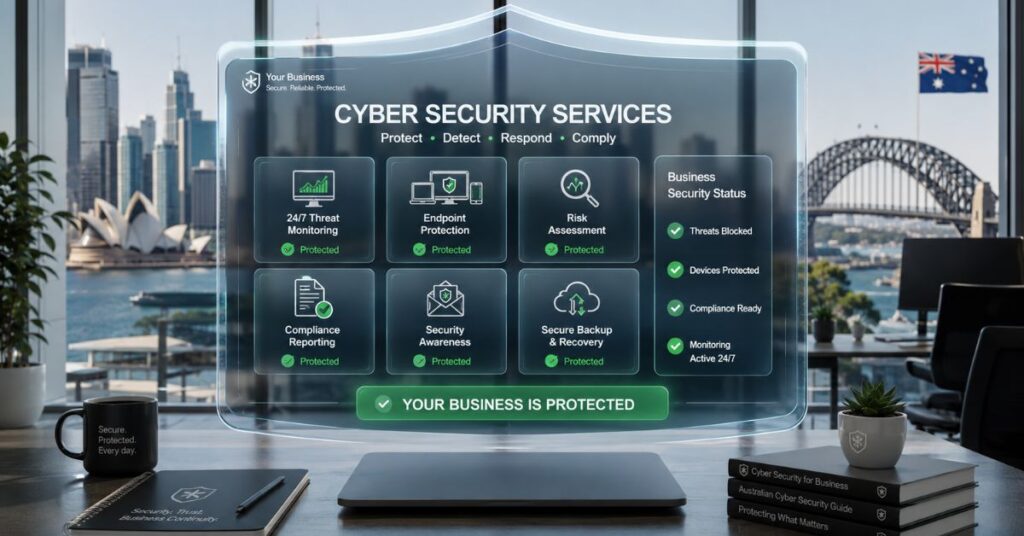
Cyber security services in Australia are the outsourced or in-house protections that keep a business’s systems, data, and operations safe from attack. That typically includes threat monitoring, endpoint protection, compliance support, and incident response.
For most Australian small and medium businesses, that means partnering with a provider who handles detection, response, and reporting so nobody in-house has to become a full-time security specialist. This guide breaks down what those services actually include, what they cost, and how to choose a provider that fits a business with 1-50 staff rather than an enterprise IT budget.
Why Cyber Security Services Matter for Australian Businesses Right Now
The numbers from the Australian Signals Directorate’s (ASD) Annual Cyber Threat Report 2024–25 make the case better than any sales pitch. ASD received over 84,700 cybercrime reports in the 2024–25 financial year, one every six minutes. The average self-reported cost of cybercrime per report for businesses jumped 50% to $80,850. Small businesses alone reported an average cost of $56,600 per incident, up 14% on the year before; medium businesses reported $97,200, and large businesses $202,700.
It isn’t just financial loss, either. Under the Notifiable Data Breaches (NDB) scheme, the Office of the Australian Information Commissioner (OAIC) recorded 532 data breach notifications between January and June 2025, with 59% caused by malicious or criminal attacks. For a business without a documented incident response process, that’s not just a security problem; it’s a compliance one.
This is exactly the gap cyber security services are built to close: continuous monitoring to catch problems early, and a documented response process for when something does go wrong.
What Do Cyber Security Services in Australia Actually Include?
“Cyber security services” isn’t one product; it’s a stack of individual services that a provider typically bundles together. Here’s what that stack usually covers:
Managed Detection and Response
Managed detection and response combines round-the-clock monitoring with human analysts who investigate and respond to threats in real time, rather than just flagging an alert and leaving it for someone to check on Monday.
Endpoint Detection and Response (EDR)
Endpoint detection and response protects laptops, desktops, and servers by watching for attacker behaviour, not just known malware signatures, across every device connected to the business.
Cyber Security Risk Assessments
A cyber security risk assessment identifies where a business is actually exposed before committing budget to new tools, mapping vulnerabilities across systems, data handling, and third-party access.
Compliance Reporting
For businesses that need to demonstrate adherence to a framework, compliance reporting turns technical security work into documentation that satisfies auditors, insurers, and regulators.
Security Awareness Training
Since phishing remains the most common entry point for attackers, security awareness training teaches staff to recognise and report suspicious emails, links, and requests before they become a breach.
Secure Data Storage
Secure data storage protects and backs up business-critical data so it can be recovered quickly and isn’t sitting exposed on unmanaged or unencrypted systems.
Managed Cyber Security Services vs In-House vs Traditional IT Support
Not every business needs the same delivery model. The right fit comes down to budget, risk profile, and whether the business already has internal IT capacity.
| Managed Cyber Security Services | In-House Security Team | Traditional IT / MSP Support | |
| Cost structure | Predictable monthly fee, usually per endpoint | High fixed cost (salaries, tooling, training) | Often bundled into a general IT retainer |
| 24/7 coverage | Available, often as an add-on tier | Rare for SMB-sized budgets | Rarely included as standard |
| Compliance support | Built into the service | Requires a dedicated specialist hire | Usually handled ad hoc, if at all |
| Time to deploy | Days, not months | Weeks to months for hiring and onboarding | Varies, security is often not the priority |
For a business with 1–50 staff, a managed cyber security services provider generally delivers the strongest coverage-to-cost ratio: enterprise-grade tooling and 24/7 monitoring without the overhead of building a security team from scratch.
How Much Do Cyber Security Services Cost in Australia?
There’s no single figure that applies across the board; cost depends on endpoint count, whether monitoring runs 24/7, and how many compliance frameworks a business needs to report against. As a general guide, managed per-endpoint plans in the Australia/New Zealand market typically range from the mid-double digits up to $100+ per endpoint per month, depending on coverage level, with additional compliance frameworks usually priced separately. Businesses in regulated industries (finance, healthcare, professional services) should expect costs toward the higher end, since audit-ready reporting adds overhead that a basic monitoring plan doesn’t include.
The most reliable way to get an accurate number is a provider-led assessment rather than a generic online calculator, since pricing tends to hinge on details a self-service tool can’t capture.
The ACSC Essential Eight: Australia’s Cyber Security Baseline
The Essential Eight is ASD’s set of prioritised mitigation strategies for protecting internet-connected systems: application control, patching applications, configuring Microsoft Office macro settings, user application hardening, restricting administrative privileges, patching operating systems, multi-factor authentication, and regular backups.
It isn’t legally mandatory for every private business. Still, it is the practical starting point most Australian cyber security providers build their service around, and it’s increasingly expected in government contracts, insurance applications, and client due diligence. ASD defines maturity levels from Zero through Three, letting a business scale its implementation to its actual risk profile rather than over- or under-investing.
How to Choose a Cyber Security Services Provider in Australia

A few things separate a genuinely useful provider from one that’s just reselling software licences:
- Local compliance knowledge: A provider should understand the Australian Privacy Act 1988 and Essential Eight, alongside frameworks like ISO 27001, SOC 2, HIPAA, GDPR, and PCI DSS, not just generic international standards.
- Transparent, flexible pricing: Month-to-month terms without long lock-in contracts matter more for a growing SMB than a discounted multi-year deal.
- Fast, documented onboarding: A provider should be able to tell you exactly how many days it takes to get baseline protection active, not a vague “it depends.”
- Coverage that scales with the business: The right provider offers a clear path from basic endpoint protection up to full compliance reporting, so a business doesn’t have to switch providers as it grows.
Frequently Asked Questions
What are cyber security services?
Cyber security services are the tools and expertise for monitoring, endpoint protection, risk assessments, compliance reporting, and incident response, that a business uses to detect, prevent, and recover from cyber attacks, typically delivered by a specialist provider rather than built entirely in-house.
How much do cyber security services cost in Australia?
Cost depends on endpoint count, coverage level (business-hours vs 24/7), and how many compliance frameworks are involved. Businesses should treat any published figure as a general guide and get a tailored quote based on their actual environment.
Is the ACSC Essential Eight mandatory for Australian businesses?
It isn’t legally mandatory for every private business, though government contracts, sector regulation, or client due diligence may require it. Even where it isn’t required, it’s the recognised technical baseline most providers use to structure their services.
What’s the average cost of a cyber attack for an Australian small business?
According to ASD’s Annual Cyber Threat Report 2024–25, the average self-reported cost of a cybercrime incident for a small business was $56,600, up 14% on the previous year.
Do Australian businesses have to report a data breach?
Businesses covered by the Privacy Act 1988 must notify affected individuals and the OAIC of an “eligible data breach” under the Notifiable Data Breaches scheme, where unauthorised access or disclosure of personal information is likely to result in serious harm.
What’s the difference between managed cyber security services and an in-house security team?
Managed services deliver monitoring, tooling, and expertise through an external provider for a predictable monthly cost. An in-house team gives more direct control but requires hiring, training, and maintaining specialist staff, a cost most SMBs can’t justify for round-the-clock coverage.
How quickly can a business get protected once it signs up with a provider?
Timelines vary by provider, but well-run onboarding processes typically get baseline endpoint protection active within days, not weeks, with fuller coverage rolled out over the following one to two weeks.
Is Your Business Actually Protected?
Cyber security services in Australia aren’t a single purchase; they’re an ongoing relationship between a business and a provider who’s watching its systems every day, not just when something breaks. With cybercrime costs rising sharply across every business size in Australia, the businesses in the strongest position are the ones treating security as infrastructure, not an afterthought.
If it’s been a while since your business had its security setup properly reviewed, book a consultation with CyberMark Agency to see exactly where the gaps are and what closing them actually costs. Not ready for that conversation yet? Start by browsing the services above to see which gaps apply to your business first.
Need help reducing your business security risk?
Contact us

