Top 5 Cyber Security Companies in Australia for 2026
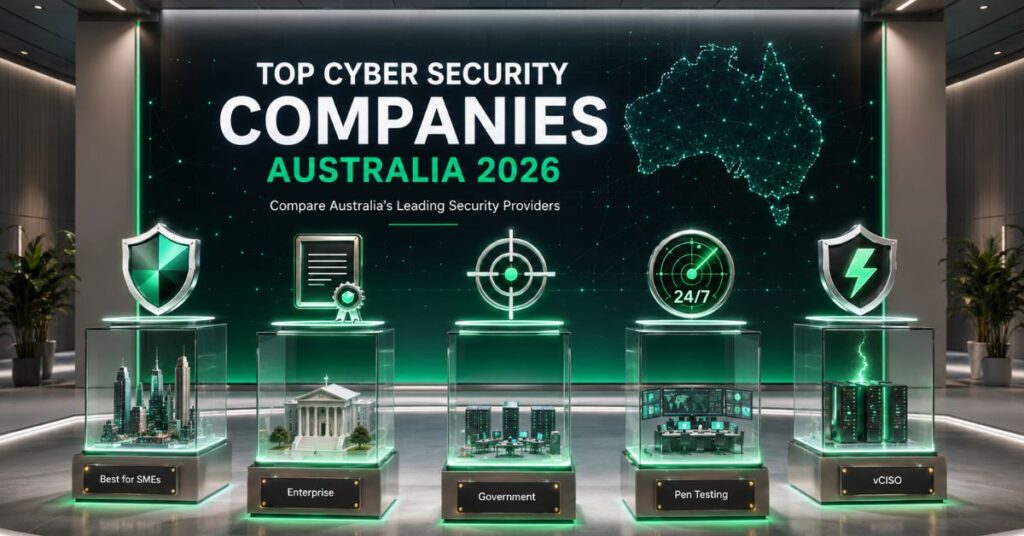
CyberMark Agency, CyberCX, Gridware, Tesserent (Thales Cyber Services ANZ), and Borderless CS are the top cyber security companies in Australia for 2026, each suited to a different type of business. Some are built for enterprise and critical infrastructure, others for government-regulated environments, and CyberMark is built specifically for small businesses with 1 to 50 staff. This guide compares each on service depth, specialisation, and business size fit, so you can shortlist the right provider by what your business actually needs, not by who ranks first.
Why Choosing the Right Cyber Security Company Matters in 2026
Cyber risk in Australia has moved past the point where it’s a background IT concern. According to the Australian Signals Directorate’s Annual Cyber Threat Report 2024–25, ASD’s Australian Cyber Security Centre (ACSC) notified organisations of potentially malicious activity more than 1,700 times during the year, an 83% jump from the previous period. Businesses reported an average self-reported cost of $80,850 per cybercrime report, up 50% year-on-year, while small businesses specifically saw average costs rise 14% to $56,600 per report.
Those figures explain why choosing a cyber security company in Australia is no longer just about installing antivirus software. Businesses now need continuous managed detection and response, documented compliance, and a provider that understands their size and risk profile. A national enterprise-grade provider and a 12-person retail business have very different needs, and the “best” cyber security company depends on which category you fall into.
How We Evaluated These Cyber Security Companies
Each provider was assessed on breadth of service (detection, compliance, testing, or all three), fit for SME versus enterprise clients, local operational presence, coverage of frameworks like the Essential Eight and APRA CPS 234, and pricing transparency. Providers aren’t ranked by size alone; a large national provider isn’t automatically the right fit for a 15-person business, and a small business specialist isn’t right for a listed enterprise with critical infrastructure obligations.
Top Cyber Security Companies in Australia (2026 List)
Here’s how each provider stacks up, from small business specialists to enterprise and government-grade security firms.
1. CyberMark Agency – Best for Small Businesses (1–50 Staff)
CyberMark Agency is a managed cyber security service provider built specifically for small businesses across Australia and New Zealand, rather than a scaled-down enterprise offering. Its model centres on affordable, month-to-month plans with no lock-in contracts, 48-hour baseline protection, and full deployment within 5 to 7 business days. Its security compliance service covers ISO 27001, SOC 2, HIPAA, GDPR, PCI DSS, and the Australia Privacy Act 1988 alongside the NZ Privacy Act 2020, which matters for AU/NZ businesses handling data across both jurisdictions.
For a business with 1 to 50 staff and no dedicated IT security team, this is the practical difference: instead of paying for enterprise complexity you don’t need, you get endpoint protection, monitoring, firewall hardening, and security awareness training under one predictable monthly fee, without competing with the enterprise SOC providers below on scale.
Best for: Small businesses (1–50 staff) that need affordable, all-in-one managed cyber security without enterprise overhead.
2. CyberCX – Best for Large Enterprise & Critical Infrastructure
CyberCX is one of the largest cyber security firms in the Asia-Pacific region, formed in Melbourne in 2019 through the merger of a dozen boutique security firms. In February 2026, Accenture completed its acquisition of CyberCX in a deal reported at more than A$1 billion, Accenture’s largest cyber security acquisition to date. CyberCX runs security operations centres across Australia and New Zealand, with roughly 1,400 professionals delivering consulting, managed security, and incident response.
Best for: Large enterprises and critical infrastructure organisations needing full-spectrum managed security at a national scale.
3. Gridware – Best for Penetration Testing & Incident Response
Gridware is a Sydney-founded cyber security company operating as an ASD-accredited industry partner, giving it direct access to ACSC threat intelligence feeds. Its service portfolio centres on penetration testing that goes beyond basic compliance checklists, alongside digital forensics and incident response, making it a fit for organisations that need offensive security testing and rapid breach response.
Best for: Mid-to-large businesses prioritising penetration testing and incident response capability.
4. Tesserent (Thales Cyber Services ANZ) – Best for Government & Regulated Industry
Tesserent was acquired by French defence and technology group Thales in 2023 and now operates as Thales Cyber Services ANZ. It delivers end-to-end cyber security across Australia and New Zealand, with a strong presence in government, defence-adjacent, and critical infrastructure work, a natural fit for organisations that need to demonstrate government-grade compliance, not just general best practice.
Best for: Government agencies and heavily regulated organisations needing defence-grade compliance and managed detection and response.
5. Borderless CS – Best for CREST-Accredited Offensive Security
Borderless CS is a CREST-accredited cyber security company offering offensive security, managed security services, and 24/7 SOC monitoring. CREST accreditation is an internationally recognised quality standard for penetration testing and red teaming, which matters for businesses that need externally verified assurance around their testing provider, not just a self-reported capability statement.
Best for: Businesses that specifically require CREST-accredited penetration testing and red teaming alongside managed SOC services.
6. Siege Cyber – Best for vCISO & Red Teaming
Headquartered in Brisbane, Siege Cyber specialises in penetration testing, red teaming, and virtual CISO (vCISO) services for organisations that want senior security leadership on a fractional basis rather than a full-time hire. It’s a common fit for growing mid-market businesses that need strategic security direction without the cost of an in-house CISO.
Best for: Mid-market businesses that need a fractional CISO-level strategy alongside technical testing.
Comparison Table: Cyber Security Companies in Australia at a Glance
| Company | Best For | Specialisation | Local Presence |
| CyberMark Agency | Small businesses (1–50 staff) | Managed detection, compliance, and endpoint security | Australia & New Zealand |
| CyberCX (part of Accenture) | Large enterprise & critical infrastructure | Full-spectrum managed security, consulting | Australia & New Zealand, plus London/New York |
| Gridware | Penetration testing & incident response | ASD-accredited testing, digital forensics | Sydney-based |
| Tesserent (Thales Cyber Services ANZ) | Government & regulated industry | Defence-grade managed security & compliance | Australia & New Zealand |
| Borderless CS | CREST-accredited offensive security | Penetration testing, 24/7 SOC | Australia-based |
| Siege Cyber | vCISO & red teaming | Fractional CISO, red teaming | Brisbane-based |
What to Look for in an Australian Cyber Security Company

Not every provider on a “top cyber security companies” list will suit your business, so it helps to filter by what actually matters for your situation:
- Essential Eight alignment: The ACSC’s Essential Eight is the baseline maturity framework most Australian providers are assessed against, particularly for government-adjacent work.
- APRA CPS 234, if you’re regulated: Financial services businesses need a provider that can speak fluently to this specific standard, not just general security compliance.
- Genuine 24/7 SOC capability: Confirm whether monitoring is truly round-the-clock or only during business hours.
- Local versus offshore delivery: A local cybersecurity company generally means faster response times and clearer accountability when something goes wrong.
- Transparent, no lock-in pricing: Ask for a straightforward monthly cost rather than a bundled enterprise quote that’s hard to compare.
A cybersecurity risk assessment is the fastest way to work out which of these actually apply to your business before you commit to a provider.
Essential Eight and APRA CPS 234: What Australian Businesses Need to Know
The Essential Eight is a set of eight baseline mitigation strategies developed by the Australian Signals Directorate, covering application control, patching, multi-factor authentication, and regular backups. It originated as a government standard but is increasingly used across finance, healthcare, and professional services as a practical due diligence benchmark. APRA CPS 234 sits alongside it as a mandatory prudential standard for APRA-regulated financial entities, requiring documented information security capability and regular control testing. The ACSC maintains full details on both frameworks at cyber.gov.au, the authoritative source rather than a provider’s summary.
How Much Do Cyber Security Services Cost in Australia?
Pricing varies by provider and service type. Enterprise-focused firms like CyberCX and Thales Cyber Services ANZ typically quote custom pricing based on scope, which can run into the tens of thousands annually. Specialist testing engagements from firms like Gridware, Borderless CS, or Siege Cyber are usually quoted per project. At the small business end, CyberMark’s plans start from a per-endpoint monthly rate with no lock-in contract, and compliance framework assessments are priced per framework rather than bundled into an opaque enterprise package.
Frequently Asked Questions
What are the top cyber security companies in Australia in 2026?
It depends more on your business size than on any fixed ranking. Enterprise providers, testing specialists, and small business managed security firms are solving completely different problems, so the “top” one is whichever matches your size and compliance needs.
What are the Big 4 cyber security firms?
That term usually points to the cyber security arms of Deloitte, PwC, EY, and KPMG, not a ranking of dedicated security vendors. Their work leans toward advisory and audit for large enterprises rather than the day-to-day monitoring that a managed provider does.
Is cyber security in demand in Australia?
Yes, and the numbers back it up. ASD logged over 84,700 cybercrime reports in its 2024–25 report, one every six minutes, with business costs up 50% in a year.
How do I choose a cyber security company for a small business?
Check three things before anything else: month-to-month terms, coverage of the compliance frameworks you actually need, and deployment measured in days, not weeks. A free risk assessment will tell you more than any website copy.
What is the Essential Eight?
It’s a set of eight baseline security controls from the Australian Signals Directorate covering things like patching, MFA, and backups. The goal is to block the most common attack methods before they get a foothold.
Do small businesses in Australia need managed cyber security?
If you handle customer data or take payments, yes, antivirus alone doesn’t cover that risk anymore. ASD puts the average cost of a small business cybercrime incident at $56,600.
Which Cyber Security Company Is Right for Your Business?
The right cyber security company comes down to matching provider scale to your actual risk and budget, not picking whichever name ranks first in search results. If your organisation needs national-scale SOC coverage, specialist penetration testing, or defence-grade compliance, enterprise and government-focused providers like CyberCX, Thales Cyber Services ANZ, Gridware, Borderless CS, or Siege Cyber are strong choices. If you’re running a small business with 1 to 50 staff and want affordable, fully managed protection without enterprise pricing or a six-week onboarding wait, that’s exactly what CyberMark Agency was built for.
Which category does your business fall into? Book a free security assessment with CyberMark Agency, a 15–30 minute call that gives you a clear picture of your current risk posture and a straightforward next step, whether you work with us or not.
Need help reducing your business security risk?
Contact us

