How much does Endpoint Security Cost in 2026?
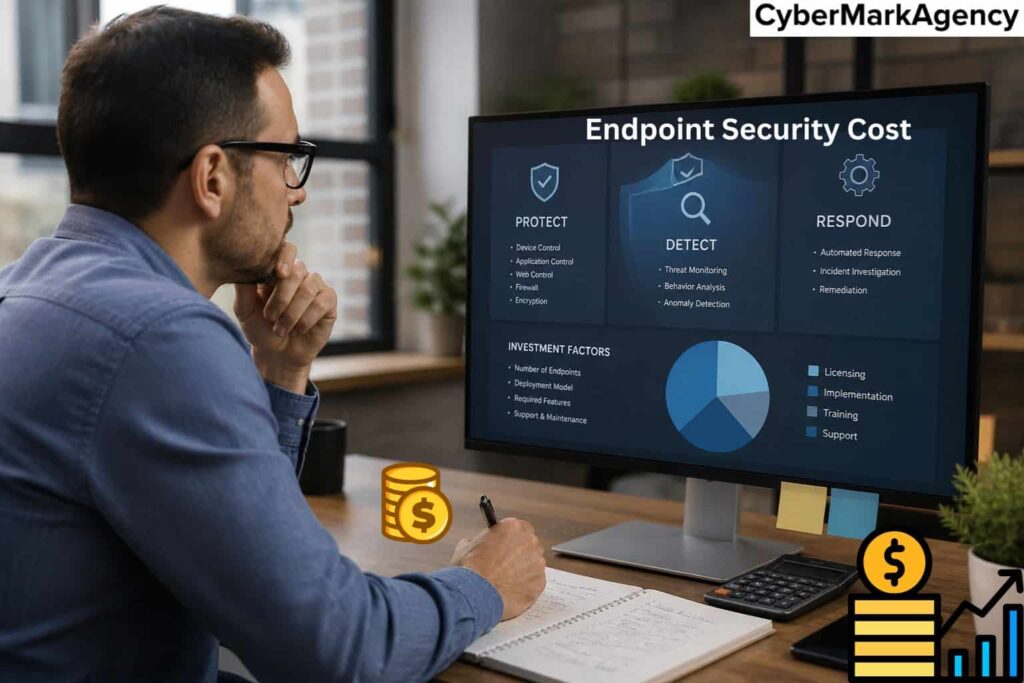
Endpoint security platform costs generally range from about $5 to $30 per user or device each month for small businesses. More advanced, enterprise-grade solutions often cost between $100 and $200 or more per endpoint per year. The exact price depends on the vendor, the level of protection (such as EDR, XDR, or MDR), and the total number of devices being secured.
We will consider different pricing models, their key elements, the factors affecting the price of endpoint security, and some methods of making the proper decision about purchasing the needed solution.
That shift explains why endpoint security now includes:
- Real-time threat detection
- Behavioral analysis
- AI-driven monitoring
- Incident response
- Centralized management dashboards
More features mean more complexity and naturally higher costs.
But a higher cost does not always mean better protection. The key lies in understanding what you actually need.
Average Endpoint Security Cost in 2026
| Security Type | Cost per device/month | Best for | Key Features |
| Basic Endpoint protection | $2-$6 | Small business, low risk | Antivirus, basic malware protection |
| Advance Endpoint Security (EPP) | $6-$12 | Growing business | Threat detection, firewall management, and device control |
| Endpoint Detection and Response(EDR) | $10-$25 | Mid-size companies | Real-time monitoring, threat hunting, and incident response tools |
| Managed Endpoint Security(MDR) | $25-$80+ | Business without a security team | 24/7 monitoring, human analysts, full incident response |
EDR Pricing Models: Per-User vs. Per-Device vs. Per-Auth-Event
The pricing table tells you what things cost. This tells you which model saves you money, because picking the wrong one can cost you 2–3x more at scale.
The three models plainly:
- Per-device: pay for every enrolled endpoint regardless of usage. Best for tightly managed, company-owned fleets.
- Per-user: pay per employee; license typically covers 2–5 devices per person. Best for BYOD or hybrid orgs.
- Per-auth-event: pay based on authentication volume. Common in identity-focused platforms. Dangerous if misapplied.
The math that matters:
500 employees, 3 devices each, plus 200 shared endpoints:
| Model | Calculation | Monthly Cost |
|---|---|---|
| Per-device | 1,700 × $12 | $20,400 |
| Per-user | 500 × $18 | $9,000 |
| Per-auth-event | 50K events/day × $0.002 | $3,000–$18,000+ |
Per-user wins here, unless the license caps devices below 3, which many do in fine print.
Call centers, shift workers, and healthcare environments generate 10–20x more auth events than standard offices, so always ask vendors for a 90-day auth event estimate before signing. Also, confirm in writing whether the per-user rate is truly flat; some vendors meter auth events above a hidden cap in the contract addendum.
What Drives Endpoint Security Pricing?
The cost of endpoint security is a rational calculation based on the number of devices, the degree of protection, and delivery methods.
- Volume Discounts: Generally, the higher the number of devices, the lower the cost per device. Vendors use tiered pricing structures to reward scale.
- Level of Intelligence: Basic solutions cost less because they focus on known threats. Advanced tools use behavioral analysis and predictive technologies to stop unknown “zero-day” attacks, which increases their value.
- Managed vs. Unmanaged: With unmanaged tools, your internal team handles monitoring and response. Managed Detection and Response (MDR) services provide a specialized external team. While MDR has a higher sticker price, it can save money by removing the need to recruit a full-fledged security team with six-figure salaries.
- Deployment Method: Cloud services typically charge monthly subscriptions, whereas on-premise solutions may require high upfront capital for hardware and maintenance.
- Compliance Requirements: Industries like healthcare and finance must follow strict regulatory standards (GDPR, HIPAA, PCI-DSS). Meeting these standards often requires more stringent security measures and higher expenses.
Such regulations include GDPR, HIPAA, and PCI-DSS. Compliance with these regulations results in more stringent security measures and higher expenses.
Reliable Endpoint Protection Platform Cost for Enterprises
Two platforms, both at $15/endpoint/month. Completely different breach outcomes. Price alone doesn’t tell you what a platform actually guarantees.
Tier-1 vendors retain 30–90 days of forensic telemetry versus 7 days or less on budget platforms, a gap that fails most regulatory breach investigations. They also include ransomware rollback capability, detection engine SLAs beyond just console uptime, and IOC updates every few minutes rather than hourly.
What enterprise buyers actually negotiate:
- Dedicated TAM (Technical Account Manager) for 1,000+ endpoint environments
- Industry-specific threat intel feeds tuned to your vertical, not generic global IOCs
- SLA credits when detection response time guarantees are missed
- Multi-year pricing locks, Vendr procurement data shows these contracts close 20–30% below list price
Realistic enterprise cost ranges:
| Protection Level | Cost per endpoint/month |
|---|---|
| EDR with forensic retention + rollback | $18–$28 |
| XDR (endpoint + identity + cloud) | $28–$45 |
| Fully managed MDR (vendor as your SOC) | $45–$80+ |
Anything well below these ranges warrants scrutiny of what was removed to hit that price.
Enterprise-Grade ITDR Solution Cost and Pricing Explained

Enterprise-Grade ITDR Solution Cost and Pricing
Most buyers search for ITDR (Identity Threat Detection and Response) as if it’s a standalone product. It rarely is, and that’s by design.
CrowdStrike bundles it through Falcon Identity Protection at an additional $6–$10/user/month on top of your existing subscription. Microsoft covers it partially through Entra ID P2 at ~$9/user/month, but only within the Microsoft stack. SentinelOne requires the Singularity Complete tier or above; it’s not available standalone below certain contract sizes. Vendors structure it this way to drive tier upgrades, not to welcome competing vendors into your environment.
When standalone ITDR makes sense: Buy dedicated ITDR (Silverfort, Vectra AI, or Semperis) when your EPP vendor’s identity module is weak, when you run hybrid AD + cloud environments a single vendor can’t fully cover, or when you need ITDR telemetry feeding a SIEM independently. Expect $12–$22/user/month for dedicated platforms.
The cost nobody puts in proposals: ITDR is ineffective in a dirty identity environment. Stale accounts, over-privileged service accounts, and undocumented AD groups generate excessive alert noise until remediated. Factor in 40–120 hours of identity cleanup at $150–$250/hour before your ITDR investment delivers a usable signal.
Hidden Costs You Should Not Ignore
Many businesses focus only on subscription pricing. That approach leads to surprises later.
Here are hidden costs you should plan for:
- Implementation Costs
- Training Costs
- Incident Response Costs
- Downtime Costs
According to IBM’s Cost of a Data Breach Report, the global average breach cost exceeds $4 million. Even small incidents can disrupt operations and damage reputation.
The relevance of this context when determining the pricing is evident.
EDR Contract Pricing: Setup Fees, SLAs, and Exit Clauses
The per-device rate is only part of what you’ll pay. The contract is where enterprises consistently get caught.
Onboarding fees by deployment size:
- 50-200 endpoints: $2,000-$8,000
- 200-1,000 endpoints: $8,000-$25,000 (higher with SIEM/SOAR integration)
- 1,000+ endpoints: $25,000-$50,000+
“Free onboarding” offers from vendors are typically amortized into your per-endpoint rate.
What SLAs actually cover (and don’t):
- “99.9% uptime” applies to the management console, not detection capability. Degraded detection performance typically falls outside SLA coverage.
- Detection response time guarantees are negotiated, not standard, and rarely offered unless you ask.
- “4-hour support response” usually means ticket acknowledgment, not an engineer actively working your issue.
Contract clauses to flag before signing:
- Auto-renewal windows of 90 days; miss the deadline and you’re locked in for another term
- Price escalation clauses of 3–7% annually, often discretionary rather than CPI-tied
- True-up provisions devices added beyond 10–15% of contracted count are billed at full list price, not your negotiated rate
Exit costs: Switching vendors costs more than most people expect. Forensic telemetry exports run $5,000–$15,000 for large environments. Custom detection rules and IOCs rarely transfer between platforms. And best-practice migration requires running both agents simultaneously for 30–60 days, meaning you pay two vendors at once.
Cost Comparison: In-House vs Managed Security

When firms consider their security needs, it will come down to either forming an internal team or adopting a managed security service.
This is an effective choice; however, the underlying cost dynamics differ significantly.
To create an internal team, an extensive investment will be necessary. An individual security analyst will cost around $80,000 to $120,000 per year.
However, that is not all. Many companies will require additional equipment and software for their employees, costing an additional $20,000 per year.
Additionally, costs will continue to accrue because of the constant learning and certification process. Consequently, costs will rise exponentially with the growth of the workforce.
On the other hand, the managed endpoint security is done on a subscription basis, with prices ranging from $30 to $80 per month for each device. Businesses are not required to employ and train a dedicated staff because all the tools and round-the-clock monitoring are provided externally.
The responsibility for dealing with possible threats goes to a specialized provider.
Managed security is often found to be more beneficial to small and medium-sized companies since they can leverage the expertise of trained professionals and high-end technology.
Selection of Endpoint Security System Based on Budget
The selection of an endpoint security system need not be based on its superiority but rather on the needs of your business and the risks associated with it.
First of all, evaluate the risks of your business activities. Take into account the kind of data that you store within the network and whether any remote working is practiced. Companies dealing with private user data and having a distributed infrastructure often require higher levels of security.
Secondly, determine your budget. Calculate the amount of money you will spend on each piece of equipment. Do not fall for marketing gimmicks such as product names and reputations without taking into account their suitability for your company.
After you determine your budget, focus on the capabilities rather than the price. Consider the capabilities needed, such as real-time monitoring, threat reaction, management tools, and whether they can work with your existing software. Although the lower-priced alternative may seem more attractive, failing to meet certain requirements could expose your company to risks.
Also consider the credibility of the manufacturer. Obtain feedback from reputable organizations such as Gartner and Forrester Wave. You should always be cautious of manufacturers who offer very low prices; it means their products are sub-standard.
The final phase will be testing out the product.
Most of the vendors that provide endpoint security solutions have a trial version or a demo mode available for users. Use this facility to test out the software’s functionality.
Here is a detailed guide on “How to Protect Your Business From Cyber Attacks in 2026“.
eBPF Security Platform Cost: Is It Worth the Premium?
If you’re securing Kubernetes clusters, containerized workloads, or Linux-heavy infrastructure, you’ve likely seen eBPF-based platforms come up. They work differently from traditional EDR and cost more; here’s why.
What makes them different: Traditional agents hook into OS security APIs from user space. eBPF platforms run inside the Linux kernel itself, giving them visibility into system calls, network events, and process behavior that user-space agents simply can’t see. Key vendors: Aqua Security, Sysdig (commercial Falco), Tracee, Elastic.
Why they cost more: Kernel-level instrumentation is technically complex, which means fewer vendors and less price competition. Most organizations also need a managed support layer on top because eBPF tooling requires Linux kernel expertise to tune effectively.
Pricing comparison:
- Open source Falco: free, but self-management overhead is substantial
- Commercial eBPF platforms (Sysdig, Aqua): $18–$40/node/month
- Traditional agent-based EDR on Linux servers: $8–$15/node/month
The real cost driver: Not the license, the skills gap. If your team lacks Linux kernel and container runtime expertise, add $150–$300/hour for external tuning and rule development.
Worth it when: You’re running Kubernetes at scale, your compliance regime demands syscall-level audit trails, or traditional EDR has persistent blind spots in your Linux environment.
For standard Windows/Mac endpoints and general servers, traditional EDR remains more cost-effective. eBPF earns its premium only in cloud-native, container-heavy environments.
FAQ About Endpoint Security Cost
Here are a few questions related to the cost of Endpoint Security:
1. What is the monthly fee for endpoint security?
The cost varies between $2-$80+ monthly per device. Antivirus software belongs to the less expensive ones, while managed detection and response services are the most costly because they require continuous support and surveillance.
2. What does Microsoft Defender for Endpoint P1 cost?
Microsoft Defender for Endpoint P1 is included in Microsoft 365 E3 packages or can be acquired separately for about $3 monthly per user. This option covers essential functions but doesn’t include such an option as threat hunting, which comes with other plans.
3. How much does a CrowdStrike EDR cost on average?
CrowdStrike Falcon pricing starts at approximately $8–$10/endpoint/month for the base Falcon Go plan and can reach $25+/endpoint/month for higher tiers with added modules. CrowdStrike does not publish official pricing; these figures are based on third-party procurement data and vary significantly by contract size, term length, and negotiated discounts.
4. What is the average Sentinel One price per endpoint?
SentinelOne pricing typically ranges from around $10/endpoint/month for the Core tier to $30+/endpoint/month for the Complete tier, which includes managed detection and response. SentinelOne does not publish official public pricing; these figures are based on third-party procurement data, and your actual quote will vary based on fleet size, contract length, and negotiated terms.
5. How much does Microsoft Defender for Endpoint cost in 2026?
Microsoft Defender for Endpoint comes in two tiers. P1 is available standalone at around $3/user/month or included in Microsoft 365 E3. P2 adds advanced threat hunting and automated investigation at approximately $5.20/user/month standalone. Most enterprises access the full suite through Microsoft 365 E5 licensing at around $57/user/month, which bundles Defender alongside other security and compliance tools.
6. How much does MDR cost for a small business with 50–160 users?
For a 50-device deployment, expect $500–$750/month in subscription costs with Huntress, putting true Year 1 spend at $7,500–$10,500 once setup is factored in. For 160 users with Sophos MDR, monthly subscription runs $2,400–$3,200, with a true Year 1 total of $33,000–$42,000. Per-device true cost across both sizes lands between $12–$22/month once onboarding and integration are included.
Sources:
- IBM Cost of a Data Breach Report 2025 – Average global breach cost hit $4.44M in 2025. Read the full report
- Verizon 2025 DBIR – 88% of ransomware incidents target smaller, underprepared organizations. View the report
- Sophos State of Ransomware 2025 – Average ransomware recovery cost was $1.53M in 2025, excluding the ransom. See the findings
- Vendr Procurement Data 2026 – Multi-year endpoint security contracts typically land 20–30% below list price. Explore pricing benchmarks
- Falconer Security MDR Pricing Guide – MDR users detected breaches 108 days faster, saving $1.76M per incident on average. See the breakdown
Need help reducing your business security risk?
Contact us