How to Choose the Right MDR Provider: Complete Buyer’s Guide
Choosing a managed detection and response (MDR) provider is one of those decisions that appears simple on paper but becomes complicated quickly once vendors start pitching. Every provider claims 24/7 coverage, fast response times, and “industry-leading” detection, but few back it up with real numbers.
If you’re wondering how to choose an MDR provider without being swayed by marketing claims, this guide provides the actual selection criteria, the questions that distinguish genuine partners from vendors selling recommendations instead of responses, and the red flags that should end a conversation before it begins.
MDR vs MSSP: Why the Difference Matters Before You Shortlist
Many buyers compare MDR pricing against traditional MSSP quotes and assume they’re buying the same thing at different price points. They’re not. An MSSP typically monitors and alerts; an MDR provider investigates and actively responds, often with contractual commitments around mean time to detect and contain. Getting this distinction wrong early leads to apples-to-oranges comparisons later in the evaluation, so confirm which model each vendor on your list is actually selling before you score them against the same criteria.
Key Criteria for Choosing a Managed Detection and Response (MDR) Vendor

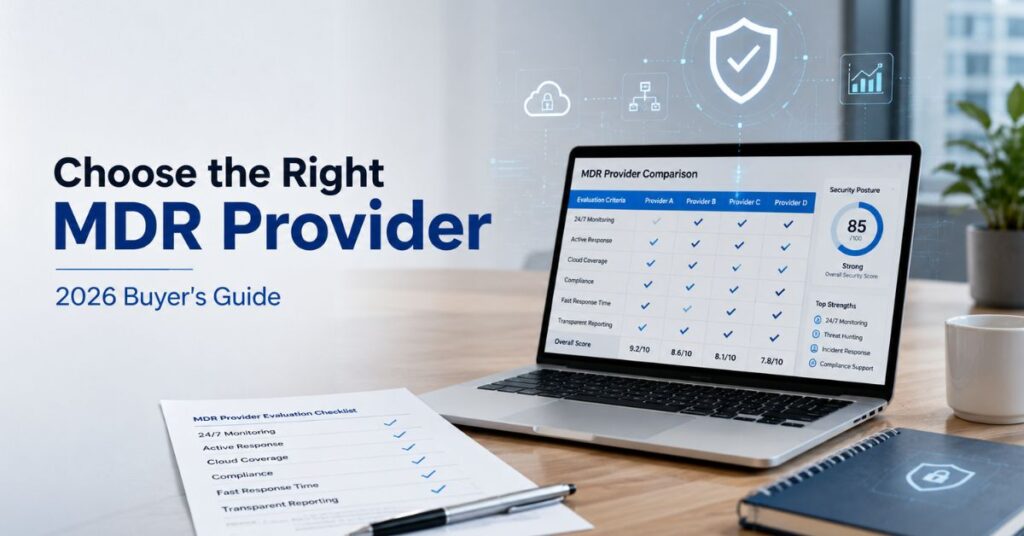
Security analysts and MDR providers alike tend to group evaluation criteria into four areas: technology coverage, detection and response capability, analyst expertise, and transparency. Treat vendor comparisons as a structured scorecard across these, not a feature-list skim.
1. Technology and Telemetry Coverage
Confirm the provider can ingest and correlate data across endpoints, cloud (AWS, Azure, GCP), identity, network, email, and SaaS applications, not just endpoints. A provider limited to agent-based endpoint monitoring will have blind spots the moment an attacker pivots to cloud infrastructure or identity-based lateral movement. Ask specifically how many third-party integrations the provider supports and whether you can keep your existing security stack rather than being forced into a “rip and replace” model.
2. Active Response, Not Just Alerts
This is the single biggest differentiator in MDR evaluations. Some providers only identify a threat and recommend action (“little r” response); others execute containment directly in your environment (“big R” response), isolating a host, killing a malicious process, or disabling a compromised account without waiting on your team. Active response has become the baseline expectation in mature MDR services, so any provider still operating recommendations-only should be treated as a downgrade, not a standard offering.
3. Analyst Expertise and Continuity
Ask whether you’ll work with a consistent team that learns your environment, or get routed to whoever is on shift. Analyst turnover, training depth, and 24/7 staffing quality vary enormously across providers, and this is the layer that determines whether incident reports feel generic or genuinely informed by your business context.
4. Transparency and Reporting
A provider that can’t show you real metrics, actual mean time to detect (MTTD) and mean time to respond (MTTR), not just SLA promises, is one you should be cautious about. Look for direct platform visibility into investigations as they happen, clear audit trails, and reporting that maps to your compliance reporting obligations rather than generic monthly summaries.
5. Compliance and Industry Fit
If you operate under HIPAA, PCI DSS, SOC 2, or ISO 27001, confirm the provider’s reporting and data handling practices actually map to those frameworks rather than offering generic templates. This matters more than it sounds: a provider unfamiliar with your regulatory environment will generate reports your auditors reject. CyberMark Agency builds detection and reporting workflows that align directly with SOC 2 and ISO 27001 requirements, which removes a step most generic MDR vendors leave to you.
Questions to Ask an MDR Provider
Generic RFP questions get generic answers. These questions tend to reveal more:
- What’s your actual MTTR on high/critical incidents, based on real customer data, not your SLA floor?
- Do you take direct action in my environment, or only send recommendations?
- What’s your current false positive rate, and how do you measure it?
- Can I watch an investigation happen in real time on your platform?
- Will I have a consistent analyst team, or am I routed to a shared pool?
- What happens if you make a mistake? Can you walk me through a real example?
- Do I need to purchase specific tools to use your service?
A provider that answers these specifically, with numbers, is worth continuing the conversation with. Vague answers to two or more of these questions are a signal to move to the next vendor on your list.
Red Flags When Evaluating MDR Vendors
Walk away from providers showing any of the following:
- Forced tool purchases: Requiring you to buy specific products as a condition of service, instead of working with what you already have
- Recommendations-only response: No active containment capability in your environment
- No platform visibility: You can’t see what their analysts are doing or why an alert was or wasn’t escalated
- Vague performance metrics: Refusal or inability to share real MTTD/MTTR/false positive data
- Limited integration support: Fewer than 20–30 supported security platforms
- No verifiable references: Can’t connect you with existing customers in a similar industry or size bracket
If a vendor hits two or more of these, it’s a strong signal to remove them from your shortlist regardless of price.
MDR Pricing: What to Expect
MDR pricing typically runs in the $10–$30 per endpoint, per month range, though what’s actually included at that price varies significantly between providers; some bundle active response and threat hunting, others charge extra for incident response hours or premium reporting. Before comparing quotes line by line, it’s worth reading our full breakdown of managed detection and response cost, which covers what drives price differences between vendors and what “per endpoint” pricing tends to hide.
How to Check MDR References Properly?
Vendor-supplied references are curated, so they’re a starting point, not the full picture. Ask specifically for references that match your company size, industry, and cloud maturity, and prioritize customers who’ve been with the provider two-plus years (to gauge consistency) alongside customers who recently onboarded (to gauge current implementation quality). Ask directly: how does actual performance compare to what was promised in sales conversations, and would they choose this provider again?
Leading MDR Providers Buyers Commonly Compare
NZ, AU, and US businesses shortlisting MDR typically compare a mix of full-service regional providers, since telemetry correlation and local SOC presence often matter more than deep integration with a single platform vendor.
| Provider | Best Fit |
| CyberMark Agency | NZ, AU, and US businesses needing full-service MDR matched to existing stack and compliance frameworks (SOC 2, ISO 27001, HIPAA) |
| AMARU | AU and NZ businesses running a mixed security stack that want MDR layered on without a rebuild |
| Bastion Security | Mid-market to enterprise NZ/AU businesses wanting a named lead analyst and forensic-grade incident response |
| Simplify Security | NZ SMBs wanting flexible, open-term MDR with no long-term lock-in |
| Spark NZ | Large NZ enterprises and government bodies needing enterprise SOC scale and NZISM-aligned intelligence |
If your business already runs on Microsoft Sentinel, providers like Spark NZ and Bastion Security build MDR directly on that ecosystem, which simplifies integration. If you want one provider correlating telemetry across a mixed toolset without forcing a platform switch, full-service options like CyberMark Agency or AMARU are built for that. For a full side-by-side breakdown of these five providers, see our comparison of the best MDR providers in New Zealand.
Frequently Asked Questions
Who are the leading MDR providers?
Commonly evaluated providers include CyberMark Agency, Rapid7, CrowdStrike, SentinelOne, Arctic Wolf, Sophos, and Palo Alto Networks, alongside regional MDR providers, with fit depending on existing tech stack and company size.
What is an MDR provider?
An MDR provider delivers 24/7 threat detection, investigation, and active response by combining security technology with human analysts who monitor and act on threats across your environment.
Is MDR better than EDR?
MDR extends EDR with 24/7 human-led monitoring, investigation, and active response across your full environment, making it a better fit for teams without an in-house SOC.
Which is the best MDR provider?
There’s no single “best” provider; the right fit depends on your existing security stack, compliance requirements, company size, and whether you need full-service or endpoint-led MDR.
How much does MDR cost?
MDR typically runs $10–$30 per endpoint per month, though what’s included at that price varies widely between providers.
What’s the difference between MDR and SIEM?
A SIEM collects and correlates security logs but doesn’t investigate or respond on its own. MDR adds 24/7 human analysts who actively investigate alerts and contain threats, often using a SIEM as one data source among several.
How should I compare MDR pricing between vendors?
Don’t compare vendors on price alone. Look at what’s included: 24/7 monitoring, active response, threat hunting, compliance reporting, and incident response. Also, ask about additional costs like onboarding fees or premium reporting. The best MDR provider offers the strongest overall value, not just the lowest monthly price.
Your Next Step in Choosing an MDR Provider
A strong shortlist comes down to a short list of non-negotiables. Confirm telemetry coverage across your full environment, not just endpoints. Confirm the provider takes an active response rather than sending recommendations. Ask for real MTTD and MTTR numbers, not SLA floors. Check that compliance reporting maps to your specific regulatory framework. Review contract terms for flexibility around termination and scope changes. And speak with at least two references that match your company size and industry.
Choosing the right MDR provider isn’t about finding the vendor with the longest feature list; it’s about finding the one that can prove, with real numbers and real references, that they’ll act fast and act correctly when it matters.
CyberMark Agency works with NZ, AU, and US businesses to evaluate and implement managed detection and response that’s matched to your existing stack and compliance requirements, not a generic template. Get in touch for a free environment review and find out what MDR coverage actually looks like for your business.
Need help reducing your business security risk?
Contact us

