Understanding Insider Threats: Risks & Cyber Solutions
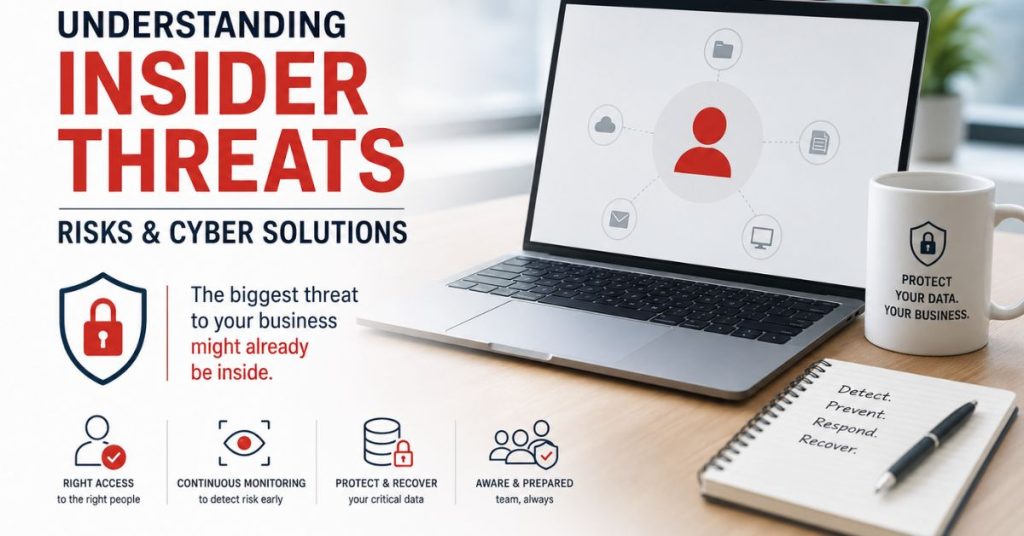
An insider threat is a security risk that comes from someone with legitimate access to your business, an employee, contractor, or vendor, rather than an outside attacker breaking in. That access is exactly what makes insider threats so hard to catch: the person triggering the incident is already inside your systems, using credentials your business gave them.
For a small or mid-sized business, that’s a bigger problem than it sounds. Enterprises run dedicated security teams that watch for unusual behaviour around the clock; most SMBs don’t have that layer, so an insider threat can sit undetected for weeks before anyone notices. This guide covers what counts as an insider threat, the three main types, the warning signs to watch for, and the cyber solutions that actually reduce your exposure.
What Is an Insider Threat?
An insider is anyone who has been granted legitimate access to your business, not just full-time employees. That includes contractors, vendors, business partners, and former staff whose accounts weren’t disabled after they left. Each of these insider threat actors has one thing in common: they don’t need to break through your firewall, because they’re already on the inside.
This is what separates insider threats from a typical external attack. An outside hacker has to find a way in. An insider already has the door open; whether they’re using that access appropriately, carelessly, or maliciously is the question your security posture needs to answer.
The 3 Main Types of Insider Threats
Most insider threats fall into one of three categories. Understanding which one you’re dealing with changes how you detect it and how you respond.
Malicious Insider Threats
A malicious insider deliberately misuses their access to harm the organisation, stealing data before resigning, leaking intellectual property to a competitor, sabotaging systems out of resentment, or colluding with an external attacker for financial gain. This category is less common than the other two, but often the most damaging, since the person already knows exactly where your valuable data lives.
Negligent Insider Threats
A negligent insider threat isn’t about intent; it’s about carelessness. This is the employee who clicks a phishing link, sends a client file to the wrong email address, reuses a weak password across systems, or ignores a software update. Ponemon and DTEX’s 2026 research found that negligent insiders now cost organisations an average of US$10.3 million annually, a 17% year-over-year increase, making this the category responsible for the bulk of insider-related losses despite involving no bad intent at all.
Compromised Insider Threats
A compromised insider threat happens when an outside attacker steals a legitimate employee’s credentials, usually through phishing or credential-stuffing, and then operates inside your systems as if they belong there. This is arguably the hardest category to catch: the activity comes from a real, trusted account, so nothing about the login itself looks unusual; only the behaviour that follows does.
Why Insider Threats Are a Growing Risk for Small Businesses
Insider risk isn’t shrinking, even as external attacks get more attention. The Verizon 2026 Data Breach Investigations Report found that internal actors appeared in 12% of breaches globally, a decline from 18% the year before, but still a meaningful share of incidents that businesses can’t afford to ignore, particularly given how costly each one tends to be once it happens.
A few shifts are driving this for smaller businesses specifically:
- Remote and hybrid work means staff, contractors, and vendors log in from more devices and networks than ever, widening where an insider incident can start.
- Cloud tool sprawl gives employees access to more systems and data than a single role may need, increasing the blast radius of both negligent and malicious activity.
- Third-party vendor access is now standard for most SMBs, but few track exactly what data each vendor can reach.
- Regulatory exposure is rising alongside these risks; insider-caused data breaches can still trigger the same security compliance obligations under frameworks like the NZ Privacy Act 2020 or the Australian Privacy Act 1988 as an external breach would.
Fewer dedicated security staff means fewer people watching for the anomalies that usually precede an insider incident, which is why detection needs to be built into your tools rather than left to manual review.
Warning Signs of a Potential Insider Threat
No single sign confirms an insider threat on its own, but a cluster of them is worth investigating. Watch for both behavioural and technical indicators:
- Unusual working hours with no clear business reason
- Sudden secrecy or defensiveness about their work or access
- Repeated policy pushback, especially around security protocols
- Access to data or systems outside their role
- Unusual volumes of file transfers or downloads, particularly of sensitive data
- Use of unauthorised personal devices or software to move company information
A potential insider threat rarely announces itself; it usually shows up first as a small deviation from someone’s normal pattern of behaviour, which is why continuous monitoring matters more than periodic manual checks.
Cyber Solutions That Reduce Insider Risk

None of these controls need to be enterprise-scale to work. For a business with 1–50 staff, the goal is to close the specific gaps insiders exploit, not buy more security tools than you can realistically manage.
Least-Privilege Access & Offboarding Controls
Give each role access only to what it actually needs, and revoke that access the moment someone leaves. Delayed offboarding is one of the most common, and most avoidable, insider threat failures: an account that should have been disabled on someone’s last day is still active weeks later, with nobody watching it.
Endpoint Detection & Behavioural Monitoring
Insider activity often looks legitimate on the surface, which is why behavioural monitoring matters more than signature-based antivirus. A 24/7 managed detection and response service tracks activity across your endpoints, network, and cloud platforms, correlating signals, like an unusual login time paired with a large file transfer, that a single tool would miss on its own.
Data Backup & Encryption
Whether an insider deletes files out of malice or by mistake, the outcome is the same without a safety net. Maintaining secure data storage means a deleted database or sabotaged file server is a recoverable inconvenience, not a permanent loss.
Security Awareness Training
Since negligent insiders cause the majority of insider-related cost, training is one of the highest-leverage controls available. A structured security awareness training program teaches staff to recognise phishing attempts, handle sensitive data correctly, and understand why security policies exist, directly reducing the human-error category of insider risk.
Building an Insider Risk Response Plan
A response plan doesn’t need to be complicated, but it does need to exist before you need it. Four steps cover the essentials:
- Detect: Monitor for the warning signs outlined above, ideally through automated tools rather than manual spot-checks.
- Investigate: Confirm whether flagged activity is a false positive before taking action, so you don’t damage trust with legitimate staff over a misread signal.
- Contain: Suspend access immediately once a threat is confirmed, limiting how much data or how many systems are affected.
- Review: After any incident, revisit what allowed it to happen. A periodic cybersecurity risk assessment helps catch the access gaps and policy blind spots insider incidents tend to expose.
Frequently Asked Questions
What are the main types of insider threats?
Insider threats generally fall into three categories: malicious insiders who intentionally misuse their access, negligent insiders who cause harm through carelessness or mistakes, and compromised insiders whose accounts have been hijacked by an outside attacker.
How is an insider threat different from an external threat?
An external threat comes from someone who has to break into your systems, while an insider threat comes from someone who already has legitimate access. That existing access is what makes insider incidents harder to detect and often more costly to contain.
What are common insider threat warning signs?
Common warning signs include unusual login times, access to data outside someone’s normal role, large or unexplained file transfers, and the use of unauthorised personal devices to move company information.
How can small businesses prevent insider threats?
Small businesses can reduce insider risk by enforcing least-privilege access, disabling accounts immediately when staff or contractors leave, deploying behavioural monitoring tools, maintaining encrypted backups, and running regular security awareness training.
Can an insider threat be accidental?
Yes. Negligent insider threats involve no malicious intent at all, they happen when an employee makes a genuine mistake, such as clicking a phishing link or misdirecting a sensitive file, and they account for a large share of insider-related incidents.
Getting Ahead of Insider Risk
Insider threats don’t require a sophisticated attacker to do real damage; they just require access that goes unmonitored for too long. The businesses that manage insider risk well aren’t the ones with the biggest security budgets; they’re the ones with clear access controls, consistent offboarding, and monitoring that catches unusual behaviour before it becomes an incident.
If you’re not sure where your business currently stands on any of that, it’s worth finding out before an insider incident forces the question. Talk to CyberMark’s team about where your access controls and monitoring may need to catch up.
Need help reducing your business security risk?
Contact us

