Third-Party Risk Management: What It Is & Best Practices
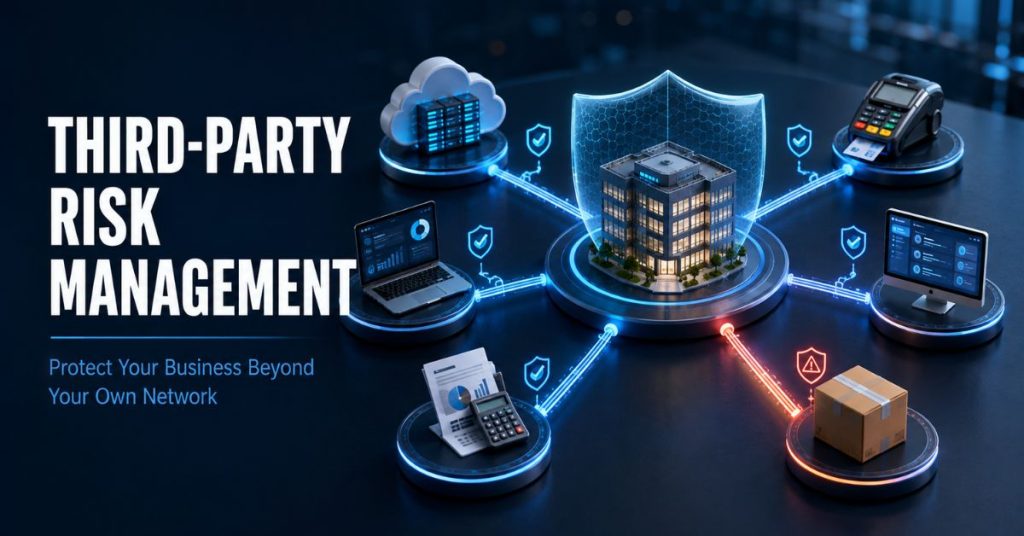
Third-party risk management (TPRM), also called vendor risk management or 3rd-party risk management, is the process of identifying, assessing, and controlling the security, compliance, financial, and operational risks that vendors, suppliers, contractors, and partners pose to a business.
It matters more than most small and medium businesses realise: Verizon’s 2026 Data Breach Investigations Report found that third-party involvement in breaches jumped 60% year-over-year and now accounts for 48% of all breaches, up from 30% the year before.
Key Components of a Third-Party Risk Management Program
A third-party risk management program is typically built around six components:
- Vendor inventory: A complete list of every third party and what each one can access
- Risk assessment: Evaluating cybersecurity posture, regulatory exposure, and financial stability
- Due diligence: Verifying claims through questionnaires, audits, and certifications like ISO 27001 and SOC 2
- Contractual controls: Security requirements, data protection clauses, and audit rights
- Ongoing monitoring: Tracking changes in a vendor’s risk profile over time
- Incident response: Aligning a vendor’s breach response with your own before something goes wrong
What Is Third-Party Risk Management (TPRM)?
Third-party risk management is the discipline of evaluating and controlling the risk posed by any external party with access to your systems, data, or operations, including software-as-a-service vendors, cloud providers, payment processors, contractors, and outsourced service providers.
The core objective isn’t to eliminate third-party relationships; it’s to understand what each one exposes you to, feed that exposure into your own risk register, and put proportional controls and audit-ready compliance reporting in place around it. A payroll processor handling employee bank details warrants far more scrutiny than an office supplies vendor with no system access.
You’ll also see the term vendor risk management (VRM) used almost interchangeably with TPRM. In practice, VRM tends to refer specifically to IT and technology vendors, while third-party vendor management is the broader umbrella term covering all external relationships, technical or not. Some businesses adopt dedicated vendor risk management solutions to automate scoring at scale, but for most small and medium businesses, a documented program that consistently covers both matters more than the label.
Why Third-Party Risk Management Matters for Small and Medium Businesses
Every business using a payroll provider, a cloud storage tool, or an outsourced IT contractor carries third-party exposure. If a vendor mishandles your data, the fallout, regulatory, financial, reputational, lands on you, not them. The Verizon statistic above isn’t a rare edge case; it’s the current baseline, driven largely by weak vendor authentication controls, poor credential hygiene, and misconfigured SaaS environments, not sophisticated nation-state attacks.
Australian regulators see the same pattern from the other side. The Office of the Australian Information Commissioner (OAIC) has repeatedly flagged multi-party data breaches, incidents that start with one vendor and cascade to every business relying on them, and recommends a documented supplier risk management framework to limit the impact when one occurs.
Small and medium businesses face the same mechanics as large enterprises, just through shorter vendor lists. A five-person accounting firm that uses a bookkeeping platform, an email provider, and an outsourced IT contractor has three separate risk surfaces, and a compromise at any one of them exposes client data as easily as a breach at a Fortune 500 supplier. Our breakdown of cyber security risks facing small NZ businesses names third-party and supply chain attacks among the five most common threats businesses face in 2026.
Types of Third-Party Risk

Not every vendor introduces the same kind of risk. Third-party risk generally falls into six categories:
- Cybersecurity risk: A compromised vendor becomes a direct entry point into your systems, often through stolen credentials or an insecure integration, a common blind spot in IT security risk management.
- Operational risk: A vendor outage disrupts your ability to deliver for your own customers.
- Compliance and regulatory risk: A vendor mishandles data in a way that breaches obligations under the NZ Privacy Act 2020, Australia’s Privacy Act 1988, or the GDPR, even if the mistake wasn’t yours.
- Reputational risk: Customers rarely distinguish “we were breached” from “our vendor was breached.” Either way, trust takes the hit.
- Financial risk: Remediation costs, contract penalties, and lost revenue following a vendor-side incident.
- Strategic risk: A vendor failure derails a business initiative that depended on their reliability.
A single vendor breach can trigger operational disruption, a notification obligation, and reputational damage all at once, which is why TPRM treats vendor evaluation as an ongoing function rather than a one-time checkbox.
The Third-Party Risk Management Process
A working third-party risk management program generally follows six steps, from first contact with a vendor through to the end of the relationship.
1. Build a Vendor Inventory
You can’t manage risk you haven’t mapped. This is an extension of your broader asset risk management: build a complete, up-to-date inventory of all vendors and contractors who have access to your systems or data.
2. Tier and Assess Risk
Not every vendor deserves the same scrutiny. Vendors are grouped into tiers based on data sensitivity, so high-risk vendors receive a more in-depth vendor risk assessment, while low-risk vendors undergo a lighter third-party risk assessment. A structured cybersecurity risk assessment methodology, the same likelihood-and-impact approach used for your own network security, applies directly to evaluating a vendor’s.
3. Due Diligence and Evidence Review
Rather than relying on self-attestation, request actual evidence: a current SOC 2 report, ISO 27001 certification, or a completed SIG (Standardized Information Gathering) or CAIQ (Consensus Assessments Initiative Questionnaire) for cloud vendors. A vendor claiming “we’re secure” carries far less weight than an independently verified audit of their third-party vendor security controls.
4. Onboarding and Contracts
Security expectations should be agreed to before a vendor gets access to anything. Contracts should spell out data-handling requirements, breach-notification timelines, audit rights, and other risk controls.
5. Continuous Monitoring
Risk doesn’t freeze at the signature date. A vendor’s posture, ownership, or subprocessors can change months into the relationship, so ongoing third-party risk monitoring, not just an annual review, is what catches drift before it becomes an incident.
6. Offboarding
When a vendor relationship ends, access needs to be formally revoked and data destruction confirmed. Offboarding gaps are among the most common and most preventable sources of lingering exposure.
Third-Party Risk Management Best Practices
The right risk management strategies turn a documented policy into a program that reduces exposure. Here’s what separates a functioning program from one that exists only on paper:
- Maintain a single, living vendor inventory: Scattered spreadsheets guarantee blind spots.
- Tier vendors by access and impact, not contract size: A low-cost vendor with data access deserves more scrutiny than an expensive one with none.
- Require evidence over attestation: Certifications and audit reports tell you more than a completed questionnaire. Our compliance readiness checklist covers the documentation a business should have ready and request from vendors.
- Monitor continuously, not just at renewal: Annual reviews miss the risk that emerges in between.
- Track program metrics: Number of high-risk vendors, average due-diligence turnaround time, third-party incident rate, and SLA compliance all show whether a vendor risk management program is working, not just documented.
- Document an offboarding process and follow it every time a relationship ends.
- Assign clear ownership: Third-party governance fails quietly when it’s “everyone’s job,” because that usually means it’s no one’s.
Compliance Frameworks That Support Third-Party Risk Management
Several established frameworks give structure to third-party compliance management instead of leaving it to guesswork. ISO 27001 and SOC 2 are the two most commonly requested certifications when evaluating vendor security posture. NIST SP 800-161 (Cybersecurity Supply Chain Risk Management) is built specifically for risk introduced through suppliers and complements the broader NIST Cybersecurity Framework (CSF). Businesses handling card payments should also confirm PCI DSS alignment for any vendor touching payment data.
Regulatory obligations vary by jurisdiction but consistently hold businesses accountable for how their vendors handle data, including the NZ Privacy Act 2020, Australia’s Privacy Act 1988, and GDPR for businesses handling EU resident data. If you haven’t mapped your obligations against what your vendors can demonstrate, a compliance gap analysis is the fastest way to find where the exposure sits.
How CyberMark Supports Third-Party Risk Management for Small and Medium Businesses
TPRM isn’t just about scrutinising your vendors, it’s also about making sure your own business isn’t the weak link in someone else’s chain. Every client or partner you work with is assessing you the same way you should be assessing them.
CyberMark’s managed detection and response services function alongside broader third-party risk management services and security risk management services, giving small and medium businesses in New Zealand a continuous network security risk assessment posture and rapid incident response, the same visibility a mature program expects from every vendor in its chain.
Frequently Asked Questions
Who is responsible for third-party risk management in an organisation?
Responsibility is usually shared: IT or security owns technical assessment, procurement owns vendor selection, and legal owns contract terms. One team should still hold overall risk oversight so nothing falls through the gaps between departments.
What is the difference between VRM and TPRM?
Vendor risk management (VRM) and third-party risk management are often used interchangeably, but VRM typically refers to IT and technology vendors specifically, while TPRM is the broader discipline covering every external party.
Is third-party risk management part of enterprise risk management (ERM)?
Yes. TPRM is a specialised subset of ERM focused on risk from external relationships, and it should feed into the organisation’s broader risk register rather than operate as a standalone function.
What is the NIST framework for third-party risk?
NIST SP 800-161 (Cybersecurity Supply Chain Risk Management) is the primary framework, built on the broader SP 800-53 supplier-risk controls, for a structured, auditable approach to vendor risk.
What two types of risk does TPRM typically consider?
Inherent risk (a vendor’s exposure before controls are applied) and residual risk (what’s left once controls and mitigations are factored in). Residual risk should drive tiering decisions.
Building a Sustainable Third-Party Risk Management Program
Third-party risk management isn’t a project with an end date, it’s an ongoing discipline that scales as your vendor list grows. The businesses that get it right treat vendor risk with the same rigor they apply to their own security: a clear inventory, proportional scrutiny, real evidence, and continuous attention rather than a once-a-year checkbox.
If you’re not sure where your business stands, whether as the one assessing vendors or the one being assessed, book a free security assessment with CyberMark’s New Zealand-based team to see where the gaps actually are.
Need help reducing your business security risk?
Contact us

