Managed SIEM vs Managed SOC Services in Australia Explained
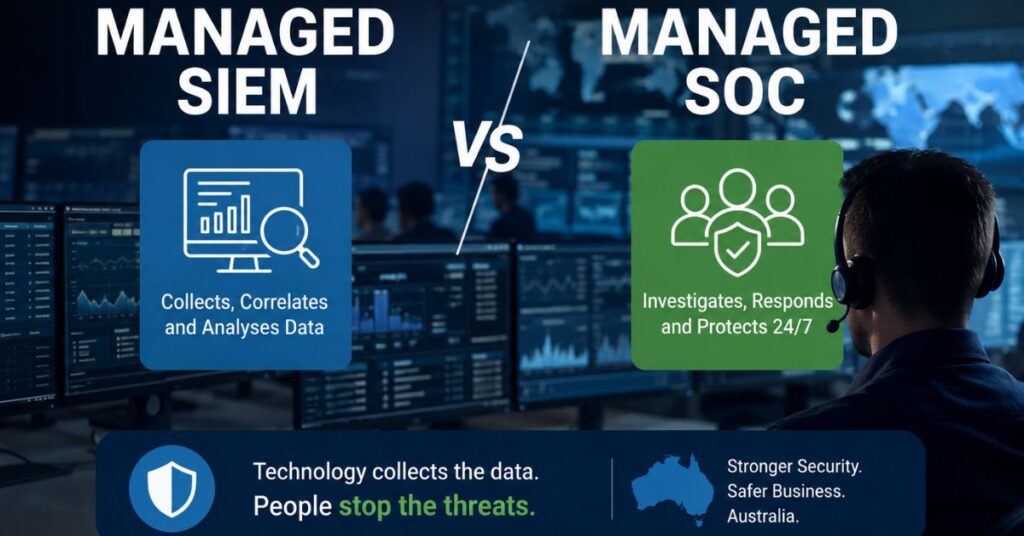
A Managed SIEM is a technology platform that collects, correlates, and analyses security log data from across your network. A Managed SOC is a team of security analysts who use that data, alongside other tools, to actively monitor, investigate, and respond to threats around the clock. For most Australian small businesses, the SOC’s human response layer matters more than the SIEM platform on its own, because a tool that only generates alerts still needs someone to act on them.
The two terms get used almost interchangeably in vendor marketing, which is part of why the decision feels confusing. They’re not competing options so much as two different layers of the same defence: one handles the data, the other handles the decisions. Understanding where each one starts and stops is the fastest way to work out what your business actually needs to pay for.
Quick Summary
Before going deeper, here’s the short version:
- SIEM is the technology that aggregates and correlates log data from your network, endpoints, and cloud platforms.
- SOC is the team of analysts who investigate what the SIEM flags and take action on confirmed threats.
- A SOC without a SIEM has limited visibility. A SIEM without a SOC just produces alerts that pile up unread.
- Australian small businesses lost an average of $56,600 per cybercrime report in FY2024–25, up 14% year-on-year, according to the Australian Signals Directorate’s Annual Cyber Threat Report 2024–25.
- Best-practice event logging is one of four priority actions the ASD names for lifting an organisation’s cyber resilience.
- Most Australian SMBs without a dedicated internal security team get more real-world protection from a managed SOC service than from a standalone SIEM subscription.
What Is a Managed SIEM?
Security Information and Event Management (SIEM) is a platform that pulls log and event data from firewalls, servers, identity providers, cloud services, and endpoints into a single, correlated view. It applies rules-based logic and behavioural analytics to spot patterns that look like an attack, a login from an unusual location, a spike in failed authentication attempts, or unusual data movement between systems.
A managed SIEM outsources the infrastructure and the tuning work to a third party, so you’re not running the platform yourself. What it typically doesn’t include is a dedicated team watching the alerts in real time. That distinction matters: a SIEM tells you something might be wrong. It doesn’t, by itself, tell you whether it’s serious or what to do about it. Many SIEM platforms ingest data from endpoint detection and response (EDR) tools as one of their core log sources, since endpoints are where most intrusions first show up.
What Is a Managed SOC?
A Security Operations Centre (SOC) is a dedicated team of analysts responsible for continuous monitoring, investigation, and response. A SOC combines SIEM-style technology with human judgement, threat intelligence, and predefined response playbooks. When a SIEM stops at the alert, a SOC picks it up from there, sorting it, deciding whether it’s a real threat, and taking action if it is.
Not every SOC looks the same. Some run 24/7 with dedicated analysts on shift; others operate business hours only and escalate after-hours incidents through an on-call process. The distinction that matters most for a small business is simple: is there a human being who will actually look at an alert at 2 am on a Saturday, or is it sitting in a queue until Monday?
Managed SIEM vs Managed SOC: Key Differences
| Factor | Managed SIEM | Managed SOC |
| What it is | A software platform | A team of analysts |
| Primary job | Collects, correlates, and logs security events | Investigates alerts and responds to threats |
| Human involvement | Vendor maintains the platform; your team (or you) triage alerts | Dedicated analysts triage and act on your behalf |
| Response to threats | Generates alerts but doesn’t contain the threat | Actively investigates, contains, and remediates |
| Compliance fit | Strong for audit logging and reporting | Strong for both active defence and reporting |
| Best suited to | Businesses with internal staff who can action alerts | Businesses without 24/7 in-house security capacity |
Framing this as strictly SIEM or SOC slightly misrepresents how the technology is actually used in practice. A SIEM is frequently one of the tools running inside a SOC, not a separate product competing against it. The more useful question for most businesses isn’t “which one”; it’s whether you have the internal people to act on what a SIEM tells you, because if you don’t, the platform alone won’t protect you.
How Managed SIEM and Managed SOC Work Together

The two function as a loop. The SIEM ingests logs from every connected source, normalises the data, and applies correlation rules to flag anomalies. Those flagged events are then reviewed by SOC analysts, who determine severity, investigate context, and either close the alert as benign or escalate it for containment. After an incident, the SIEM’s log history supports the forensic review that explains what happened and how to stop it recurring.
This is also where managed detection and response fits into the conversation. Many providers now bundle SIEM-style correlation, SOC monitoring, and active response into a single MDR service, rather than selling the technology and the team as separate line items. For a business trying to compare options, it’s worth checking whether a “SIEM” quote already includes SOC-level response, or whether that’s a separate cost you’d need to add.
Which Does Your Australian Business Need?
The right answer depends on what you already have in place, not on which acronym sounds more advanced.
- Choose SIEM-only if you already have an internal team capable of 24/7 alert triage and investigation, and your main driver is compliance-grade log retention rather than active defence.
- Choose a Managed SOC if you don’t have staff available to monitor and respond after hours, and you want threats actively stopped rather than just flagged.
- Choose a bundled service if you want both visibility and response without building either function internally; the most common fit for Australian businesses under 50 staff, where hiring a dedicated security team isn’t realistic. This is often where MDR for Australian businesses becomes the more practical starting point than shopping for SIEM and SOC separately.
Managed SIEM, Managed SOC, and Australian Compliance
Compliance is where this decision has real teeth for Australian businesses. Event logging is explicitly named by the ASD as one of the priority actions organisations should take to strengthen their cyber security posture, and a SIEM is the most direct way to meet that requirement; it’s built to centralise and retain exactly the kind of log data that regulators and auditors expect to see.
The SOC side matters for a different reason. Under the Australia Privacy Act 1988 and the Notifiable Data Breaches scheme, businesses that experience a data breach involving personal information may be required to report it, and the documentation a SOC produces during an incident shows what was detected, what was contained, and when is often the evidence you need to meet that obligation. Cyber insurers are also increasingly asking whether 24/7 monitoring is in place before offering favourable terms, which pushes the decision beyond just “nice to have.” If compliance is a primary driver for your business, it’s worth reviewing security compliance support options that map directly to the frameworks you’re being assessed against.
Managed SIEM vs Managed SOC Cost in Australia
Pricing for both services depends on a handful of variables rather than a flat rate: daily log ingestion volume, the number of connected log sources, how long data needs to be retained, and whether coverage is business-hours or 24/7. As a general rule, 24/7 human coverage is the single biggest cost driver in a Managed SOC quote, not the underlying software, which is often the smaller line item.
Outsourcing either function typically costs less than building it in-house once you account for the real cost of staffing around-the-clock coverage, which usually requires multiple full-time analysts to cover shifts, leave, and turnover. Because pricing varies significantly by provider and scope, it’s worth getting a scoped quote based on your actual log sources and coverage needs rather than comparing headline numbers between providers.
How to Choose a Managed SIEM or Managed SOC Provider in Australia
Before signing with any provider, a short list of questions will tell you more than their marketing page will:
- Where is your log data stored, and does that meet your data residency requirements?
- What’s the actual response SLA for a confirmed critical alert?
- Is monitoring genuinely 24/7, or business-hours with after-hours escalation only?
- Which compliance frameworks does their reporting map to?
- What happens during onboarding, and how long until you have full coverage?
Getting straight answers to these before you commit is the difference between paying for a service and paying for a brochure. If you’re weighing multiple options, it helps to look at providers side by side on response times, coverage hours, and compliance mapping rather than comparing feature lists in isolation.
Frequently Asked Questions
Do I need a Managed SOC if I already have a Managed SIEM?
In most cases, yes. A SIEM generates alerts, but without a SOC, internal or outsourced, someone still needs to review, prioritise, and act on every one of those alerts, including outside business hours.
Does a Managed SIEM satisfy Essential Eight logging requirements?
A SIEM directly supports the event logging control within the Essential Eight maturity model, since it centralises and retains log data. Full alignment with a specific maturity level still depends on which log sources are connected and how long data is retained.
Is my data safe with an offshore Managed SOC?
This depends entirely on the provider, not the SOC model itself. Ask specifically where log data is stored and processed, since data residency requirements vary by industry and by the compliance frameworks your business needs to meet.
Why is a Managed SOC typically more expensive than SIEM alone?
Staffing 24/7 human coverage, multiple analysts rotating shifts, holidays, and turnover is the dominant cost in any SOC service. The underlying technology is usually a smaller portion of the total price.
What questions should I ask a Managed SOC provider before signing?
Ask about response SLA for critical alerts, where your data is stored, which compliance frameworks their reporting covers, and what onboarding looks like before you have full coverage. These four answers reveal more about actual service quality than any feature list,
SIEM or SOC: Which One Actually Protects Your Business
SIEM and SOC solve different problems; one gives you visibility, the other gives you a response. For the vast majority of Australian small businesses without a dedicated internal security team, a standalone SIEM leaves a gap: you’d still need someone watching it around the clock, every day of the year. A managed SOC, or a bundled service that combines both, closes that gap without the cost of building an internal team from scratch.
The right choice comes down to what you already have in place, not which acronym sounds more advanced. If your business has no one available to triage alerts after hours, the SOC’s human response layer is what actually stops a threat; the SIEM alone won’t do that for you.
If you’re still weighing which setup fits your business, get in touch with CyberMark’s team for a straightforward assessment of what you actually need no jargon, no upsell to coverage you don’t require.
Need help reducing your business security risk?
Contact us

