Australian Small Business Cybersecurity News (2026)
Last updated: 6 October 2026
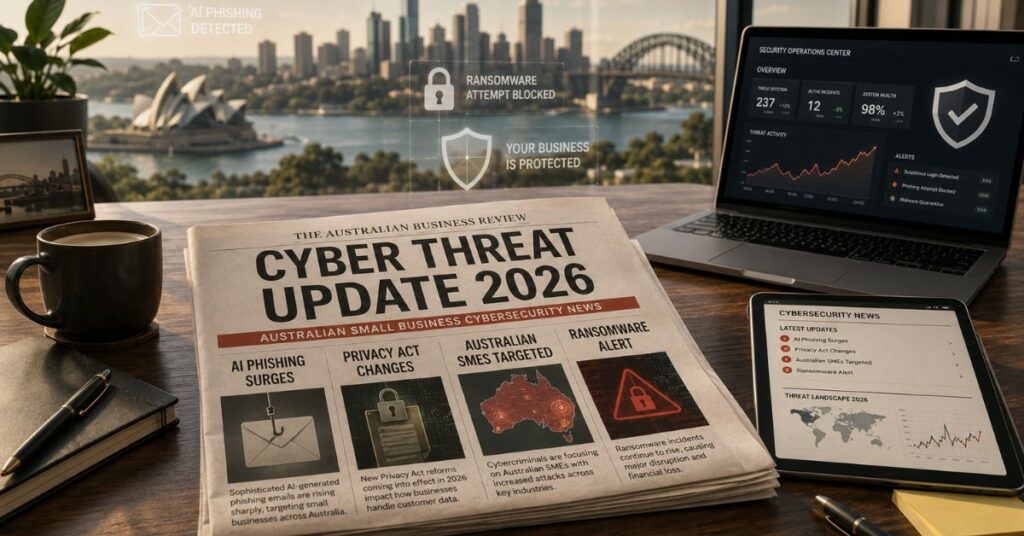
Australian small business cybersecurity news in 2026 centres on three developments. AI-driven scams are rising. The federal government has announced an AU$18 million SME support package. Privacy Act reforms continue, with some small businesses drawn in via AML/CTF rules from 1 July 2026.
Small businesses account for 43% of reported cybercrime in Australia. The average incident costs them $56,600. Only 40% treat cybersecurity as a priority.
That gap between exposure and preparation is the real story of 2026. This page tracks the numbers, breach headlines, government programs, and practical steps for small businesses. It is updated as the landscape shifts.
Latest Cybersecurity Stats for Australian Small Business (2026)
- ASD recorded more than 84,700 cybercrime reports in 2024-25. That is roughly one every six minutes. Source: ASD Annual Cyber Threat Report 2024-25
- The average self-reported cost for small businesses rose 14% to $56,600. Source: ASD Annual Cyber Threat Report 2024-25
- The Notifiable Data Breaches scheme recorded 1,205 notifications in 2025. That is an 8% rise and an all-time high. Source: OAIC NDB statistics
- 59% of those breaches were caused by malicious or criminal attack. Source: OAIC NDB statistics
- A 2026 Ipsos study for Optus found 35% of small businesses have already been attacked. Source: Optus/Ipsos
- The same study found 60% have no cyber response plan. Among sole traders, 79% have none. Source: Optus/Ipsos
- 38% of sole traders take no action after an incident. Source: Optus/Ipsos
“We’re too small to be a target” is one of the most expensive assumptions a business owner can make. Compare what’s included across different cyber security services in Australia before deciding where to invest first.
Emerging Cyber Threats Australian SMEs Should Watch in 2026
AI-Generated Phishing and Business Email Compromise
Criminals feed stolen data into automated tools. These tools write personalised phishing emails in seconds, using real names, job titles, and recent events. Deepfake voice cloning makes it harder still. A fake “director” can now phone staff and ask for an urgent transfer. Regular, scenario-based training is the most reliable defence because it builds staff judgement.
Ransomware-as-a-Service and Double Extortion
Ransomware groups now rent out ready-made attack kits. This lets less-skilled criminals launch serious attacks. Many campaigns also copy data before encrypting it. The attackers then threaten to publish it, a tactic called double extortion. It pressures businesses to pay even when clean backups exist. Managed detection and response shortens the time between compromise and containment.
Supply Chain and Third-Party Vendor Attacks
Attackers target a smaller, weaker supplier and move sideways into every business connected to it. If you rely on vendors, SaaS platforms, or contractors, ask them directly how they protect your data.
Cloud Misconfigurations and Shadow AI
Common gaps include exposed storage buckets, weak admin passwords, missing MFA, and old permissions left over from staff changes. Shadow AI is a newer risk. It means staff using unapproved AI tools, which can leak business data. A cybersecurity risk assessment is the fastest way to find these gaps.
Recent Australian Data Breach News (2026)

Lifeline Confirms Data Breach: Hacker Targets 25 Australian Organisations in Five Months
On 12 July 2026, Lifeline Australia confirmed that staff and volunteer data had been accessed. A threat actor had posted details on a dark web forum. Threat intelligence tracking links the same attacker to about 25 Australian organisations since early 2026. Repeat attackers often work through a list of smaller, less-defended targets.
Other 2026 incidents reinforce the same pattern:
- A construction firm was hit by ransomware, and contract and financial data was stolen.
- A healthcare practice had staff and patient payment details exposed.
- A council had to respond after a ransomware gang published stolen files.
None of these attacks were sophisticated. The causes were unpatched systems, stolen credentials, and third-party exposure.
Faster detection is what separates a contained incident from a headline. If you have no dedicated coverage, start with the difference between managed SIEM and managed SOC services.
Encrypted, offsite, regularly tested backups remain the most reliable way to recover from ransomware without paying.
Government Support and Regulation Update
- AU$18 million SME support package: free cybersecurity checkups, one-on-one help, and simple action plans. It is part of the 2023-2030 Australian Cyber Security Strategy.
- Cyber Wardens Program: an AU$23.4 million initiative to train 60,000 small business employees in basic cyber safety.
- Cyber Action Year 2026: an ASD-led program that asks organisations to assume a breach will happen. Priorities include legacy technology, event logging, and secure-by-design products.
- Privacy Act 1988: the $3 million small-business exemption remains in force. Some small businesses (e.g. certain professional services under AML/CTF rules) are brought into scope from 1 July 2026. Broader removal is still only proposed.
- Ransomware payment reporting: businesses with $3 million or more in annual turnover must report ransomware payments. Obligation commenced 30 May 2025 (education phase to 31 Dec 2025; active enforcement from 1 Jan 2026).
Even if a business isn’t bound by every clause, clients and partners increasingly expect proof of active security.
2026 Cybersecurity Action Checklist for Small Business
- Switch to phishing-resistant MFA. Use hardware keys or passkeys, not SMS codes, on every account that supports them.
- Align with the Essential Eight. Maturity Level 2 is a realistic target for most small and medium businesses.
- Test your restores. A backup only helps if you can recover from it, so keep tested, offsite copies.
- Add endpoint detection and response. It stops ransomware spreading before it becomes business-ending.
- Penetration test anything internet-facing. Vulnerability exploitation is now the most common way attackers get in.
- Audit vendor and supplier access. Don’t assume it’s covered.
- Review your cyber insurance cover and exclusions before you need to claim.
- Train staff every few months. Short, regular sessions work better than one annual session.
Frequently Asked Questions
What is the Essential Eight for Australian small businesses?
It is ASD’s baseline set of eight mitigation strategies, including patching, MFA, and restricting admin privileges. It is increasingly the benchmark for “reasonable” security in Australia.
What are the mandatory data breach notification laws in Australia?
Organisations covered by the Privacy Act must notify affected individuals and the OAIC as soon as practicable after confirming an eligible breach. They have 30 days to assess a suspected breach.
Do I need cyber insurance for my Australian online business?
It isn’t legally required. But with average incident costs above $56,000, most brokers treat it as standard risk management, especially if you hold payment or health data.
How do I train employees on cyber awareness in Australia?
Use short, recurring sessions with simulated phishing tests and clear reporting steps. This is the model behind the government-backed Cyber Wardens program.
Why is Australia such a common target for cyberattacks?
Australia has high digital adoption, valuable personal and financial data, and many under-defended small businesses. That makes it a high-yield target.
Are Australian small businesses still not prioritising cybersecurity in 2026?
Yes. 2026 research found only 40% treat it as a priority, and 60% have no response plan.
Should small businesses rely on younger staff to manage cybersecurity?
No. Being good with technology is not the same as security expertise. A dedicated provider or trained IT lead should cover patching, access control, and incident response.
Where can Australian small businesses get cybersecurity help?
Options range from free government-backed checkups to managed providers. See how leading cyber security companies in Australia compare, including options in Sydney and Melbourne.
Staying Ahead of Australia’s 2026 Threat Landscape
The businesses that get hurt rarely face a sophisticated attack. They have an unpatched system, a reused password, or a supplier nobody checked. Fixing these doesn’t need an enterprise budget. It needs consistency.
Not sure where you stand against the checklist? CyberMark Agency offers a free, no-obligation security posture assessment for Australian small businesses. Book your free assessment and get a clear picture of your risk.
Need help reducing your business security risk?
Contact us

