5 Best Security Awareness Training Platforms in NZ (2026)
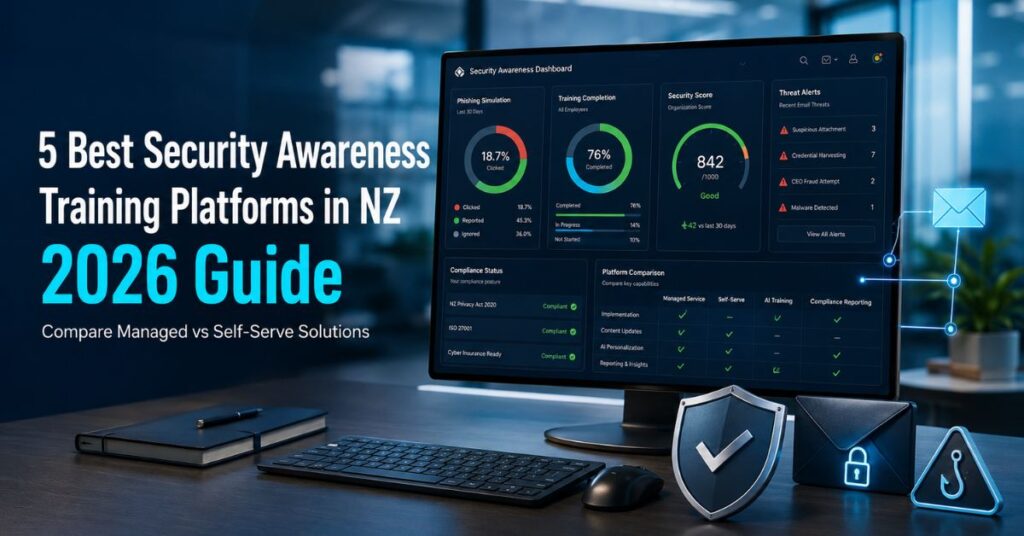
The 5 best security awareness training platforms for NZ businesses in 2026 are CyberMark Agency, KnowBe4, Proofpoint Security Awareness, Hoxhunt, and Mimecast Awareness Training. They split into two categories: fully-managed services that run the programme for you, and self-serve platforms you configure and operate yourself, and which one fits depends less on features than on how much admin time you actually have to run a phishing programme month after month.
Every one of these platforms will run a phishing simulation. What separates them is what happens after the click, whether someone chases staff for completions, adjusts difficulty over time, or leaves that admin work to you. That distinction matters more for a 15-person Wellington business than any feature checklist does.
What to Look for in a Security Awareness Training Platform?
New Zealand’s National Cyber Security Centre (NCSC) is explicit on this point: many breaches involve a human element, such as clicking a link or handing over credentials, which is why investing in staff security awareness alongside technical controls is a long-term commitment, not a one-off task. The NCSC also notes that an effective awareness programme is not a once-a-year induction video; it needs regular, ongoing training and interaction to actually change behaviour.
Before comparing platforms, weigh them against four criteria, you’d use when evaluating any cybersecurity risk assessment tools:
- Delivery cadence: Annual tick-box training versus continuous, point-of-failure reinforcement
- Compliance mapping: Does it produce evidence for the NZ Privacy Act 2020, ISO 27001, or cyber insurance renewal, or just a completion percentage
- Admin burden: Do you run the campaigns, or does the provider
- Attack coverage: Email phishing only, or simulations that reflect how staff are actually targeted today
The 5 Best Security Awareness Training Platforms for NZ Businesses
| Platform | Best For | Starting Price | Admin Model |
| CyberMark Agency | NZ small businesses (1–50 staff) wanting a fully-managed programme | $5 NZD/user/month | Fully managed |
| KnowBe4 | Large, multi-region teams needing the deepest content library | Quote-based (US list pricing from ~$2.79–$3.75/seat/month) | Self-serve |
| Proofpoint Security Awareness | Organisations wanting simulations driven by live threat intelligence | Quote-based | Self-serve |
| Hoxhunt | Teams wanting low-admin, adaptive engagement | Quote-based (reported ~$12–$18/user/year in enterprise deals) | Largely automated |
| Mimecast Awareness Training | Businesses already using Mimecast for email security | Quote-based | Self-serve |
1. CyberMark Agency – Best Fully-Managed Option for NZ Small Businesses
CyberMark is built for New Zealand businesses with 1–50 staff and runs as a managed security awareness training service rather than a self-serve platform. It schedules the phishing simulations, chases completions, and sends plain-language monthly reports.
What’s included: Monthly simulated phishing campaigns, pre-recorded anti-phishing modules, real-time click intervention, and reporting mapped to the NZ Privacy Act 2020 and ISO 27001. Every new client gets a free phishing baseline test for up to 100 users, with results within 24 hours.
Pricing: From $5 NZD per user per month, month-to-month with no lock-in and no setup fees. Our NZ security awareness training pricing guide compares how costs differ across delivery models.
Why it fits: Most platforms on this list assume you have someone to run the programme internally. CyberMark’s model assumes you don’t, and pairs the training with the same NZ-based team handling endpoint protection, so reporting stays consistent across both layers.
2. KnowBe4 – Best for Content Library Depth and Large, Multi-Region Teams
KnowBe4 is the largest player in the category by customer count, and its scale shows up mainly in content depth rather than automation.
What’s included: A training library spanning 35+ languages with interactive content and risk-based assessments, across four tiers: Silver, Gold, Platinum, Diamond. The Diamond tier unlocks AI Defense Agents (AIDA), which automate template selection, campaign management, and follow-up training after a failed simulation.
Pricing: No NZ list pricing is published. US list pricing (per G2) starts around $2.79–$3.75 per seat/month, depending on tier and volume, and KnowBe4 states pricing may differ by country. NZ buyers should request a local quote rather than budget off US figures. A 25-user minimum applies.
Why it fits: Large or multi-region organisations with an admin who has time to run campaigns and wants the deepest content library on the market. It’s self-serve, not hands-off.
3. Proofpoint – Best for Threat-Intelligence-Driven Simulation
Proofpoint’s differentiator is that its simulations are built from what its email security stack is actually seeing in the wild, not a static template library.
What’s included: Thousands of phishing, SMS, and USB attack templates drawn from real-world lures identified in Proofpoint’s threat intelligence, plus Nexus People Risk Explorer, which ranks your riskiest users using vulnerability, attack, and privilege data rather than treating every employee as equal risk.
Pricing: Quote-only, per-user annual. Reported pricing runs 20–40% higher than comparable platforms like Hoxhunt for standalone security awareness training.
Why it fits: Organisations already using Proofpoint’s email security products, where the threat-intelligence integration is the actual value driver. Outside that ecosystem, you’re paying a premium for a signal you can’t fully use.
4. Hoxhunt – Best for Low-Admin, Adaptive Engagement
Hoxhunt is built around a specific problem: most awareness programmes plateau after year one because keeping simulations fresh takes more admin time than most security teams have.
What’s included: AI-adaptive phishing simulations that adjust difficulty and delivery automatically based on each employee’s behaviour, department, and location, paired with instant gamified micro-training (badges, leaderboards, streaks) triggered right after a mistake.
Pricing: Quote-only. Reported per-user pricing for annual contracts typically falls in the $12–$18/year range.
Why it fits: Teams that want an engagement-led, largely automated programme over a broad compliance content library. The trade-off is a narrower content scope than KnowBe4.
5. Mimecast Awareness Training – Best for Teams Already on Mimecast Email Security
Mimecast’s awareness module is designed to sit directly on top of its email security platform, and the value case mirrors Proofpoint’s.
What’s included: Short, monthly video-based training sessions rather than long annual modules, with user risk scores enriched by real-world click data pulled from Mimecast Email Security, not simulation results alone.
Pricing: Quote-only, bundled into Mimecast’s broader plan structure. Reported per-user pricing runs $40–$80/year for base bundles, rising to $100–$150+/year for comprehensive enterprise packages.
Why it fits: Businesses already paying for Mimecast email security that want to add training as an incremental module rather than a standalone purchase. It’s a weak fit as a first-time, standalone buy.
Types of Security Awareness Training Explained

Most platforms combine several of these approaches rather than relying on just one, so it’s worth knowing what each one actually does before comparing vendors.
- Simulated phishing: Fake phishing emails sent to staff to measure who clicks, forming the baseline “phish-prone percentage” most platforms report against.
- Microlearning: Short (3-15-minute) video or interactive modules covering a single topic, designed to be completed without a half-day workshop.
- Point-of-failure training: A brief lesson triggered immediately after an employee clicks a simulated phishing email, when retention is highest, this is also the moment a documented cybersecurity incident response plan should tell staff what to do next if the click was real.
- Gamified training: Badges, leaderboards, and scoring used to drive voluntary engagement rather than compliance-driven completion.
- Managed vs. self-serve delivery: The biggest practical divide on this list: whether your team configures and runs the programme, or a provider does it for you.
How to Choose the Right Platform for Your NZ Business?
Start with admin capacity, not features. If nobody on your team can dedicate ongoing hours to campaign scheduling, template selection, and chasing completions, a fully-managed service will outperform a self-serve platform regardless of that platform’s content library, this is often one of the clearest signs your business needs a cybersecurity risk assessment before choosing a training platform. Phishing remains the most common way NZ small businesses get compromised, and unused features don’t reduce that risk.
Next, check compliance fit specifically. If you need documented evidence for NZ Privacy Act 2020 accountability, ISO 27001, or a cyber insurance renewal questionnaire, confirm the platform produces exportable reports in that format, not just a dashboard our cybersecurity risk assessment and audit service can establish that baseline first . Finally, budget in NZD from the outset: every platform on this list except CyberMark publishes pricing in USD or not at all, so get a written NZD quote before comparing costs against a fully-managed NZ alternative.
Frequently Asked Questions
Which platforms actually help with NZ Privacy Act 2020 compliance?
Platforms that export documented phishing simulation results and training completion records, not just a completion percentage, since that’s what satisfies the “reasonable steps” standard. On this list, CyberMark and KnowBe4 map reporting directly to the NZ Privacy Act 2020 and similar frameworks by default.
Do NZ businesses need a paid security awareness training platform?
Not legally. Security awareness training isn’t mandated for most private-sector organisations, but the NZ Privacy Act 2020 requires reasonable steps to protect personal information, and documented training helps show that. The NCSC’s free guidance is a fair starting point. A paid platform or managed service becomes worthwhile once you need repeatable simulations and exportable evidence.
What are the different types of security awareness training?
The main types are simulated phishing, microlearning modules, point-of-failure training triggered after a mistake, and gamified engagement programmes; most mature platforms combine several of these rather than relying on one.
Are there free security awareness training platforms?
Most credible platforms are paid, per-seat products; free options are typically limited trials or basic phishing-awareness resources rather than full managed programmes. NZ businesses can also draw on the NCSC’s free public guidance as a starting point before investing in a paid platform.
What are the “5 P’s” of security?
There’s no single official standard; several frameworks use this name, most commonly People, Policy, Process, Products, and Proof. It’s a useful mnemonic for structuring a security programme, but not a formal certification or regulatory requirement.
Who are the top cyber security companies in New Zealand?
It depends on business size and sector, see our full comparison of leading cyber security companies in New Zealand for providers broken down by who they serve.
Get Your Baseline Number Before You Choose a Platform
Every platform in this comparison, CyberMark included, is only as good as the problem it’s solving for. And most NZ businesses choosing between security awareness training platforms are doing it without the one number that should actually drive the decision: how many of your staff would click on a phishing email today.
CyberMark’s free phishing baseline test covers up to 100 users and delivers results within 24 hours, with no obligation to proceed. It’s the fastest way to find out whether your team needs the content depth of a KnowBe4, the automation of a Hoxhunt, or a fully-managed programme that runs itself. For more comparisons like this, browse the CyberMark blog.
Book your free phishing baseline test →
Need help reducing your business security risk?
Contact us

