Cybersecurity Risk Assessment Tools & Software: A 2026 Comparison
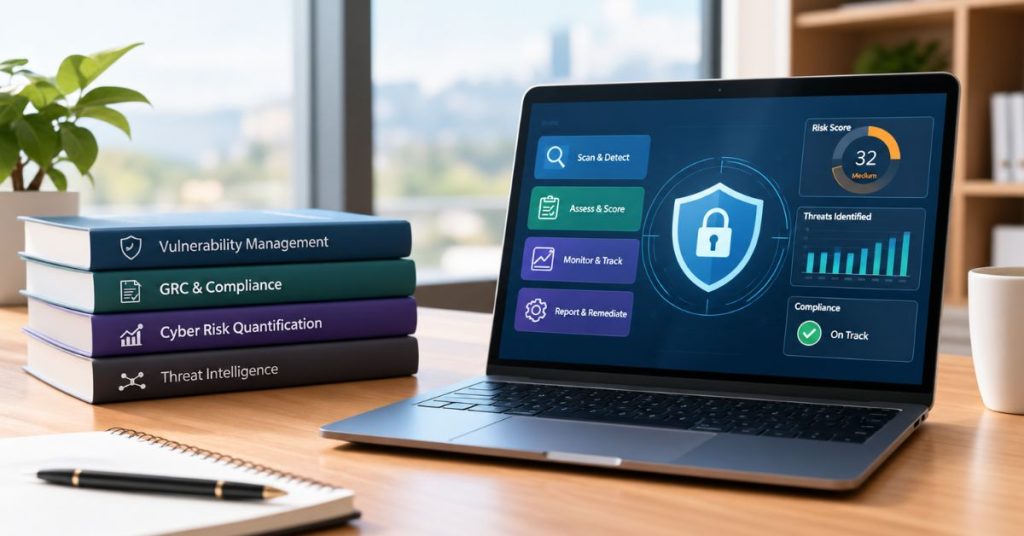
Cybersecurity risk assessment tools are software platforms that identify, score, and track an organisation’s exposure to cyber threats. In practice, risk assessment tools get applied to products built to answer very different questions. A vulnerability scanner, a compliance platform, and a financial risk quantification tool all get marketed under the same banner, yet they solve almost entirely different problems.
What Cybersecurity Risk Assessment Tools Actually Do
Cybersecurity risk assessment tools identify where your systems are exposed, map those findings to a recognised framework, and turn them into an actionable score. A serious tool pulls data from your existing systems automatically rather than relying on manual exports. It translates findings into standards like ISO 27001 or NIST CSF without you mapping it by hand, and produces scores you can trace back to specific inputs rather than trust as a black box. It also needs to serve two different audiences. Auditors need evidence trails. Business owners need plain-language summaries.
The Four Categories of Cybersecurity Risk Assessment Tools
Cybersecurity risk assessment software splits into four distinct families. Most “top 10 tools” roundups get this wrong by ranking a vulnerability scanner against a compliance platform as if they compete for the same budget. They don’t, and no single platform covers all four.
Vulnerability management platforms
Scan infrastructure, endpoints, and cloud environments for technical weaknesses, then prioritise fixes by severity and exploitability rather than raw CVE counts. Their output is a patch list, not a compliance report or a financial figure. For a feature-by-feature look at the leading endpoint-focused platforms, see this EDR solutions comparison.
Governance, Risk, and Compliance (GRC) platforms
They manage the risk register and map security controls to frameworks like ISO 27001, SOC 2, or the NZ Privacy Act, producing audit-ready evidence. Their strength is breadth; their weakness is technical depth. CyberMark’s compliance management software comparison covers ten leading GRC platforms in detail.
Cyber Risk Quantification (CRQ) tools
Convert technical findings into dollar-denominated exposure figures a board or CFO can act on. Most are built on or compatible with FAIR (Factor Analysis of Information Risk), the standard methodology for turning “twelve unpatched high-severity vulnerabilities” into an expected annual loss figure. This category has historically been an enterprise tool for cyber insurance renewals and board reporting, but as insurers ask sharper underwriting questions, it’s starting to matter earlier in a business’s growth than it used to. Security software spend in Australia is forecast to grow 12.3% in 2026, according to Gartner’s latest forecast.
Free and public agency tools
Free and public agency tools give any business a no-cost starting point. Published in February 2024, the NIST Cybersecurity Framework 2.0 organises cybersecurity activity into six functions: Govern, Identify, Protect, Detect, Respond, and Recover, with Govern the newest addition covering how an organisation sets and oversees its strategy rather than just executing it.
For the assessment methodology itself, NIST SP 800-30 is the dedicated reference, while CISA’s CSET tool offers a free desktop application for a structured self-assessment. Internationally, ISO 27005 is now in its fourth edition, aligned with ISO 27001:2022 and restructured around event-based and asset-based risk identification. These tools are rigorous but manual, so most growing businesses pair them with commercial software rather than relying on them indefinitely.
Where Tools Fit Into the Risk Assessment Process
Tooling supports each step of an assessment; it doesn’t replace the judgment calls in between. The standard sequence, scope, asset inventory, threat and vulnerability analysis, risk scoring, remediation planning, holds across NIST, ISO 27005, and most vendor methodologies. A scanner automates technical discovery, a GRC platform automates evidence collection, and a CRQ tool automates impact scoring. Deciding what’s a priority for your business still takes someone who understands both the findings and the business.
Assessing Vendor and Third-Party Risk With Software
Vendor risk gets its own corner of the market because self-attestation doesn’t hold up under scrutiny; a current SOC 2 report or ISO 27001 certificate carries far more weight than a completed form. Third-party risk software typically automates questionnaire distribution, flags expired certifications, and tiers vendors by data access rather than contract size. A structured third-party risk management process defines how to tier vendors and what evidence to request, rather than relying on self-attestation.
How to Choose the Right Risk Assessment Software

Category fit depends on where your program actually is, not which platform has the most recognisable name. Check whether a vendor maintains and updates its own control library as standards change, or whether that work falls on you. Check whether the scoring model is explainable to an auditor or a black box you can’t defend. Check how cleanly it pulls data from the rest of your stack, since a GRC tool needing manual CSV uploads goes stale within weeks. And weigh total cost, not list price: implementation time and ongoing maintenance usually drive the real cost far more than the licence fee.
For most small and medium businesses in the 1 to 50 staff range, the right starting point is rarely an enterprise GRC suite built for organisations running multiple frameworks with dedicated compliance headcount. A lighter compliance tool for evidence collection plus a vulnerability scanner for technical exposure usually covers more ground than one expensive platform doing both poorly.
Software Tools vs an Expert-Led Assessment
Software finds and scores exposure. It still takes a person to decide what to do. A scanner ranks hundreds of findings by severity but won’t tell you which three matter most given your budget and what your insurer is likely to ask next quarter. A GRC platform shows you which controls are documented, not which ones were documented on paper but never actually implemented, the gap that shows up in a real audit. A CRQ tool gives you a defensible dollar figure, but you still need someone who understands the business to sanity-check the inputs.
A one-time, tool-based scan also has a short shelf life: it’s accurate for the environment it scanned, on the day it scanned it. New hires, vendors, and cloud services shift that picture within weeks, which is why continuous coverage closes a gap an annual snapshot can’t. Managed detection and response services are built to keep monitoring live between formal assessments rather than leaving a business blind until the next scheduled review.
CyberMark doesn’t sell risk assessment tooling as standalone software; that’s a deliberate line. What it provides is an expert-led layer that combines the technical scanning, framework mapping, and impact analysis those four tool categories each handle separately into one engagement: a cybersecurity risk assessment and audit delivered as a prioritised plan, not a dashboard you still have to interpret yourself. Not sure you need an assessment yet? See the signs your business needs a cybersecurity risk assessment.
Frequently Asked Questions
What are cybersecurity risk assessment tools?
Software platforms that help identify, score, and track cyber risk. They fall into four distinct categories, and no single tool covers all of them.
Is there a free cybersecurity risk assessment tool?
Yes. NIST’s Cybersecurity Framework 2.0 and CISA’s CSET are both free. They’re manual and take staff time to run, but they’re a legitimate starting point for a very small business.
Which phase includes the initial cybersecurity risk assessment?
The scoping and asset-inventory phase, before threat analysis or remediation begin. NIST SP 800-30 calls this the “prepare” step: you have to know what you’re protecting before assessing what threatens it.
How much does cybersecurity risk assessment software cost?
Licence pricing varies widely by category and usually requires a custom quote. That’s separate from the cost of a delivered assessment: CyberMark’s own baseline engagement starts at around $2,000 NZD.
Should a small business buy risk assessment software or hire a provider?
Without a dedicated security or compliance function, an expert-led assessment usually delivers more usable output faster than learning a new platform. Software pays off once someone can run it continuously; otherwise, it produces findings nobody has time to act on.
Which Cybersecurity Risk Assessment Approach Is Right for Your Business?
Vulnerability scanners handle technical exposure, GRC platforms handle compliance evidence, CRQ tools translate findings into financial terms, and free frameworks like NIST CSF 2.0 give any business a structural starting point at no cost. Most growing businesses eventually use more than one category together, not because a vendor failed, but because each was only ever built to answer part of the question.
Talk to CyberMark’s risk assessment team for a straight answer on whether a tool, a managed service, or a combination is the right next step for yours. For more comparisons, browse the Cybermark blog.
Need help reducing your business security risk?
Contact us

