EDR vs MDR vs XDR: Which Cybersecurity Solution Do You Need?
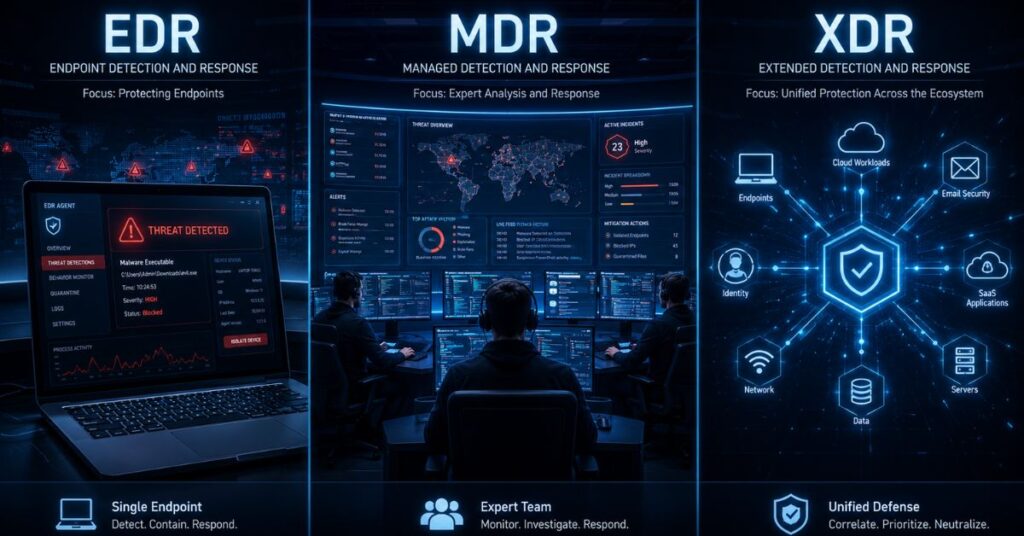
EDR, MDR, and XDR are three different approaches to cybersecurity threat detection and response. EDR monitors endpoints, MDR adds expert-managed 24/7 monitoring as a service, and XDR unifies detection across your entire security stack. Which one you need depends on your team size, infrastructure, and how much operational control you want to keep in-house.
That distinction matters more than most businesses realize. The global average cost of a data breach hit $4.9 million in 2024, the highest figure ever recorded, and security teams are still getting overwhelmed by alerts from tools that don’t talk to each other.
The problem isn’t always the threat itself. It’s often a mismatch between the tool and the team using it. A business running EDR without dedicated analysts is flying blind. A growing company paying for XDR without the infrastructure to support it is overspending on visibility it can’t act on.
EDR, MDR, and XDR all fall under the broader category of detection and response solutions, but they sit at very different points on the spectrum of coverage, automation, and operational ownership. Understanding those differences is what separates a security strategy that holds up from one that looks good on paper.
Here’s what each solution actually does, where each one breaks down, and how to choose the right one for your business.
What EDR Does and Where It Breaks Down
Endpoint detection and response (EDR) is a cybersecurity tool that continuously monitors endpoint devices, laptops, desktops, servers, and mobile devices, and gives your security team the tools to investigate and stop threats fast.
EDR systems place software agents on endpoints to record all endpoint activities: running processes, file changes, network connections, and user behavior. That data flows to a centralized platform for analysis.
Core EDR capabilities:
- Real-time visibility into endpoint health and activity
- Behavioral detection that catches threats traditional antivirus misses
- Alert triage and threat hunting for your internal analysts
- Automated containment and remediation to limit damage
Here’s the honest limitation: EDR only watches endpoints. It cannot see your cloud services, email traffic, network activity, or identity systems. If an attacker moves from a compromised endpoint into your cloud environment, a standalone EDR solution loses the trail completely, leaving blind spots across the rest of your security stack.
EDR works best for organizations with skilled in-house security analysts, a relatively contained infrastructure, and the capacity for analysts to manage daily alert triage.
MDR Is Not Just a Tool: It’s the Humans Behind the Tool
Managed detection and response (MDR) is endpoint security delivered as a managed service, an outsourced security operations center (SOC) that monitors your environment, investigates threats, and responds on your behalf around the clock.
If EDR is the security camera, MDR is the security camera plus the trained guard watching the screens 24/7.
MDR combines detection technology, often EDR and more, with a team of highly skilled cybersecurity professionals who handle what most internal teams simply don’t have bandwidth for.
MDR service capabilities include:
- 24/7 monitoring across endpoints, and in many cases, cloud services and networks
- Proactive threat hunting before threats trigger alerts
- Alert validation to cut through false positives
- Managed incident response and guided remediation
- Compliance-ready reporting
The main reason businesses choose MDR is the global cybersecurity skills gap. Finding experienced security analysts is genuinely hard. MDR fills that gap without building an internal team from scratch.
MDR works best for small and mid-sized businesses with limited in-house security staff, regulated industries like healthcare and finance, or any business that needs always-on protection without a large capital expense.
One thing to verify before signing with any MDR provider: some simply forward alerts with recommendations, while others take full ownership of detection and response. Understand exactly where their responsibility ends and yours begins.
XDR Fixes the Blind Spots That EDR Alone Can’t See
Extended detection and response (XDR) is a platform that collects and correlates threat data across your entire security stack, not just endpoints, but networks, cloud services, email systems, and identity platforms, and responds through a single unified console. While EDR watches one layer, XDR connects them all.
A real-world example: an attacker uses a stolen credential to access a cloud app, downloads a sensitive file on a remote endpoint, then tries to move laterally through your network. Viewed separately, each action looks routine. XDR consolidates all three signals into a single attack chain and flags it as a high-priority incident before damage is done.
XDR platform capabilities include:
- Unified visibility across endpoints, network, cloud, email, and identity
- Automated correlation of threat signals from multiple data sources
- Cross-domain threat hunting and forensic investigation
- Integrated incident response workflows that speed up remediation
There are two ways XDR gets delivered. Native XDR keeps everything within one vendor’s ecosystem, cleaner to manage, but you’re locked into their tool set. Open XDR connects products from different vendors, which works well if you’ve already invested in a mixed security stack, though expect more upfront configuration work.
Either way, XDR isn’t something you switch on and walk away from. It needs proper integration time and a team that actually knows how to work with data coming in from multiple security layers. If that foundation isn’t there, you won’t get the value you’re paying for.
It fits best when your environment has grown beyond just endpoints, multiple clouds, SaaS tools, remote teams, and corporate networks, all in the mix. The numbers back up that trajectory, too: XDR was an $8 billion market in 2025 and is expected to exceed $30 billion by 2030, reflecting just how quickly businesses with complex infrastructure are moving toward it.
EDR vs MDR vs XDR: The Real Differences
| EDR | MDR | XDR | |
| What it is | Detection tool | Managed service | Unified platform |
| Scope | Endpoints only | Endpoints + more | Full environment |
| Who operates it | Your team | Vendor SOC team | Your team or managed |
| 24/7 monitoring | Only if you staff it | Included | Depends on setup |
| Best for | Teams with internal SOC | Lean teams, SMBs | Complex enterprise environments |
The biggest source of confusion: these are not always competing options. MDR services frequently use EDR and XDR tools as their detection engine. XDR doesn’t replace EDR, it extends it. Managed XDR (MXDR) gives you cross-domain visibility with expert-operated response layered on top.
The clearest way to frame it is that EDR and XDR are tools. MDR is a service model built around outcomes.
What About NDR? The Fourth Layer Most Comparisons Skip
Network Detection and Response (NDR) monitors traffic flowing between devices on your network, not the devices themselves. It’s the layer that catches threats EDR, MDR, and XDR frequently miss.
Here’s why it matters: EDR requires an agent installed on a managed endpoint. But what about your IP cameras, smart HVAC systems, unmanaged contractor laptops, or legacy medical equipment? Those devices generate network traffic. NDR watches that traffic without touching the device.
The scenario EDR and XDR both miss: An attacker compromises an unmanaged IoT device, then moves laterally across your network using legitimate Windows protocols. Each hop looks routine. No managed endpoint triggers an alert. NDR catches the lateral movement because it sees the traffic pattern, not the endpoint.
Where NDR fits in each model:
| EDR | MDR | XDR | NDR | |
| Requires agent on device | Yes | Yes | Usually | No |
| Catches lateral movement | Partially | Partially | Better | Best |
| Works on unmanaged devices | No | No | No | Yes |
| Best environment | Managed endpoints | Any with lean team | Complex multi-cloud | OT/ICS, IoT, legacy devices |
When NDR matters more than XDR: If your environment includes manufacturing equipment, legacy medical devices, or any significant number of devices that can’t run security agents, NDR deserves a place in your evaluation, ahead of XDR. You can’t install a CrowdStrike agent on a hospital infusion pump.
Most enterprise MDR providers now offer NDR sensors as part of their service. Ask explicitly during vendor evaluation.
Which Security Solution Does Your Business Actually Need?

From endpoints to enterprise: the evolution of modern cybersecurity.
Choose EDR if you have in-house analysts, a straightforward infrastructure, and want to own your tool operations. EDR is the foundation on which every strong cybersecurity strategy is built.
Choose MDR if your team is stretched thin or you have no dedicated security staff. MDR gives you access to highly skilled cybersecurity professionals and 24/7 coverage without having to hire them directly. It works especially well for compliance-heavy industries.
Choose XDR if your environment spans multiple clouds, SaaS applications, remote endpoints, and corporate networks. You need threat visibility and response capabilities across the entire enterprise, not just at the device level.
Consider MXDR if you want XDR’s full-spectrum detection but lack the internal team to run it. You get the platform and the expert operations together.
Most businesses don’t need to choose just one forever. A smart cybersecurity strategy often starts with EDR as the foundation, layers MDR for operational coverage, and expands to XDR as the environment grows. If you’re unsure where your organization stands, a security assessment from CyberMark Agency can map your real gaps to the right solution, without vendor bias.
What to Actually Ask Before Signing an MDR Contract

What to Actually Ask Before Signing an MDR Contract
Most businesses evaluate MDR on features and price. The buyers who get burned do so on contract terms they never scrutinized. These are the questions experienced security leaders ask, and most first-time buyers don’t.
1. What actions will your team take without calling us first?
This is the single most important question. Some MDR providers guarantee they’ll alert you. Others guarantee they’ll contain the threat, isolating the endpoint, blocking the IP, executing a runbook, before notifying you. These are not the same service. Verify this in writing before signing.
2. What’s your Mean Time to Contain, not just Mean Time to Detect?
Most MDR SLAs commit to detection response time (“we’ll alert you within 15 minutes”). Very few commit to containment time. In a ransomware incident, the gap between alerting and containing is where most damage happens. Push for an MTTC commitment in the contract.
3. Who owns detection engineering as my environment changes?
Your environment will add new SaaS tools, cloud services, and infrastructure over the next 12 months. MDR contracts often restrict your ability to modify the vendor’s detection rules. Find out who writes new detections when you onboard a new tool, and what that process costs.
4. What happens to my data if I switch providers?
MDR vendors ingest endpoint telemetry into their platforms. If you leave, can you export your historical data? In what format? Many contracts make data portability deliberately difficult. Discover this before you’re locked in, not after.
5. Is this ‘monitoring with recommendations’ or actual managed response?
Some MDR contracts specify the vendor will recommend remediation steps, not execute them. If your team can’t act on those recommendations at 3AM, you’re paying for an expensive alert service, not managed response. Read the scope of work carefully.
Four Things Most Comparisons Get Wrong About EDR, MDR, and XDR
XDR replaces SIEM: No. XDR correlates threat signals for detection and response. SIEM aggregates logs for compliance, long-term retention, and forensic investigation. They solve different problems. Vendors marketing XDR as a SIEM replacement are selling a cost-reduction story, not a security improvement story. Most enterprises that move to XDR keep their SIEM running alongside it.
MDR is only for companies that can’t afford a full SOC: Fortune 500 companies with mature in-house security teams use MDR, for after-hours coverage, threat hunting capacity, and surge support during incidents. MDR is an augmentation model as often as it is a replacement model. The assumption that choosing MDR means admitting your security team is inadequate keeps many mid-market companies from a model that would serve them well.
Switching to MDR means giving up control: The level of operational control in an MDR engagement is negotiable. Most providers offer tiered response models, from “notify only” to “full autonomous response.” You define where the boundaries sit. The assumption that MDR equals surrendering control causes many organizations to self-manage tools they don’t have the staff to operate effectively.
XDR gives you full visibility: XDR visibility is only as comprehensive as the integrations you’ve configured. A platform with two integrations has less actual coverage than a well-tuned EDR deployment. The platform doesn’t create visibility, your integrations do. Before buying XDR, map out exactly which data sources you’ll connect on day one and which will take months to configure.
Frequently Asked Questions
Can you use EDR and XDR together?
Yes. XDR integrates EDR data as one of its core inputs. Using both is common and recommended for organizations expanding their security stack beyond endpoints.
Is MDR replacing EDR?
No. MDR is a service model. Most MDR providers use EDR or XDR tools as their detection engine and add the human operational layer on top.
Which option is most cost-effective for small businesses?
MDR is generally the most affordable entry point. It provides 24/7 expert coverage without the cost of building and staffing an internal SOC.
Can XDR replace EDR?
No. XDR extends EDR by incorporating data from networks, the cloud, and email, but it still relies on endpoint telemetry as a core input. Think of XDR as EDR plus broader coverage, not a replacement.
Do you need an EDR if you have MDR?
Most MDR services include EDR as part of their technology stack. So, in practice, yes, EDR runs inside your MDR service, even if you’re not managing it directly.
Is EDR the same as SIEM?
No. SIEM collects and aggregates logs from across your environment for compliance and analysis. EDR actively monitors endpoints and responds to threats in real time. They serve different purposes and are often used together.
Is MDR the same as EDR?
No. EDR is a tool your team operates. MDR is a managed service, a vendor’s security team runs the detection and response on your behalf, often using EDR as one of their underlying tools.
What is the main advantage of XDR over EDR?
XDR catches threats that span multiple systems, a compromised credential, a suspicious download, lateral network movement, and correlates them into a single attack chain. EDR sees each endpoint event in isolation. The advantage is cross-domain visibility, not better endpoint detection.
Can MDR replace XDR?
It depends on what technology your MDR provider runs underneath. Providers operating on an XDR platform give you cross-domain coverage as part of the service (sometimes called MXDR). Providers built purely on EDR give you expert-managed endpoint coverage only. Always verify what data sources your MDR vendor actually ingests.
Is EDR vs. XDR even the right question for a small business?
Usually not. For most small businesses, the real decision is between self-managed EDR and MDR. XDR’s cross-domain correlation becomes valuable when you have multiple clouds, SaaS stacks, and complex networks, complexity most small businesses haven’t reached yet.
Stop Guessing: Match Your Security Tool to Your Actual Risk
EDR gives your team deep endpoint visibility. MDR provides expert-led detection and response as a service. XDR unifies your entire security environment into one platform.
The right cybersecurity solution depends on your team size, infrastructure complexity, budget, and risk profile, not on which acronym sounds most advanced.
The cybersecurity team at CyberMark Agency works with businesses to cut through the noise, find the real gaps, and recommend solutions that actually fit. Book a free consultation and find out exactly where your defenses stand.
Need help reducing your business security risk?
Contact us

