Managed Detection and Response Cost in 2026
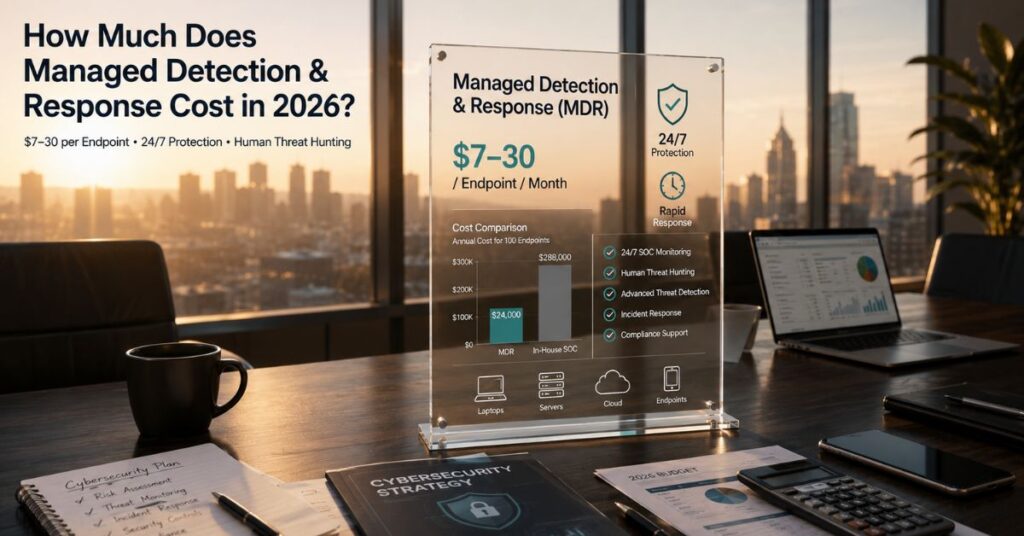
Managed Detection and Response (MDR) costs between $7 and $30 per endpoint per month in 2026, though what’s actually included at that price varies widely. Most small businesses (roughly 25–50 endpoints) spend $200 to $1,500 per month, while larger organisations pay significantly more depending on monitoring scope, compliance requirements, and response capabilities.
The range is wide because MDR isn’t a single product. It covers everything from basic endpoint monitoring to full 24/7 SOC-as-a-service with human threat hunting and active incident response. This guide breaks down what’s inside that range, which factors push your number up or down, and what to ask every vendor before signing.
Key Takeaways
Average MDR cost is $7 to $30 per endpoint per month
Small businesses usually spend $200 to $1,500 per month
Most providers charge monthly per device
Compliance and cloud monitoring increase pricing
Compare response capability, not just price
How MDR Differs From MSSP and SIEM
Before looking at pricing, it helps to clarify what each service actually is. Many businesses overpay or end up with gaps because these categories get conflated.
SIEM is a technology platform, not a service. It collects and correlates log data, generates alerts, and gives your security team a dashboard. Without analysts behind it, a SIEM is just a log aggregator that produces noise. Licensing alone runs $20,000 to $100,000+ per year for platforms like Splunk or Microsoft Sentinel, before any staffing costs.
MSSP (Managed Security Service Provider) manages your security tools for you. They monitor your firewall, handle patching, and escalate alerts. When they detect something suspicious, they notify you and leave the investigation to your team. Think of an MSSP as a monitoring and management layer, not an investigative one.
MDR combines technology, threat intelligence, and human analysts to actively detect, investigate, and respond, which is the core distinction in any EDR vs MDR vs XDR comparison. When the MDR team identifies a confirmed threat, it isolates the endpoint, blocks the malicious IP, and contains the threat without waiting for your approval. That active response capability is what separates MDR from every other option.
MDR Pricing Models Explained
Providers structure MDR contracts in a few main ways. Knowing which model a vendor uses changes how you read their quote.
Per-endpoint pricing is the most common model for SMB-focused MDR. You pay a monthly rate per monitored device, typically $7 to $30 per endpoint. Based on independent 2026 pricing data, Huntress’s published Managed EDR list price is $8.99 per endpoint per month, Sophos MDR runs $7 to $17, and Arctic Wolf runs $8 to $25 per endpoint per month. CrowdStrike Falcon Complete is quote-based rather than published, with sources citing endpoint minimums anywhere from 150 to 299 and annual per-endpoint costs roughly $125 to $325, confirm current figures directly with CrowdStrike, but expect a minimum well beyond what most SMBs need. SentinelOne’s Wayfinder Threat Detection and Response (rebranded from Vigilance, via Singularity MDR in 2024, then Wayfinder in November 2025) is priced differently again: it’s an add-on to a separate Singularity platform licence rather than a standalone rate, and typically totals $18 to $25 per endpoint per month once the platform and MDR add-on are combined. The advantage of per-endpoint pricing is predictability. The downside is that growth events, like a new hire cohort or a device refresh, directly increase your bill.
Per-user pricing charges by the number of users rather than devices. This suits organisations where employees use multiple devices. Per-user pricing typically runs $20 to $60 per user per month. It’s often more economical when one person operates a laptop, phone, and remote desktop.
Tiered flat-rate packaging bundles capabilities into named tiers. A typical structure for SMBs looks like:
- 1 to 50 endpoints: $2,500 to $5,000 per month
- 51 to 250 endpoints: $5,000 to $12,000 per month
This model suits organisations that want room to grow without renegotiating their contract. Watch for entry tiers that exclude incident response or cap IR hours at a low annual limit.
Consumption-based pricing ties cost to daily log volume, typically $3 to $10 per GB per day. This benefits organisations with stable log volumes but can spike badly during an actual security incident, at exactly the worst moment.
When comparing quotes, convert everything to a monthly total at your actual endpoint count and log volume, not the headline rate.
What Factors Affect Your MDR Quote?
Several variables move the final number considerably from the published range.
Endpoint and user count
Per-endpoint pricing scales directly with device count. Count every server, workstation, laptop, and cloud workload that needs monitoring, not just the machines your team actively uses day to day.
Coverage scope
Endpoint-only MDR costs less than MDR covering cloud environments, network traffic, email, and identity systems. Adding each source increases telemetry volume and analyst workload. Independent data shows that adding cloud, email, and identity monitoring typically doubles the per-endpoint base rate.
Response capability
Alert triage with guided remediation is the baseline. Active containment, where the provider isolates devices and removes malware without waiting for approval, costs more. Full incident response with forensics and root cause analysis sits in higher tiers or comes as a retainer add-on, typically billed at $200 to $400 per hour in 40-hour blocks.
SLA speed
Mean time to respond (MTTR) guarantees under 30 minutes require more analyst capacity. Faster SLAs carry a 30 to 70 percent premium over standard 8-hour commitments. For businesses in regulated sectors, cyber insurance conditions may require fast SLAs.
Contract length
Three-year contracts typically shave 15 to 30 percent off annual rates. Month-to-month plans carry a small premium but eliminate lock-in risk.
Onboarding and setup fees
Some providers charge $5,000 to $25,000 for initial deployment and tuning. Others include it. This fee often goes unstated in a per-endpoint quote and can materially change your year-one cost.
Compliance reporting
If your business needs documentation for ISO 27001, SOC 2, HIPAA, GDPR, or the NZ Privacy Act 2020, confirm whether your MDR plan includes compliance reporting or bills it separately.
What MDR Includes at Each Price Point
The tier name a vendor uses tells you almost nothing. What matters is what actually happens when something fires at 2am.
Entry-level ($7 to $15/endpoint/month) gets you EDR software deployed and running, automated alert triage, basic containment like device isolation, and a monthly report. A human analyst looks at your environment only when automation escalates something. No proactive threat hunting, no network detection and no IR retainer. Huntress sits in this range with solid baseline coverage, a good fit for SMBs that want real protection without overpaying for capabilities they’ll rarely use.
Mid-tier ($15 to $25/endpoint/month) is where most NZ, Australian, and US small businesses land, and it’s usually the right call. You get 24/7 SOC coverage with human review on medium and high-severity alerts, scheduled threat hunting, defined response SLAs (typically 30 minutes to 4 hours), and quarterly security reviews. Arctic Wolf and Sophos MDR Complete operate in this range.
Upper tier ($25+/endpoint/month) adds a full IR retainer with guaranteed hours, dark web monitoring, dedicated security advisor, compliance reporting, and sub-30-minute MTTR guarantees. CrowdStrike Falcon Complete is the reference point here, with a strong 1-hour SLA but a 250-endpoint minimum that rules out most small businesses before the conversation even starts. MDR providers in Australia span a similar spread, from Huntress-level entry packages up to CrowdStrike-level enterprise contracts.
How MDR Costs Compare to Building Your Own SOC
Running a 24/7 SOC in-house requires at least 8 to 12 analysts to cover shifts without gaps. At current market rates, that’s $85,000 to $140,000 per analyst annually. Salaries alone reach $1 million or more, before SIEM licensing, threat intelligence feeds, and management overhead. Total in-house SOC cost for a small to mid-size organisation typically falls between $1 million and $2.5 million per year.
MDR delivers comparable capability at a fraction of that. Industry analyses of build-versus-buy economics consistently put managed SOC services 30 to 50 percent below the cost of an equivalent in-house function, once staffing, tooling, and turnover are fully accounted for.
Cyber insurance adds another layer. Insurers increasingly expect 24/7 EDR with active response as a baseline control for coverage, and businesses that can document continuous monitoring are generally better positioned at renewal, though the actual premium impact varies by underwriter and should be confirmed with your broker rather than assumed.
What This Means for NZ and Australian SMBs
MDR pricing in New Zealand and Australia follows the same global per-endpoint model, but most enterprise-tier providers set minimum spends that make them impractical for businesses under 100 employees.
CyberMark Agency’s Managed Detection and Response service pricing starts at $25 NZD per endpoint per month with no lock-in contracts, sitting toward the lower end of what leading cyber security companies in New Zealand typically charge for comparable 24/7 coverage.
Hidden Costs to Check Before You Sign
MDR contracts can include costs that don’t appear in the headline rate. Ask these questions with every vendor.
Is onboarding included or billed separately?
Setup fees of $5,000 to $25,000 are common with enterprise vendors and substantially change your year-one total.
Are incident response hours capped?
Many MDR contracts include a fixed annual IR allowance, often 20 to 40 hours. If your incident requires more, overage rates apply, and they’re frequently higher than your base contract rate. Whatever your provider includes, pair it with your own documented incident response plan so escalation paths and responsibilities are clear before an incident happens, not during one.
Does the per-endpoint rate cover cloud workloads and servers, or only workstations?
Cloud and server monitoring are often separate SKUs even when the base contract lists “full environment coverage.”
What happens at renewal?
Some contracts have growth bands that raise per-endpoint rates if your device count crosses a tier threshold.
What data jurisdiction applies?
For NZ businesses with obligations under the NZ Privacy Act 2020, or Australian businesses under the Privacy Act 1988, confirming data is stored and processed in an appropriate jurisdiction is a legal requirement, not an optional checkbox.
Frequently Asked Questions
How much does MDR cost per month for a small business?
For 20 to 50 endpoints, expect $200 to $1,500 per month at the SMB tier, with per-endpoint rates running $7 to $30 depending on coverage level.
What is the difference between MDR and MSSP pricing?
MSSPs charge for a broader bundle, including firewall and patch management, alongside detection. MDR focuses on detection, investigation, and active response, with faster SLAs and more hands-on containment.
Do MDR providers require long-term contracts?
Most enterprise vendors require annual or multi-year contracts. SMB-focused providers increasingly offer month-to-month plans with no lock-in.
What is MITRE ATT&CK coverage, and why does it matter for MDR?
It’s the industry framework for classifying attacker behaviour across initial access, lateral movement, and exfiltration. Providers who can’t speak to their ATT&CK coverage are usually operating at an alert-triage level, not a threat-hunting level.
Does MDR include compliance reporting?
Not always. Reporting for frameworks like ISO 27001, HIPAA, or the NZ Privacy Act 2020 is frequently sold as an add-on or reserved for higher tiers, so confirm before signing.
Is MDR the same as a SOC?
MDR provides SOC-equivalent capability without you having to build or staff one. The functional outcome is the same; the cost and operational model are very different.
Are there setup or onboarding fees associated with enterprise MDR deployments?
Yes, often. Many enterprise vendors charge $5,000 to $25,000 for onboarding and initial tuning; some SMB-focused providers include setup in the subscription. Always ask whether onboarding is included or billed separately, because that fee can materially change your year-one cost.
Can a small business afford a managed detection and response subscription?
Yes. At $7 to $30 per endpoint per month, a business with 25 to 50 endpoints typically pays $200 to $1,500 per month. That is a fraction of the $1 million-plus annual cost of staffing an in-house SOC, and it is why many SMBs choose MDR over building their own monitoring team.
Getting the Most From Your MDR Budget
MDR pricing spans a wide range for a reason: a $9-per-endpoint plan and a $30-per-endpoint plan are different products, not different discounts on the same one.
The fastest way to compare quotes fairly is to normalise everything to a monthly total at your actual endpoint count, then check what’s included at that price, alert triage versus active containment, scheduled threat hunting versus escalation-only review, and whether IR hours and compliance reporting are bundled or billed separately.
Want a clear read on where you’d actually land? Talk to our team about CyberMark’s Managed Detection and Response service, and we’ll map your endpoint count and coverage needs to a real quote, no lock-in, no obligation.
Need help reducing your business security risk?
Contact us

