Cybersecurity Services in Wellington: Protect Your Business from Modern Digital Threats
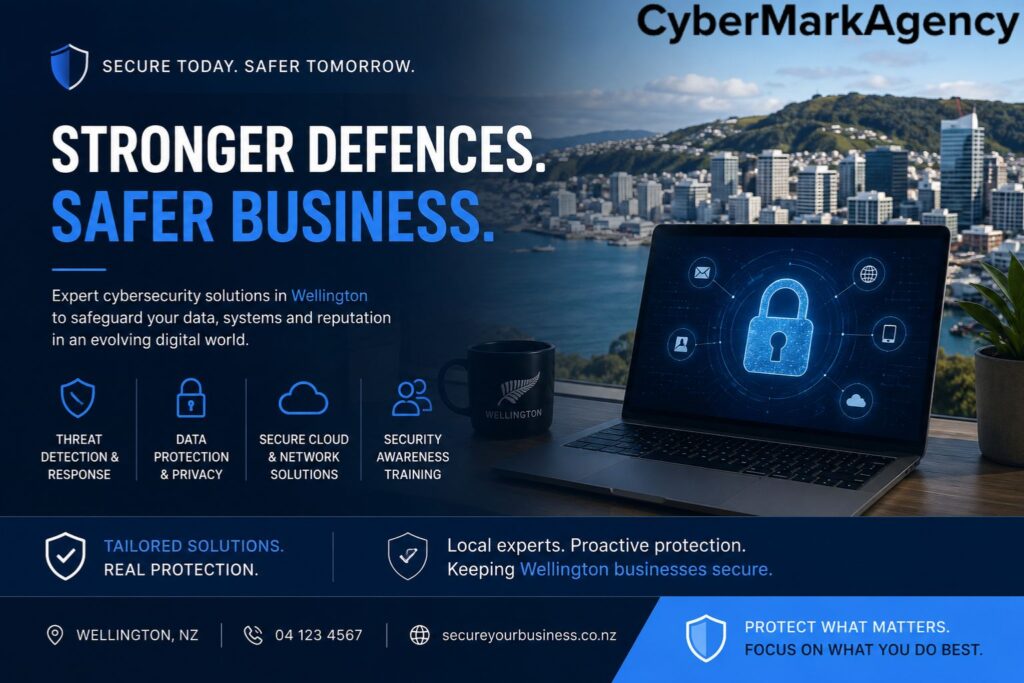
Wellington businesses need a combination of threat monitoring, risk assessment, incident response, and compliance support, delivered by experts who understand the New Zealand threat environment.
With the National Cyber Security Centre (NCSC) recording nearly 6,000 incident reports in 2024/25 and direct financial losses across NZ reaching $26.9 million in a single year,
Key Takeaway
– Wellington faces a fast-growing cyber threat environment: NCSC recorded nearly
6,000 incident reports and $26.9 million in direct losses in 2024/25.
– Core cybersecurity services in Wellington include penetration testing, managed
security (MSSP), risk assessment, incident response, cloud security, and
GRC/compliance support.
– Local Wellington providers bring NZ-specific expertise (Privacy Act 2020,
NZISM, PSR) that offshore providers typically can’t match.
– Small businesses are frequent targets — not because they’re valuable, but
because they’re often under-protected.
– Organisations that recover fastest from an incident are the ones that assessed
their risk and built a response plan in advance.
the question is no longer whether your organisation will face a cyber threat; it is whether you will be ready when it arrives.
Wellington sits at the centre of New Zealand’s public and private sector activity. That makes it a prime target. Government agencies, professional services firms, healthcare providers, and small businesses alike are facing a threat landscape that grows more sophisticated every year.
This guide covers the core cybersecurity services in Wellington, the specific threats NZ businesses face right now, and what you can do to manage cyber risk before a breach forces your hand.
The Growing Cyber Threat Landscape for NZ Businesses
New Zealand’s remote geography offers no protection in the digital world. State-sponsored actors, financially motivated criminal groups, and hacktivists are all actively targeting NZ organisations, and that is not speculation. It is documented in the NCSC’s Cyber Threat Report 2025, which identifies five key threat judgments for organisations operating in this country.
Ransomware remains the most damaging form of attack. What has changed is the delivery model. Ransomware-as-a-service now allows less technically skilled criminals to rent sophisticated attack tools, dramatically widening the pool of people who can target your business. Alongside ransomware, phishing and credential harvesting increased by 15% in Q1 2025 alone, with $7.8 million in direct financial losses recorded in that single quarter, the second-highest figure ever reported by the NCSC.
Supply chain attacks are another growing concern for Wellington organisations. Rather than targeting your business directly, attackers compromise a vendor, software provider, or third-party service your organisation depends on, and use that relationship as a backdoor. Business email compromise works similarly, with attackers impersonating helpdesk staff or trusted suppliers to extract login credentials or redirect payments.
One of the most persistent misconceptions among NZ business owners is that they are too small to be worth targeting. The data says otherwise. More than half of NZ small and medium businesses experienced at least one cyber threat in the past year, with many still lacking basic protections such as multi-factor authentication and reliable backups. Under the Privacy Act 2020, a data breach can also trigger mandatory reporting obligations and significant reputational damage, regardless of your organisation’s size.
Understanding these risks is the first step. The second is knowing which cyber security services actually address them.
Core Available Cybersecurity Services in Wellington
Wellington businesses have access to a full range of cyber security services, from foundational risk assessments through to 24/7 managed monitoring. Here is what each service covers and why it matters.
Penetration Testing Wellington
Penetration testing, often called pen testing, involves security professionals simulating real-world attacks against your systems, applications, and network to find vulnerabilities before malicious actors do. A well-structured penetration test follows established methodologies such as MITRE ATT&CK and NIST SP800-115, giving you a detailed picture of your attack surface and prioritised remediation steps.
For NZ businesses evaluating penetration testing costs, pricing typically varies based on scope, complexity, and the number of systems being tested. An investment in pen testing is considerably less costly than the average breach, which, once you factor in downtime, recovery effort, and reputational harm, almost always exceeds the upfront cost of prevention.
Managed Security Services (MSSP)
Not every Wellington business has the resources to build an in-house security team. A managed security services provider (MSSP) delivers around-the-clock threat detection, network monitoring, and incident coordination, without the overhead of full-time security staff.
Core managed security services typically include Security Information and Event Management (SIEM), which aggregates and analyses log data across your environment to surface anomalies in near real time. Cloud security monitoring for platforms like Azure and Microsoft 365 is increasingly central to this offering, given how broadly NZ businesses have adopted cloud-based tools for day-to-day operations. For a detailed look at how endpoint detection integrates into managed security, this comparison of EDR vs MDR vs XDR solutions covers the key differences worth understanding before you choose a provider.
Security Risk Assessment and Vulnerability Management
A security risk assessment gives your organisation a structured view of where your vulnerabilities lie, across your technology stack, your processes, and your people. It identifies hidden risks you may not be aware of, maps them against your business operations, and delivers a prioritised mitigation plan.
Vulnerability management is the ongoing process that follows: regularly scanning your environment, tracking unpatched systems, and ensuring that known weaknesses are closed before attackers can exploit them. The NCSC Cyber Threat Report 2025 explicitly identified unpatched vulnerabilities and organisational blind spots as two of the five most significant threat factors for NZ organisations this year.
For businesses assessing their endpoint exposure specifically, the benefits of endpoint protection solutions for NZ businesses is worth reading alongside your broader risk assessment process.
Incident Response Wellington
When a breach occurs, the speed and quality of your response determines how much damage is done. Incident response services provide structured, expert-led coordination from the moment a threat is detected, through containment, investigation, remediation, and recovery.
A comprehensive incident response capability includes digital forensic investigation to establish exactly what happened, what data was accessed, and how the attacker gained entry. This forensic evidence is often critical for Privacy Act 2020 reporting obligations, insurance claims, and any regulatory or legal proceedings that follow a significant breach. Business continuity planning is closely linked here, knowing in advance how your organisation will keep operating during and after an incident is what separates businesses that recover quickly from those that do not.
Cloud Security (Azure and Microsoft 365)
The majority of Wellington businesses now run critical workloads in the cloud. That brings considerable benefits, and new security responsibilities. Cloud security services cover identity and access management, configuration hardening, threat detection within cloud environments, and email security.
Email remains the single most common initial attack vector. Phishing, business email compromise, and malicious attachments are all delivered through email, making robust email filtering and security an essential baseline. Understanding the difference between EDR and traditional antivirus is also relevant for businesses trying to determine what level of endpoint protection their cloud-connected devices actually need.
Governance, Risk and Compliance (GRC)
Governance consulting helps organisations build the policies, frameworks, and processes that underpin long-term security resilience, not just technical controls. For Wellington businesses operating in regulated sectors, this often includes working towards ISO 27001 NZ certification, aligning with the NZ Information Security Manual (NZISM), or meeting Protective Security Requirements (PSR) for government suppliers.
The Privacy Act 2020 introduced mandatory breach reporting obligations for organisations that hold personal information about New Zealanders. A GRC advisory engagement helps you understand exactly what those obligations mean for your business, what controls you need to demonstrate, and how to maintain compliance as privacy regulations continue to evolve.
Why Wellington Businesses Trust Local Cyber Security Experts

There is a real difference between a globally templated cyber security solution and one built around the New Zealand environment. Local cyber security experts bring direct familiarity with the NZISM, the PSR, and the regulatory expectations of NZ agencies, knowledge that an offshore provider simply cannot replicate from a distance.
Wellington-based security advisors also understand the specific sectors that make up the capital’s economy: central government, professional services, healthcare, and a growing technology sector. Tailoring security advice to the actual risk profile of your organisation, rather than applying a generic framework, is what produces meaningful security outcomes, not just compliance paperwork.
Speed also matters. When an incident occurs, a local incident response team can engage on the ground quickly. Threat intelligence that reflects current activity targeting NZ organisations is more actionable than global feeds that may not capture the specific tactics being used against businesses in this region.
New Zealand’s Cyber Security Strategy 2026–2030, published by the Department of the Prime Minister and Cabinet, sets out four national objectives: Understand, Prevent and Prepare, Respond, and Partner. Effective cyber security services in Wellington should reflect all four, building your organisation’s awareness, strengthening its defences, preparing its response capability, and connecting it to the broader NZ security ecosystem.
How to Manage Cyber Risk as an NZ Business
Managing cyber risk as an NZ business means understanding your specific exposure, applying proven controls, and maintaining them consistently over time. Here are the practical steps that make the most difference.
Start with a security risk assessment
You cannot manage what you cannot see. A structured assessment maps your attack surface, identifies hidden risks, and gives your leadership team a clear, business-focused view of what needs to be prioritised.
Implement multi-factor authentication (MFA) across all accounts
The NCSC consistently identifies credential compromise as one of the most common attack pathways. MFA closes this gap for the majority of phishing and credential harvesting attempts.
Establish reliable, tested backups
Ransomware is devastating when there is no clean backup to restore from. Backups need to be regular, stored separately from your main environment, and tested, not just assumed to be working.
Train your people
Your staff are both your first line of defence and your greatest area of human risk. Regular, practical training on recognising phishing attempts, social engineering, and suspicious activity reduces the likelihood of a successful attack significantly.
Monitor your network continuously
Threats that go undetected for days or weeks cause far more damage than those caught early. Continuous monitoring, whether through an in-house team or a managed security service, enables faster detection and disruption of malicious activity.
Engage a security advisor for governance and compliance
Particularly if your organisation handles sensitive data or works with government agencies, having structured governance in place is both a legal obligation and a practical safeguard.
For small businesses wanting a practical starting point, how to protect your business from cyber attacks covers the foundational steps in straightforward terms.
Cyber Security Solutions for NZ Businesses Across All Industries
Cyber risk does not discriminate by sector. Every Wellington organisation that operates online, holds customer data, or depends on digital systems for its operations faces meaningful exposure. That said, certain industries carry sector-specific regulatory obligations alongside their general security responsibilities.
Government and public sector organisations must align with NZISM and PSR frameworks, and increasingly with the expectations set out in the NZ Cyber Security Strategy 2026–2030. Professional services firms, legal practices, accountancies, consultancies, handle sensitive client data that is highly attractive to both financial criminals and espionage actors. Healthcare providers face strict obligations around patient data and must maintain operational resilience even under attack conditions.
For smaller Wellington businesses, the priority is right-sized security, controls that are proportionate to your risk profile and your budget, rather than enterprise solutions designed for organisations ten times your size. Endpoint protection for NZ small businesses is one area where small businesses can achieve a significant security uplift without substantial complexity or cost.
Enterprise organisations and those operating critical infrastructure face a different challenge: the convergence of operational technology (OT) and IT systems introduces new attack surfaces that traditional security approaches were not designed to address. The NCSC’s 2025 report explicitly identifies OT environments as an area where organisational blind spots are common and attackers are increasingly active.
Get Expert Cyber Security Services in Wellington Today
Wellington businesses are operating in one of the most active cyber threat environments New Zealand has seen. State-sponsored intrusions, ransomware, phishing, and supply chain attacks are not abstract risks, they are happening to NZ organisations right now, at a rate of roughly one nationally significant incident per day according to the NCSC.
The organisations that come through these threats with the least damage are not necessarily the largest or best-resourced. They are the ones that invested in understanding their risk, put the right controls in place, and had a clear response plan ready before they needed it.
If you are ready to take a serious look at your organisation’s security posture, speaking with a Wellington-based cyber security expert is the right place to start. For more information about what a professional cyber security engagement looks like, the CyberMark Agency services page covers the full range of solutions available to NZ businesses.
FAQs Related to Wellington Cybersecurity Services
1. What cybersecurity services are available in Wellington?
Wellington businesses can access penetration testing, managed security monitoring, security risk assessments, incident response, cloud security, and compliance consulting. Local providers also cover NZ-specific frameworks like the Privacy Act 2020, NZISM, and PSR, which offshore providers rarely understand in practice.
2. Why use a local Wellington cybersecurity provider instead of an offshore one?
Three reasons. Local providers know the NZ Privacy Act, NZISM, and CERT NZ guidance from the inside, not from a checklist. They understand Wellington’s dominant sectors like government, healthcare, and professional services. And when something goes wrong, a local team can respond on the ground quickly instead of coordinating across time zones.
3. Are NZ small businesses actually targeted by cybercriminals?
Yes, more than most owners expect. The NCSC recorded nearly 6,000 incident reports in 2024/25, with $26.9 million in direct financial losses in a single year. Small businesses are targeted specifically because attackers assume they have weaker defences. Being small does not mean being safe. It often means being easier to hit.
4. What is penetration testing and does my business actually need it?
Penetration testing is where security professionals simulate a real attack against your systems to find weaknesses before someone malicious does. You get a prioritised report of what they found and how to fix it. If you handle sensitive client data, operate in a regulated industry, or need to demonstrate security due diligence for insurance or compliance purposes, yes, you need it. The cost of a pen test is a fraction of what a real breach costs.
5. What does a managed security services provider actually do for my business?
They take over the ongoing work of monitoring, detecting, and responding to threats so you do not have to. That includes watching your network around the clock, investigating alerts, managing your endpoint security, and sending you plain-language reports on what happened and what was done about it. You stay focused on running your business. They handle the security behind the scenes.
6. What does a cybersecurity risk assessment involve?
A risk assessment maps where your vulnerabilities actually are across your technology, your processes, and your people. It looks at things like unpatched systems, weak access controls, and third-party dependencies you might not have considered. You get a prioritised action plan at the end, not just a list of problems. The NCSC identified unpatched vulnerabilities and organisational blind spots as two of the biggest threat factors for NZ businesses in 2025. A risk assessment addresses both.
7. What happens during a cybersecurity incident response?
When a breach is detected, an incident response team steps in to contain the damage, investigate what happened, and guide your recovery. They preserve the forensic evidence you need for Privacy Act 2020 reporting, insurance claims, and any legal proceedings. The difference between businesses that recover quickly and those that do not usually comes down to one thing: whether they had a response plan ready before the incident happened.
Sources and References
- NCSC Cyber Threat Report 2025, National Cyber Security Centre (NCSC / GCSB), December 2025 https://www.ncsc.govt.nz/insights-and-research/cyber-threat-reports/cyber-threat-report-2025/
- NCSC Incident Reporting Analysis 2024/25, National Cyber Security Centre https://www.ncsc.govt.nz/insights-and-research/cyber-threat-reports/cyber-threat-report-2025/incident-reporting-analysis/
- Quarter One Cyber Security Insights 2025, National Cyber Security Centre, 2025 https://www.ncsc.govt.nz/insights-and-research/insights-reports/quarter-one-cyber-security-insights-2025/
Need help reducing your business security risk?
Contact us

